

South Australia is lagging behind other states when it comes to sex work reform. OTR talks to Georgia Thain from the Sex Industry Decriminalisation Action Committee, who explains why they keep advocating for change. (Image via SIDAC)
By Katarina Bozic | @KatarinaBozic_
Meet Georgia Thain, the policy officer and criminology student whose passion for human rights activism has led to her role as coordinator of the Sex Industry Decriminalisation Committee (SIDAC).
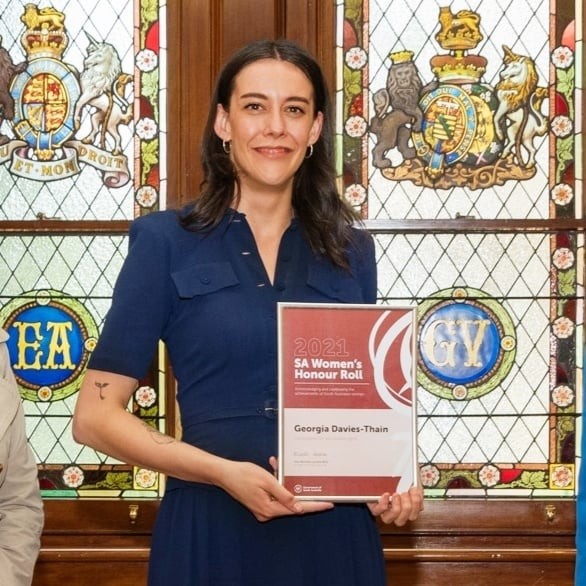
SIDAC is a volunteer-based committee which meets regularly to build community and political support for the decriminalisation of sex work in South Australia.
The committee is supported by organisations such as SA Unions, Aboriginal Health Council of South Australia, Australian Services Union SA/NT, sexual health agency SHINE SA, Women Lawyers Association SA, Working Women’s Centre SA, the South Australian Rainbow Advocacy Alliance, Australian sex worker organisation Scarlet Alliance, national feminist organisation YWCA Australia, global feminist organisation Zonta International District 23 clubs.
Why are you campaigning for the decriminalisation of sex work in South Australia?
The benefits of decriminalisation are far-reaching, including access to human and workers’ rights like bodily autonomy, freedom of choice in occupation, rights to unionise, and fair working conditions.
Work done by the World Health Organisation finds that under any form of criminalisation, including the Nordic Criminal Model, sex workers face three times the risk of experiencing violence.
So far, New South Wales, the Northern Territory, Victoria, New Zealand and soon Queensland have accepted internationally-supported evidence and reformed to a decriminalised model.
But while South Australia has had more than enough opportunities to do so too, we have failed to recognise sex work as work.
SIDAC began in 2018 in support of the Statutes Amendment (Decriminalisation of Sex Work) Bill 2018 introduced by Tammy Franks MLC.
This bill was the 13th attempt at sex work law reform in SA over the previous 40+ years, with bills being introduced by members of the Australian Democrats, Labor, Liberal, and the Greens.
The aim of SIDAC was and continues to be to demonstrate the widespread support for the decriminalisation of sex work because of the extensive evidence-base.
Our state has the most outdated laws for sex work in the entire country that put sex workers at risk.
What will decriminalising sex work actually look like?
The premise of decriminalisation is that an adult person of any gender has the right to choose to provide a sexual service on a commercial basis if they choose.
It is evidence-based best-practice policy to minimise work health and safety risk, reduce harm, and protect the rights of the workforce.
Decriminalisation for SA would remove mention of consensual adult commercial sexual services from the criminal code by amending the Summary Offences Act 1953 and the Criminal Law Consolidation Act 1935.
Normal existing regulation like taxation law, health and safety requirements, local planning considerations, and business control legislation would apply to the sex industry like it does to other adult industry.
This means, for example, trafficking, servitude, and sexual exploitation of a minor would continue to be serious offences.
How have we seen other states benefit from legalising sex work?
Decriminalisation and “legalising” sex work (legalisation) are two different models. Despite this, the terms can sometimes be used in media interchangeably.
Legalisation (or legalising) sex work is the model Victoria and Queensland had prior to announcing decriminalisation.
Essentially, legalisation sees aspects of sex work remain criminalised and police continue to have power to target, entrap and arrest sex workers.
Many of the criminalised parts of sex work in both Victoria and Queensland’s models undermined basic work health and safety considerations. For example, under Queensland’s legalisation model, private sex workers must work alone and cannot communicate with other workers.
This forces sex workers to work in isolation which increases workplace risks. Legalisation also does not address stigma and discrimination and so barriers to healthcare, housing, and justice remain.
New South Wales decriminalised sex work in 1995, New Zealand in 2003, Northern Territory in 2019 and Victoria in 2022.
Research demonstrates that decriminalisation provides sex workers with better access to their human and workers’ rights, safer workplaces, more access to reporting crimes committed against them and they are better able to refuse clients that do not respect workers’ boundaries or safe work practices. Sex workers working in a decriminalised framework report better mental health to levels compared to the general population.
What kind of abuse do we see sex workers at risk of?
SA’s current criminalisation of sex work sees sex workers, a predominantly woman-based workforce, at risk of experiencing violence or exploitation in the workplace as well as barriers to accessing healthcare, housing, and justice.
Criminalisation pushes the sex industry, and therefore the workforce, underground, which puts workers at risk of violence, wage theft, sham contracting and harassment.
Sex workers have no recourse for (and are therefore at risk of) experiences of workplace harassment, potential wage theft, unsafe working conditions, or unfair dismissal because they are not recognised as workers.
Under current laws, SAPOL are empowered to enter any premises an officer suspects is a brothel, and a “brothel” is defined as any premises where commercial sexual services are taking place.
Sex workers are regularly entrapped by SAPOL officers who pose as clients and question workers about services to incriminate them before up to nine other officers enter to raid the premises.
This entrapment method significantly undermines an important aspect of safe work in sex work, which is open and honest conversation about consent and boundaries.
SAPOL data indicates that charges laid against sex workers increased significantly from 2014/15 when 24 charges were laid to 2017/18 when 211 charges were laid, so an overall increase of over 770%.
When questioned, SAPOL claimed the increase was due to looking for organised crime, drug and human trafficking; however, they admitted that despite the increased policing, there were very few charges outside of sex work-related offences laid – only two minor drug charges during the period of increased policing.
Also, Police Commissioner Grant Stevens claimed to a parliamentary committee and in media articles that policing was targeted towards “Asian syndicates” operating in hotels and motels.
But FOI data shows that in 2017/18, SAPOL officers used their entry powers to enter 188 premises suspected to be brothels, with 52 percent of those being residential or apartment premises and only 15 percent being hotel premises.
Furthermore, a 2015 Select Committee on the Decriminalisation of Sex Work report stated, “The committee did not hear any evidence that confirmed criminal activity within the sexual services industry in South Australia.”
As a result of the targeting and entrapment performed by SAPOL, sex workers in South Australia do not feel able to report crimes committed against them and report being dismissed by SAPOL when reporting crimes.
What are your thoughts on those who disagree with decriminalising sex work?
Those who disagree with decriminalising sex work are a small minority with no understanding of the real sex industry in SA, and who are having an entirely different conversation to what we’re actually trying to discuss.
Personally, I am not interested in whether people agree that sex work is work and should be treated as so, or disagree and want the industry to disappear.
Because the reality is that sex work has existed for all of recorded human history, it exists now, and it is going to keep existing.
People choose to enter sex work for a variety of reasons – in South Australia mainly flexible work and high wages – and so it is the government’s responsibility to implement reform that provides everyone, including sex workers, with basic health, safety, and rights.
Ideology-driven policy cannot provide this and so government must focus on evidence, harm minimisation, and lived experience.
Premier Malinauskas voted against the bill to decriminalise sex work in 2019. How confident are you that the bill will pass through this year?
Labor governments in New South Wales, Northern Territory, Victoria, and soon Queensland have passed decriminalisation legislation.
And so, with the new Labor government in South Australia, SIDAC remains confident that this important workers’ rights issue will be prioritised, as current Labor MPs have previously acknowledged the desperate need for law reform.
 ontherecordunisa.com