
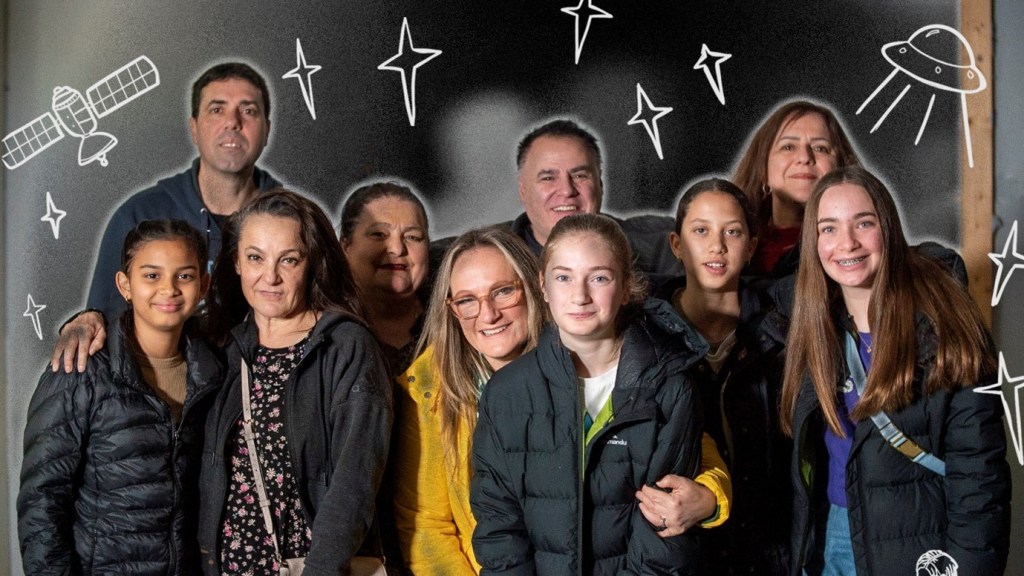
Aliens, comets, apple sauce – find out what they have in common in After All This. (Image supplied by Against The Grain)
By Viki Ntafillis | @viki_ntaf
After All This – written by Elbow Room’s Marcel Dorney, directed by Nate Troisi and produced by Caitlin Ellen Moore – is a multi-sensory, experiential play that asks the questions humanity has dwelled on since the beginning of our time.
Namely, how did we get here? Who, or what, has created all this? Does morality come from a higher power, or do human beings decide what is right or wrong based on their cultural norms and what “the group” accepts?
The performance opens in the theatre’s foyer. In a living room created before our eyes, two children argue over whether the Nativity truly happened, and if there is any truth behind the Bible at all. They debate what determines whether someone goes to “heaven” or “hell”.
In the hall leading to the theatre, a mysterious mathematic equation is draped in the “sky”: twinkling fairy lights etching symbols and numbers on a black velvety backdrop. Two scientists debate whether altruism truly exists, and where it is derived from.
For the last act, the audience finally moves into the main theatre. A group of people enter, all donning grey tracksuits. They describe human bodies as “vehicles”, “temporary”, “meat”. They are the victims – or participants, as they likely would have seen themselves – of Heaven’s Gate (although this is not explicitly stated in the play). They represent a group of 39 people who, in San Diego on March 25, 1997, willingly ingested poison under the belief that when the Hale-Bopp comet shot across the sky that night, their souls would be taken up into an alien spacecraft. They would then be transported to find redemption in the “Kingdom of Heaven”.
Throughout the play, set design and characterisation support recurring themes of discomfort, alarm and confusion. From the very first scene, the play intrudes on a space traditionally reserved for the audience: the foyer. This creates the sense that discussion of religion, spirituality or higher power can occur anywhere, anytime, with anyone. It is not one that can wait; it must happen here and now, and if children can talk about it, so can we.
The unnerving feelings settle in at the start of the second scene, when two playgoers burst out laughing. They are scolded by someone who might work in the theatre, but the pair then emerges from the crowd and become characters: act two’s scientists. The audience feels relief, but only momentarily, soon feeling like intruders themselves as they pass one of the scientists, a forlorn and suicidal George Price, on their way to the final scene.
In the theatre, the tracksuit-wearers are calm. Here, the audience is convinced to feel relaxed during a discussion of topics that are far from relaxing. And it is by far the most unsettling part of the performance.
Lighting choices convey that humans are mostly “in the dark” when it comes to a higher power. This is evident in the middle and last sections of the performance, which involve adults. Part of learning more as we grow up is understanding the vastness of the unknown.
Convergently, minimalistic costuming illustrates that our appearances become irrelevant when discussing the afterlife. We will not take these forms with us. How we have treated others, though, will stay with them forever.
No matter what your stance is on “the beyond”, After All This reminds us it is a topic not many take lightly. Upon listening to the Heaven’s Gate group talk so confidently, the audience comes to appreciate the opposite point of view: we actually know very little.
Furthermore, they realise no one alive will ever truly know what happens after death. To a degree, discussion is speculation and certainty is folly.
After attending this performance, you are likely to leave with more questions than answers. But don’t worry; that’s the point.
After All This is playing at Rumpus Theatre until Sunday, October 16.

 ontherecordunisa.com