
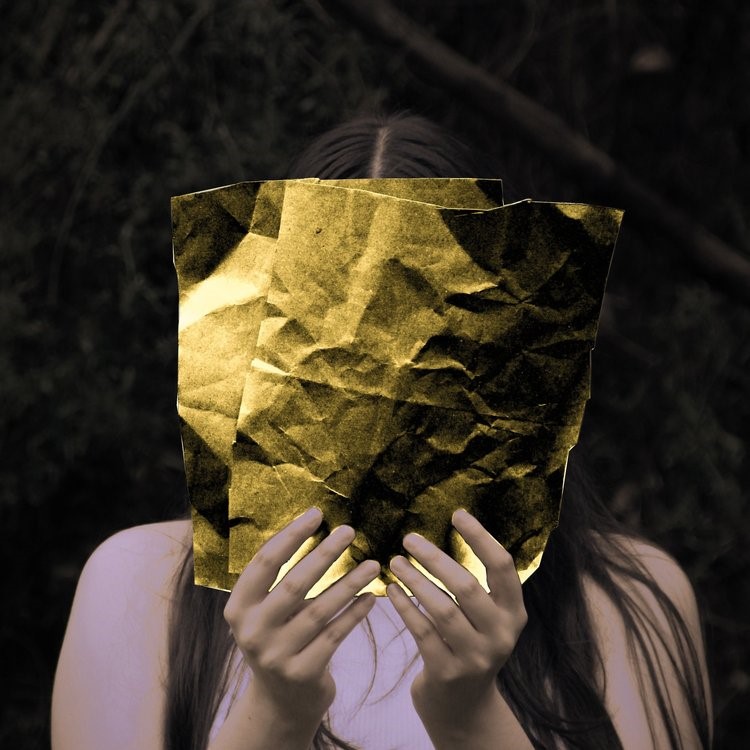
Coldhands presents an apocalyptic world riddled with hunters, sacrifice and betrayal – one that might be closer to our own than we’d like to admit. (Image: Rumpus Theatre)
By Alana Pahor | @Alana_Pahor
From the imaginations of director Zola Allen and writer Dora Abraham comes Coldhands, an unsettling, thought-provoking play that melds love with loss and sacrifice with selfishness in its subtle commentary on climate destruction.
Coldhands transports the audience to an apocalyptic future in which all the world’s gold has been stolen by the fabled “Aurum Daemon”. Here, during the middle of “the annual hunt” – a search for a human sacrifice to appease the Aurum Daemon – three strangers meet, known simply as Mother (Bonet Leate), Girl or “Coldhands” (Danielle Lim), and Hunter (Sam Lau).
Bound together by story, fear, and a secret – Coldhands can turn things to gold – the three embark on a journey of survival as they attempt to outrun the hunt, learning humanity’s triumphs and pitfalls through the relationships they form along the way.
While the choice to feature just three actors in Coldhands is a bold move, it feels over-ambitious considering the play’s complex storyline.
The audience would have benefited from additional characters or context when it came to scenes involving hunters, rituals, and sacrifices – the lack of both rendered the storyline convoluted and at times hard to follow.
It is a play that leaves much to the imagination – and much unanswered.
Nonetheless, the audience can still discern that the juxtaposition of Hunter’s “lone wolf” characterisation with that of Coldhands’ “heart of gold” reflects the two competing natures of humanity; the self-serving, cynical nature that furthers destruction and the self-sacrificing, optimistic nature that rebuilds.
Here, Allen and Abraham cleverly create a socio-political commentary on our own world’s divided response to modern crisis, namely one that pertains to the climate, politics, and war.
The play hence functions as both a warning against the doom humanity’s greed will bring itself, and as a reminder that we may still restore “gold” or prosperity to earth should we turn to generosity.
An unsettling message begs for an unsettling viewer experience, and Allen and Abraham deliver on this well through use of space onstage – if one can call it a stage.
Rather than entering an auditorium that slopes down towards a distant platform, the audience is seated on a U-shaped ring of folding chairs, which face inwards to enclose a snaking red cloth.
Within the loop created by this cloth, a mere metre from the audience’s chairs, is a makeshift, hypermodern stage – at the far end of which stands a raised, circular altar framed by white, ghostly tree branches.
As the actors pace within this space, the audience hears every footstep, echo, and breath – an eerie, immersive feature emphasised by the absence of non-diegetic sound in some scenes.
The proximity of performer to observer grows eerier still as Leate (Mother) pauses to stare audience members directly in the eye; the intensity of her gaze gives one a sense of vulnerability, as if they are being hunted alongside her character.
Tension is furthered through the actors’ manipulation of body language and voice, which expresses the fear and paranoia experienced by the trio of characters. Quick, jerky movements alongside fast-paced, resounding speech renders the character’s movements animalistic and skittish like that of prey being hunted.
Unfortunately, the melodramatic acting style deployed by the actors throughout the play simultaneously detracts from the realism of this effect, making it appear performative and forced rather than instinctive.
Kobe Donaldson’s use of lighting is more effective, as they incorporate bold colour changes that portray an innate sense of fright and danger within the characters.
When the characters are set on edge by distant noise, Donaldson bathes them in an alarm-red light; when danger is imminent, they plunge both the stage and the audience into darkness.
Through this intentional absence of lighting, Donaldson submerges audience members into the thick of the play, forcing them to experience the vulnerability and unease felt by the characters who hide in the dark with them.
Coldhands renders its tale of survival and loss universal through incorporation of plain, grey-toned costume (designed by Ellana Murphy) and the impersonal, role-based character names of “Mother”, “Girl” and “Hunter”. It presents itself not as a single tale, but rather as a collection of “stories the world gives you to remember”.
At first, Coldhands is a subtle – albeit confusing – commentary on climate destruction. Foremost, however, it is a disconcerting testament to the best and worst of humanity, the dangers of greed, and the hope that prevails through story and human connection.
Perhaps in part due to its lack of context, it is a play that remains stubbornly fixed in the mind; a riddle to be puzzled over long after the actors take their final bow.
Coldhands is playing at Rumpus Theatre until December 4, 2022.

 ontherecordunisa.com