
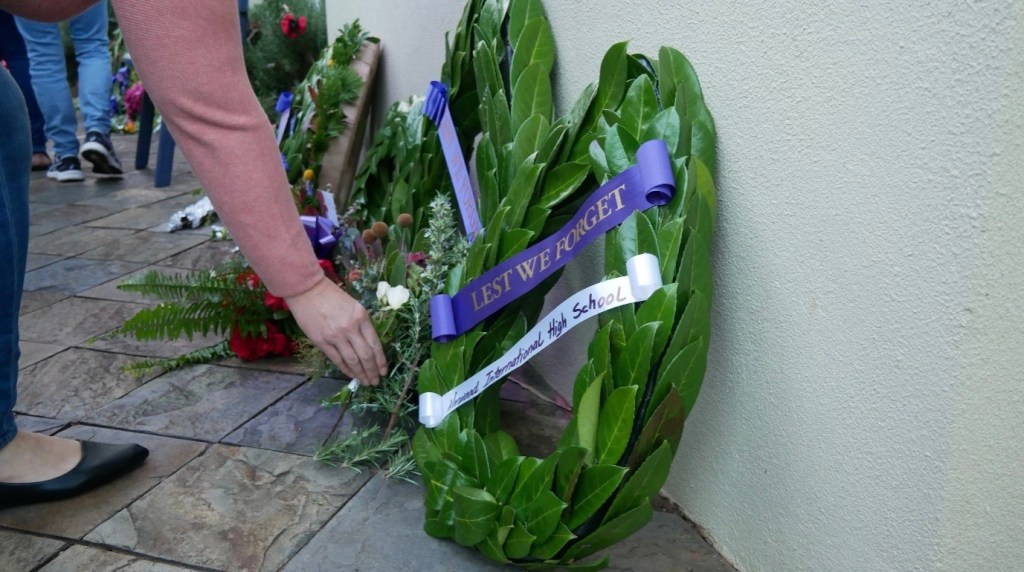
On the 108th anniversary of the Australian and New Zealand Army Corps (ANZAC) landing on the beaches of Gallipoli, OTR journalist Robert Hicks investigates Anzac Day’s cultural, historical, and political significance. (Image: Robert Hicks)
By Robert Hicks | @_roberthicks
Anzac Day is a solemn day for reflecting on and remembering those who have fought for Australia. It is unlike any other day for this nation culturally, historically, and politically.
To those who have served, have family who have served, or have come to find their own rituals, today serves as the crux of commemoration, bringing people together to acknowledge veterans and those lost in conflict.
President of the Returned and Services League of Australia (RSL) SA branch Cheryl Cates says Anzac Day “commemorates sacrifice, shows mateship at its best, and it is part of what has brought countries and, in our own back yard, communities together”.
Speaking on her own history with Anzac Day, Cates says it began when her parents would take her, as a young girl, to the march to pay respects to those who fought for our country and future.
“It wasn’t until I became a teenager that I fully understood the impact and emotion surrounding the day after attending my first Dawn Service,” Cates says.
“This made it even more special when I joined the army in the early ’70s and I felt just as proud as those men and women before me to be able to march out of respect for my forebearers,” she says.
“I haven’t missed a Dawn Service or march since my teens, and I am nearly 70.”
Cates is a military veteran and served for 23 years in several roles across Australia. Her husband served for 26 years, and two of her sons — veterans of Afghanistan, Iraq, and still active servicemen — have served 15 years each. Her paternal and maternal grandfathers were WWII veterans, her father a Vietnam veteran, and her stepfather a national serviceman.
Individual experiences with Anzac Day, such as Cates’, are of extreme importance, yet they are only half of the story.
Anzac Day plays an important role in not only commemoration and culture, but also in politics and international relations, especially regarding New Zealand and Turkey, with whom Australia shares common history.
UniSA History and Politics lecturer Dr Daniel Fazio says the “relationship has very deep historical, social, and cultural roots largely because of the shared Anzac experience. It goes beyond diplomacy”.
“This sentiment is best expressed by the very powerful words of Atatürk, modern Turkey’s founder, inscribed on the Anzac memorial at Gallipoli,” Dr Fazio says.
These words are:
“Those heroes that shed their blood and lost their lives …
‘You are now lying in the soil of a friendly country. Therefore, rest in peace. There is no difference between the Johnnies and the Mehmets to us where they lie side by side in this country of ours.
‘You, the mothers, who sent their sons from far away countries, wipe away your tears.
‘Your sons are now lying in our bosom and are in peace. After having lost their lives on this land they have become our sons as well.’”
While Anzac Day is less important to Australia’s relationships with other countries, Dr Fazio says it is still “an important element in the relationship with France and Papua New Guinea”.
“Anzac Day is celebrated in other parts of the world but, not surprisingly, it does not have the profile that it does in Australia and New Zealand. The two biggest international celebrations are at the war cemeteries and memorials at Gallipoli in Turkey and at the Western Front battlefields in France and Belgium,” Dr Fazio says.
“Some context is important here. 60,000 Australians were killed in World War One. Approximately 9000 Australians died at Gallipoli, whereas approximately 45,000 died on the Western Front in France and Belgium,” he says.
“Anzac Day is also celebrated at the war cemeteries and memorials in New Guinea, where Australian troops were instrumental in stopping the Japanese advance along the Kokoda Track in World War Two.”
Dr Fazio says he became interested in Anzac Day when he was approximately 10 years old, coinciding with his burgeoning interest in history.
“As I grew to love history, my interest in Anzac Day evolved, too. For many years, I have been fascinated by the historical, political, and social aspects of Anzac Day,” Dr Fazio says.
“I have happy memories of some World War Two, Korean and Vietnam war veterans that I knew personally. They inspired me and they taught me much about history and life,” he says.
Closer to home, Dr Fazio says Anzac Day “has very much become part of the political identity of Australia”.
“Most politicians partake in the nationwide celebrations, which is appropriate given that they are our elected representatives. The very few who do not or raise questions about the occasion, irrespective of whether they are fair and legitimate, are strongly criticised,” Dr Fazio says.
Yet Dr Fazio also notes Anzac Day has been used by politicians to further their agendas.
“Politicians have used the occasion to demonstrate their ‘patriotism’ while implying that anyone who does not share their views is ‘unpatriotic’ or ‘un-Australian’,” Dr Fazio says.
“A number of politicians have referred to Anzac Day in asserting that Australian history should be compulsory for students in Australia and in talking about Australian ‘values’ and ‘identity’,” he says.
“Most of these politicians do this as a tactic to try to ‘wedge’ their political opponents and anyone else who disagrees with them. These politicians also present themselves as the custodians of the Anzac ‘tradition’.
“However, contrary to their claims, these politicians often present a strongly distorted and historically inaccurate narrative of the history of Anzac Day.
“They are adept at manipulating the history to suit their political objectives.”
Lamenting the use of Anzac Day for political purposes, Cates says “I have seen it first-hand that in some cases, not all mind you, over the years, politicians have turned their speeches political and lost sight of the fact that they were there to respect our veterans.”
Turkey, the other participant in the Gallipoli campaign, is no stranger to this either.
A clash between a secular student body and a ruling religious political party led to the re-enactment march of the 57th Regiment — the regiment led by Atatürk that fought the ANZACs on the cliffs of Gallipoli — shifting from its secular and student grassroots origin to a more religion-focused ordeal to serve the domestic political goals.
UniSA associate and sociologist Brad West says the march “started off as a ground-up initiative by local university students”.
“They wanted to counter what happened in the aftermath of that large 90th anniversary — counter the dominance of young Australians and New Zealanders going to the battlefields,” West says.
Yet, due in part to Atatürk’s importance in the march, it remained a secular event until the ruling Justice and Development Party (AKP) changed that.
“They take control of this [march], which was rising in popularity, they pay for other students and other groups to come from all around Turkey, and, in that way, they counter the secular emphasis of the ritual. And then, within the itinerary of that ritual, they insert prayer,” West says.
West admits Anzac Day has been politicised in Australia as well, but notes there is more under the surface.
“I think my critique of a lot of scholarship by historians, as well as fellow cultural sociologists, is that they often see the mythology and meanings of Gallipoli as a mirror of political interests, and of course they attempt to direct the meanings of Gallipoli in particular ways, but they’re not always successful,” West says.
“There’s been various attempts, most notably by the Prime Ministers Paul Keating and Tony Abbott, to move attention away from Gallipoli to other battles and wars, for different political purposes,” he says.
“They both kind of said, ‘It’s bizarre. There’s no rational reason. We shouldn’t be celebrating Gallipoli so much.’
“But still, Gallipoli retains this prominent role in the public imagination.
“It’s not, to use semiotic terms, a floating symbol that people can easily use. There is some kind of inherent meaning to it.”
Over the course of his research, West says he has been frequently asked why he’s interested in Anzac Day.
“I’ve studied this on and off for over several decades now and ever since I was working on this topic, generally for my PhD in the 1990s, people would say ‘Oh, are you a veteran? Did you have a great grandfather who served in World War One?’ or whatever it might be,” West says.
“None of that’s the case. I didn’t even grow up actually going to Anzac Day Services or [come from] a family that participated in Anzac at all,” he says.
“It comes through having a research interest in national identity and new forms of national identity, but also times of crisis and an interest in remembrance.”
West says that pilgrimages to Gallipoli by Australians, New Zealanders, and Turks have become central to the memory of Anzac Day and the way it is commemorated; they embody the complexities of Anzac Day, a reflective commemoration of those lost in war often mistaken for a one-sided display of militaristic patriotism — a patriotism which celebrates victory in war.
“Gallipoli is a military defeat, which makes it particularly unique as the most important historical moment for a nation,” West says.
“But not only that, it’s in a country that Australia otherwise doesn’t have strong cultural or even economic ties to. And I think this served a purpose, in a way, for a lot of the history of the remembrance of Gallipoli, and by extension Anzac Day itself. And that we, most principally, remember a battle overseas, but one which the foes wouldn’t have much influence in the way we would remember that,” he says.
As with most topics that are inherently, or have become, politicised, there is a large body of discourse surrounding the commemoration of Anzac Day.
Cates acknowledges politicians and the community at large accept what servicemen go through, but wants current veterans, and members of the military more generally, to be acknowledged better on Anzac Day.
“Both physically and mentally, men and women suffer from their experiences. Their families suffer and fall apart. If our community expects us to have a military, then they should look after them and acknowledge them better,” Cates says.
Politicians themselves, from both Australia and Turkey, have expressed concerns about Anzac Day for different reasons.
“Some politicians have been concerned that the celebrations glorify war. They have opposed the ‘romantic’ Anzac narrative and the commercialisation of the event. Others, most notably Paul Keating, have challenged the narrative that the Australian identity is defined by what happened at Gallipoli in 1915,” West says.
West undertook the Gallipoli pilgrimage himself and was in attendance for the 90th Anniversary, the event West says was the prelude to a decline in pilgrimage attendance.
“At the time, I didn’t witness any lack of decorum, by and large, but before and afterwards you had massive amounts of people engaging in drinking and other things in very festive-like behaviour,” West says.
“That was seen by Turkey as a line in the sand, and that this couldn’t go on. Ever since then, numbers of people attending Anzac Day have been declining,” he says.
So, what is the future for Anzac Day, then?
Cates says that, as each year ticks by, more of Australia’s youth attend Anzac Day commemorations and schools increase their focus on Australian Anzac history. The more this occurs, the more the youth crave knowledge of it.
“As far as Australia and New Zealand goes, the future of Anzac Day will hold steadfast forever,” Cates says.
Dr Fazio is confident Anzac Day will continue into the future, and its role in history will also be continually debated.
“I expect Anzac Day to be strongly celebrated for the foreseeable future. The history will always be told and retold and contested and debated, as it should be! That said, Anzac Day is clearly deeply ingrained in Australian culture, society, and identity,” Dr Fazio says.
“I think it is Australia’s unofficial national day. Its public significance is infinitely greater and stronger than Australia Day, which is becoming increasingly contested as Australia seeks to come to terms with its settler-colonial history,” he says.
West, reflecting on Anzac Day’s past, believes it inhabits a transitory time; its future is more uncertain and dependant on many factors.
“Participation in Anzac Day had been declining in the two decades prior to 1990, and that was where we had the rise of the Gallipoli pilgrimage,” West says.
According to West, Gallipoli’s rise invigorated Anzac Day with new history and new types of engagement with said history.
“The role of more cosmopolitan and multicultural memories of the past and of veterans especially invigorated both Anzac Day and the Anzac tradition,” West says.
Yet, the pilgrimage to Gallipoli has also begun to decline after the Centennial, in part due to controversies surrounding the military.
“Post-Centennial it’s kind of ‘what’s going to keep the Anzac Day tradition alive?’,” West says.
“It’s one at the moment that’s kind of plagued by controversy, emanating from contemporary veterans and, more recently I think, the controversies around the Brereton Report and war crimes by Australian Special Forces in Afghanistan,” he says.
West says that, if anything, it will be a slow decline.
“It’s not going to go overnight, [where] people who have gone to Anzac Day services just stop going,” West says.
“It doesn’t work that way,” he says.
Yet Anzac Day is malleable. The ways we commemorate it have shifted, but the core message has remained the same.
West notes the recent changes in commemoration due to the pandemic, and how Anzac Day can adapt to contemporary concerns.
“In some ways the pandemic provided, it’s too much to say a lifeline, but it provided ritual forms that invigorated Anzac Day because it made it about the local,” West says.
“So, when people couldn’t attend Anzac Day services, they would go out to their driveway, when people were in lockdown, and people would play the Last Post and talk to their neighbours … many people found this quite compelling as a ritual form,” he says.
“I think the pandemic mentality endures in many ways, and you probably will see more people going to local services and Anzac Dawn Services, rather than mass services in the capital cities.
“But [Anzac Day’s] future really hangs on how it incorporates, or fails to incorporate, the Afghanistan and Iraq contemporary veteran.”
Lest we forget.
*
If this story or any of the topics in it have caused distress, please contact Lifeline Australia at 13 11 14 or text 0477 13 11 14.
 ontherecordunisa.com