
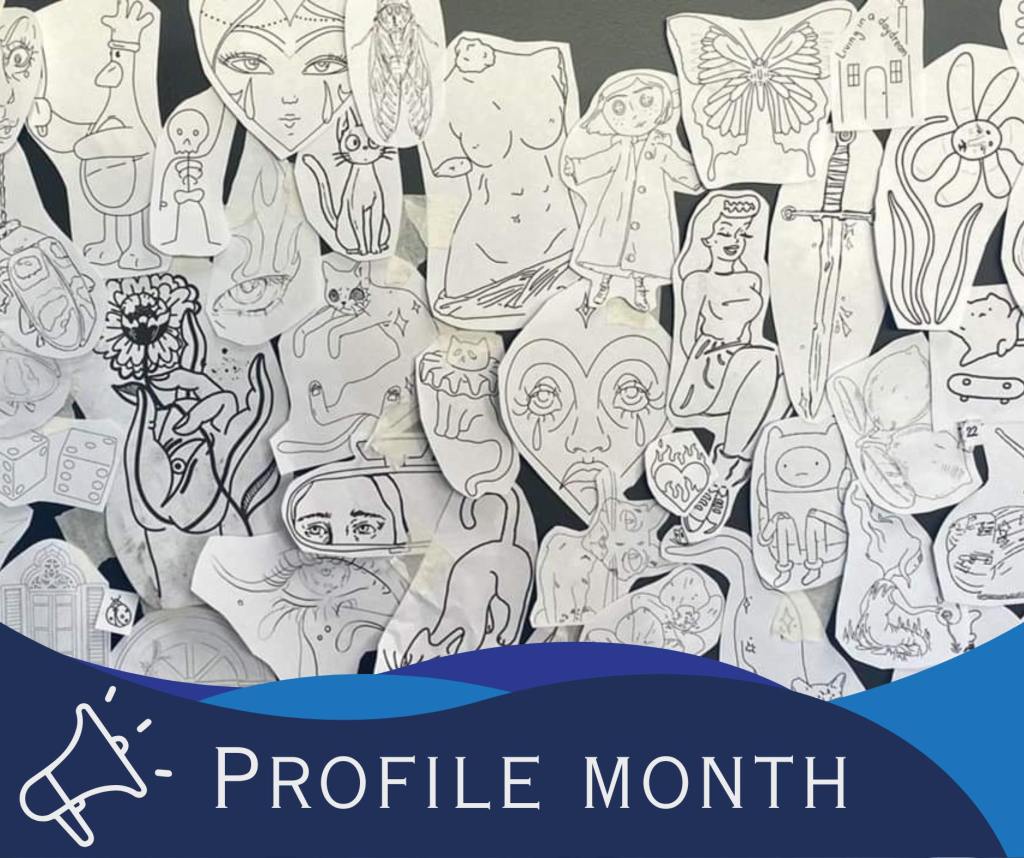
Prior to graduating from the University of South Australia earlier this year, like many students, Elly Lewis was facing uncertainty about her future in the workforce. However, with a lot of hard work and a lucky connection, she has transformed her love of tattoos and art into a promising career. (Image: Jessica Dempster)
By Jessica Dempster | @dempsterjess_
The sensation of getting my first tattoo isn’t pleasant, but it is nowhere near as bad as I anticipated. I’ve felt more discomfort at the dentist or getting my eyebrows waxed. Any nerves I’m experiencing, however, feel kind of silly when I look at my tattoo artist Elly Lewis, who is sitting at my feet practically covered in ink.
The 22-year-old tattoo apprentice originally from the Barossa Valley has 29 tattoos, although she says she’s unsure if that number is exact. Her first was a shoulder piece replicating a work by Austrian painter Egon Schiele, and her most recent is an exquisitely realistic green butterfly on the back of one of her thighs. She’s done five out of the 29 herself, a fact that both impresses and comforts me as a client.
Lewis is a first-year tattoo apprentice under fellow Adelaide tattoo artist Talia Green. She started her apprenticeship in April 2022 and since then has been trying to establish a client base as an up-and-coming tattoo artist.
“I always knew I wanted tattoos,” Lewis says, who has been giving herself and her friends “stick and poke” tattoos since she was a teenager, which are tattoos administered by hand without the use of a machine. She graduated from the University of South Australia in 2023 with a Bachelor of Contemporary Art. However, Lewis experienced doubts throughout her studies wondering if the field was right for her.
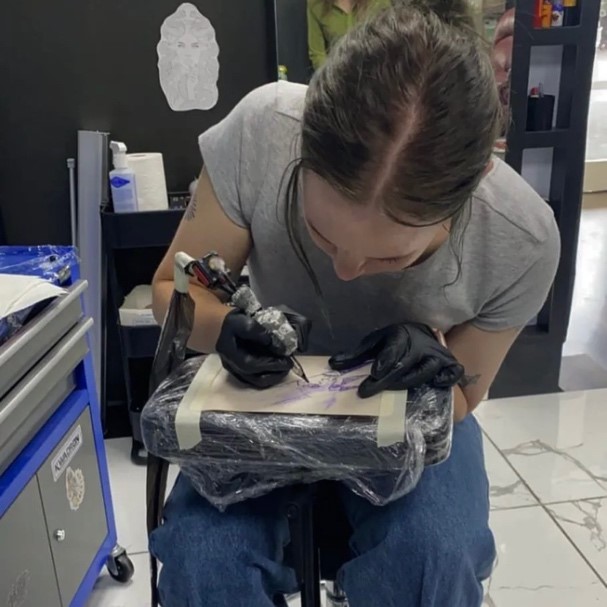
“I found when I was doing my degree, I didn’t love all the other people in the industry. It didn’t feel like they were my people,” she says.
“Whenever I went to get tattoos, I felt like I fit in.”
In her final year of university, Lewis combined her love for tattoos with her degree, choosing to focus her penultimate assignment on tattooing. This got her thinking about what would come next after she finished university.
“I was originally planning on doing more traditional art, like paintings and stuff. I was hoping to travel as well but obviously COVID threw a spanner in the works there,” Lewis says.
“I went to school with my boss Talia. I reached out to her after I had some friends tell me tattooing might be a good career for me. She helped me build a portfolio and there was a room here at her studio, and then next thing you know I was working here,” she says.
Lewis says that her pre-existing connection to Green really helped get her foot in the door.
“I got lucky,” she admits. “It’s kind of hard to get into the industry. There’s no government involvement or schooling or anything really. It’s up to you to find someone who’ll take you on as an apprentice and teach you everything they know.”
I ask Lewis if she thinks there should be some form of university or TAFE pathway to help people who want to pursue tattooing as a career.
“I think there could be. I’m kind of happy there’s not, though, because I don’t really want to go back to uni or TAFE,” she laughs. “But I think there should be, considering it’s a permanent procedure that has a lot of serious hygiene risks.”
Some of Lewis’s work is pinned on the wall above the bed I’m lying on. Each design is unique but somehow distinctly representative of her. There are a few stick figure skeletons, a lot of cats, some flowers, butterflies, flaming hearts, classical sculptures, daggers, snakes, and the one that catches my eye: a cartoon chicken wearing a hat and holding a gun.
“He’s from Wallace and Gromit, I think,” Lewis explains. “He was really fun to do, I love doing little characters like that.”
She elaborates, “I like darker sort of imagery, somewhat realism-based and nothing that’s like super perfect. I love the style that has thick, really clean outlines.”
Lewis’s affinity for this style is apparent looking at her designs. As she’s doing my tattoo, it’s clear she’s in her element. It takes only 40 or so minutes for her to finish the initial design.
“So, I’ve finished the outline if you want to have a look,” she says. “I recommend, if you want, that we do a little bit of shading just to add some dimension.”
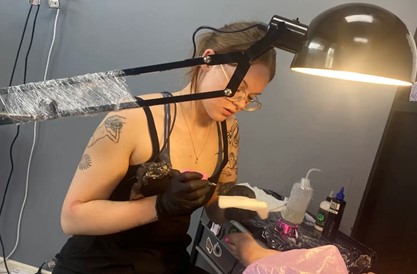
Lewis helps me sit up as I peer down at the newest addition to my body. It’s better than I could’ve expected. I’m stoked with the design as it is, but I trust her opinion, so I tell her to just do what she thinks will look good.
“I’ll just add some shading to the petals and stems,” Lewis says. “It’ll make it feel more finished.”
In a complete moment of transparency, she adds, “because I’m still new at this, none of my work feels perfect, even at my best, so shading is a nice buffer and I think it makes my designs look better”.
And look better it does. After another 30 minutes of shading, the tattoo has completely come together. I always thought I’d be a more fine-line tattoo person rather than a hyper-realistic, shaded piece, but Lewis has mastered combining the two art forms brilliantly. I love it and I’m glad to have it on me forever.
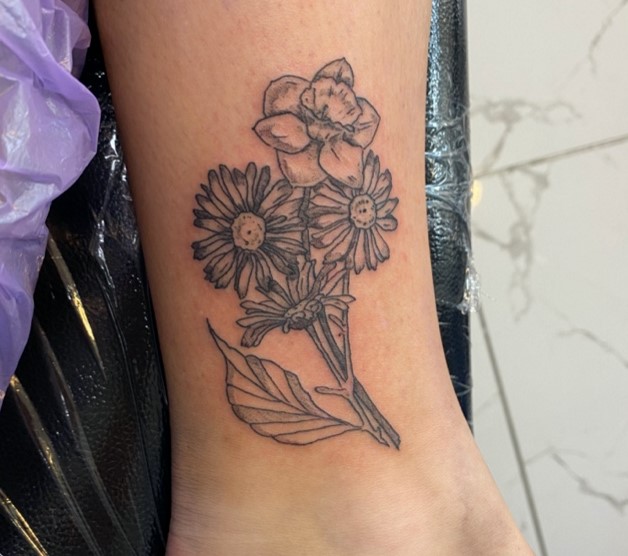
After my appointment, we sit down on an old leather couch near the front of the salon and Lewis asks me how I’m feeling. I tell her I truly love the tattoo but I’m nervous for how my Nanna will react. She laughs at my nerves and does her best to reassure me, saying her dad also never liked tattoos.
“He’s put off by them because of how permanent they are … which I think is valid, but I feel like a tattoo is just like any other decision you make in your life. I mean, the man has three daughters, that’s pretty permanent,” Lewis laughs.
“There’s a quote from Ed Hardy that I really like. He says compared to every other form of art, traditional tattooing lasts the least amount of time. It’s permanent, but it probably won’t even last 80 years.”
We move on to discussing how Lewis has gone building up a client base so far, and how difficult it can be for new tattoo artists to get their career off the ground.
“I work as a sole trader so I do everything myself. I have to buy all my equipment, my own stock, and I have to get my own clients,” she says.
Lewis reveals that only 20 per cent of her job involves actual tattooing. The rest of it is spent engaging with clients online, coming up with designs, paperwork, cleaning, and sterilising equipment. So far, most of her clients have been friends and family, and people who have been drawn in by word of mouth. Going forward, Lewis says she would really like to further define her own style and have clients wanting tattoos representative of that.
“At the moment, I would like to get a little bit more of a client base to keep it busier. I would like my flash [designs] to be like most of what I do. But that sort of thing comes with time.”
Overall, however, Lewis is extremely happy to be in an industry that brings her so much joy as an artist and a client.
“Tattoos do something to you that’ll last forever. I feel like tattooing is one of those extra little things that’ll make people feel better,” she says.
“I think they’re a good way to commemorate things, people, yourself, or events you’ve been through, and they can be very therapeutic.”
 ontherecordunisa.com