
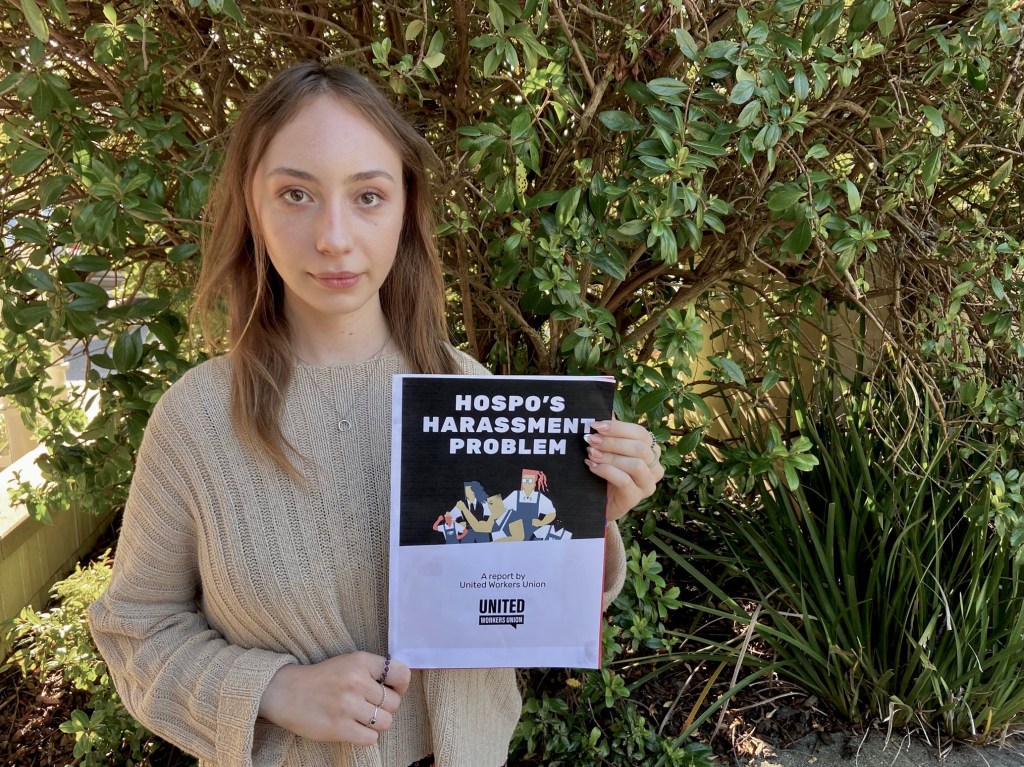
Ex-hospitality worker Ellorah Boss first endured harassment in the workplace at just 15 years old. OTR journalist Amelia Walters investigates what is being done to change the culture of SA’s hospitality industry. (Image: Amelia Walters)
By Amelia Walters | @ameliawclaire
Ellorah Boss was just 15 years old when she first experienced sexual harassment in the workplace.
It began with sexualised comments: “I thought you were so much older. I would’ve already tried to sleep with you if you were.”
This eventuated to 18 months of sexual harassment and assault, including messages requesting nude photos, inappropriate touching at work, and explicit commentary that suggested a desire for underage sex.
As a young employee in her first job, Boss was unaware that these acts were unlawful and, to a degree, she believed them to be normal.
“The thing about hospitality is you get a lot of young people coming into an environment where there are a lot of adults who have been exposed to a culture of constant drinking, going out and partying, which is then bred into the workplace,” she says.
These behaviours were reinforced by Boss’s friends at school, who would tell her to take the attention as a compliment.
“I found it really hard because not a lot of my friends were working in hospitality at the time, and if I had friends who were working in hospitality, they were older,” Boss says.
“I felt isolated in this experience and if I told people, they were like, ‘Oh well, it just means he’s really into you.’”
Boss began to change how she dressed, behaved and interacted with others. She stopped wearing skirts and any type of pant that was tight to her body in a bid to try and stop the harassment.
“I stopped wearing makeup … I really thought it was my fault for making myself look older,” she says.
‘A Guide to Equal Opportunity law in South Australia’, produced by the State Government, defines sexual harassment as “sexual behaviour which makes people feel offended, afraid or humiliated”.
“Sexual harassment is determined from the point of view of the person feeling harassed. It is how the behaviour is received not how it is intended that counts,” the document reads.
Although Boss did not know the signs of sexual harassment, her female employer helped her come to terms with the extent of what was happening. Boss was encouraged to speak out and reminded that the harassment was not a reflection on her actions.
“I went to my boss, and they were fantastic about it. They immediately sorted it out,” Boss says.
“As a young woman, I prefer to work for women because I just find the level of understanding is just so much better. You just feel so much more supported,” she says.
Sadly, Boss’s story is not a rarity. According to the fifth national survey to investigate the prevalence, nature and reporting of sexual harassment in Australian workplaces, a study previously conducted by the Australian Human Rights Commission in 2003, 2008, 2012 and 2018, one in three Australians have been sexually harassed at work in the last five years. Of these people, 41 per cent were female and 26 per cent were male.
In November 2022, the United Workers Union (UWU) opened a survey to all South Australian hospitality workers via the ‘Hospo’s Harassment’ website.
The survey aimed to accumulate comprehensive data on sexual harassment in the industry, and how the UWU could improve working conditions.
On April 18, 2023, the survey findings were released via the ‘Hospo’s Harassment Problem’ report — the first of its kind in South Australia.
The report shows South Australia’s survey respondents are not only concerned about how many workers are being affected, but the lack of mandatory training and education to stop these numbers from decreasing. According to the report, this is causing a “systemic” issue in the South Australian hospitality industry.
‘Hospo’s Harassment Problem’ findings
The report is based on union discussions with 868 hospitality workers and an anonymous survey where workers could report abuse. Of the 74 survey respondents, 47 per cent experienced workplace sexual harassment themselves, with 58 per cent of those who had been harassed female.
Compared to the findings from the Australian Human Rights Commission, these figures sit significantly higher than the national workplace average.
Sexual harassment is not limited to situations when others are not present, the report found. Nearly half the survey respondents witnessed the sexual harassment of a co-worker, yet 72 per cent said they did not report the incident.

Boss’s experiences are representative of this data, as multiple staff witnessed or experienced harassment but did nothing to intervene.
“Every girl who worked there did end up with at least one message or did have at least one red flag about this particular person,” Boss says.
“When I got older and I thought about it more, it made me angry because I realised that they all probably would’ve known,” she says.
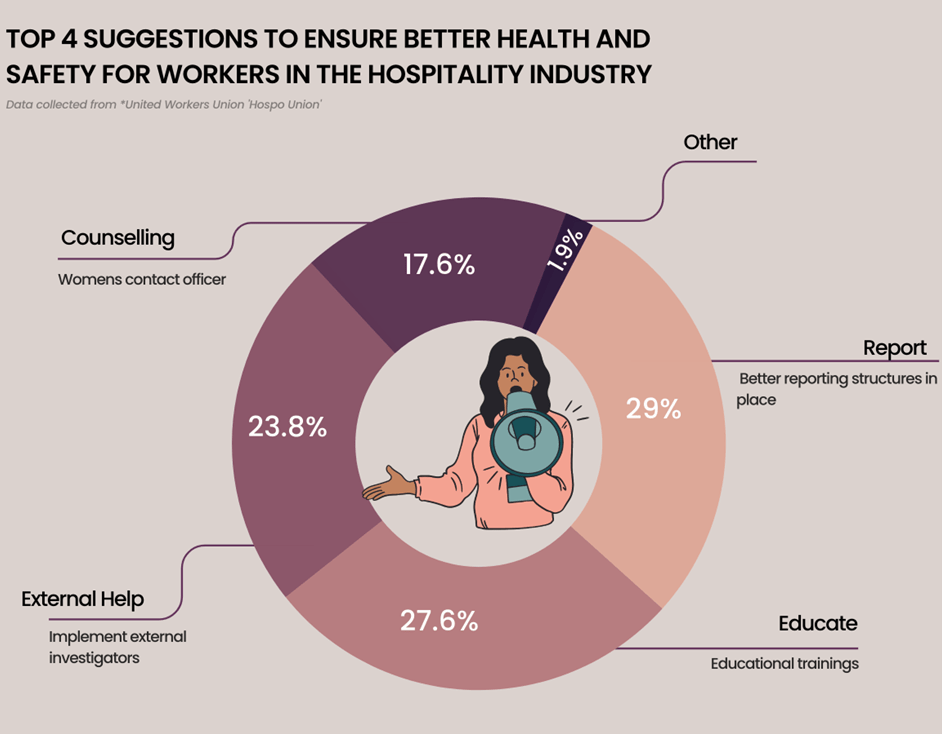
As part of the UWU report respondents were asked how their workplace could ensure better health and safety practices to avoid instances of sexual harassment in the workplace. The preferred measures for creating a safer workplace were ‘better reporting structures’ (29 per cent) and ‘educational training’ (27.6 per cent).
What is currently being done to mandate sexual harassment prevention training in SA?
We’re Equal
One of the key players advocating for change in the hospitality industry is the South Australian Commissioner for Equal Opportunity Jodeen Carney.
The commissioner believes hospitality venues should have stronger policies in place, including better training for both employers and employees, to ensure a safer working environment.
One of the ways this training can be implemented is via the ‘We’re Equal’ program, an initiative launched by Carney and her office.
Encapsulating all 13 grounds of discrimination under South Australia’s Equal Opportunity Act, the voluntary program aims to support businesses commitment to creating a safe space and treating everyone equally.
“Businesses sign a statement of commitment, and our office provides online resources, education tools, and links to training. The supports are for business owners, workers, and customers,” Carney says.
The program provides in-depth training modules for the venues’ employers and employees that includes workplace sexual harassment prevention and bystander awareness training.
“The hospitality sector is a great sector to be involved in … for many people, working in the hospitality sector is often their first job, so all of us owe to them an obligation to make sure their first job is not their worst job,” she says.
Not So Hospitable
Founder of ‘Not So Hospitable’, Jamie Bucirde has played a fundamental role in advocating for mandatory sexual harassment training in the Adelaide hospitality industry.
“Since I started working in the industry, I’ve been thinking about what it was I could do to help the reform of this industry,” Bucirde says.
“Being a young female in the hospitality industry, I have seen and experienced first-hand just how prevalent sexual harassment and assault within the industry is,” she says.
In 2022, Bucirde created ‘Not So Hospitable’, a platform that allows hospitality workers to anonymously send in their sexual harassment testimonies in a bid to gauge how many workers were being harassed at work.
Nine days after the website launched, ‘Not So Hospitable’ received over 300 testimonies.
“What ‘Not So Hospitable’ is doing is bringing this conversation to the forefront of mainstream culture within hospitality for the first time,” Bucirde says.
Project Night Light
To assist in changing these statistics, Bucirde is working alongside the Adelaide City Council to conduct the pilot program, ‘Project Night Light’.
Like the ‘We’re Equal’ program, ‘Project Night Light’ aims to enhance Adelaide’s status as a safer city for all to enjoy.
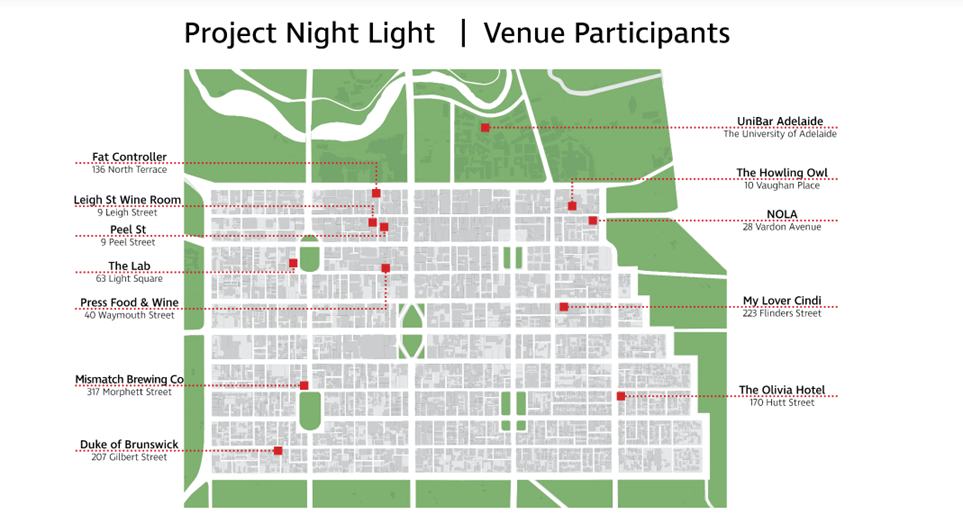
The 12-month pilot supports 12 venues around Adelaide that are committed to providing mandatory staff training and support to create and promote a culture that is safe and respectful of women.
CEO of Adelaide City Council Clare Mockler says the project has seen remarkable success so far, and she wants to see the Government mandate this training for all venues in South Australia.
“We all want our city to be a welcoming and inviting place, where everybody feels safe to have a fun night out, and we believe mandating this training would help achieve this goal,” Mockler says.
“Initial feedback from the participating venues has indicated the training has significantly improved the staff’s awareness of public behaviour and empowered them to recognise and act before situations escalate to violent altercations,” she says.
A safety assessment audit undertaken by the Adelaide City Council found that venues participating in ‘Project Night Light’ increased their understanding of how to action and stop disrespectful behaviour by approximately 70 per cent.
Mandating bystander training
Survivor Advocate Sharon Lockwood has spent 32 years working around issues of gender-based violence and says bystander training is something all hospitality workers should be made to do.
“A lot of sexual assault happens in and around drinking environments, and it’s not drink spiking. Alcohol is the most common drug used in drug-facilitated sexual assault,” Lockwood says.
“I think if you position training in a way which is about enhancing the safety of your patrons as well as of your staff, you will get more patrons if you are a safe venue.”
During her time at Yarrow Place Rape and Assault Service, Lockwood found that hospitality venues were more concerned about their liability than the welfare of their employees.
“We would notice certain trends and certain venues where we would get more reports of sexual assaults that had happened on premises,” she says.
“Yarrow Place would write to those venues and say ‘This has happened, we can offer you training. Would you like us to provide that?’, and unfortunately, that invitation wasn’t always accepted.”
Similarly, members of the UWU reported that current policies surrounding sexual harassment are often used to defend companies against claims of sexual harassment, rather than to proactively prevent gendered violence at work.
“Training is often ‘tick-and-flick’ and focused on avoiding liability rather than affecting norms and behaviours,” the report says.
Is the State Government currently doing anything to mandate sexual harassment training in the hospitality industry?
In Australia, sexual harassment is illegal. However, in South Australia there are currently no legal requirements for sexual harassment training that applies to all hospitality workers.
Although, there are some codes and practices in place to minimise sexual harassment and alcohol-fuelled violence in the sector.
Late-Night Code of Practice Review
On December 5, 2022, the State Government announced a review into the ‘Late Night Trading Code of Practice’, which aims to assess whether the code has successfully reduced alcohol-related harm in and around licensed venues.
The code states that the duty of reducing gender-based violence relies on the individual Responsible Person (RP), not all venue employees.
In their draft submission, the Adelaide City Council recommended that bystander training be implemented into the code for all employees, not just the RP.
“The draft submission supports the continuation of the Late-Night Code and provides recommendations to support venues to trade while enhancing perceptions of safety and enjoyment for city users,” a spokesperson for the Council says.
“These recommendations include mandating training to build organisational capacity to support and contribute to bystander action to prevent violence against women.”
Submissions to the review closed in February 2023, and the State Government is yet to release an update.
Positive Obligation and the Respect at Work Bill 2022
In November 2022, Federal Parliament passed the Anti-Discrimination and Human Rights Legislation Amendment (Respect at Work) Bill 2022, which introduced several amendments to the Sex Discrimination Act 1984.
The act amendment requires employers to ‘take reasonable steps to prevent workplace sexual harassment and discrimination’. This is known as a positive duty obligation.
However, the issue surrounding positive duty obligation is the onus remains on the employer, not hospitality employees (comparable to the ‘Late Night Trading Code of Practice’).
UWU Recommendations and the Government’s response
As stated in the ‘Hospo’s Harassment Problem’ report, one of the recommendations proposed is to overhaul the Responsible Service of Alcohol (RSA) certification.
This overhaul would require in-person training on sexual harassment and gender-based violence for all hospitality workers.
Carney believes the Commissioner for Liquor and Gambling should introduce this mandatory training into the RSA certification and says she is happy to provide input as commissioner for equal opportunity.
“I’m hopeful they will come up with a training module, and I would be happy to view that and offer any input that might assist based on the experience we have had.”
Although Carney is feeling hopeful, others do not believe the amendment to the RSA certification will change anything.
Executive Officer for Hospitality Industry Training South Australia (HITsa), Olivia Muller, believes that even if the training is implemented, attitudes and behaviours of workers will not change.
“Once you’ve got your RSA certificate in 2001, you’ve never had to refresh it. So, what you learned in 2001 is not the same as what it is in 2023,” Muller says.
Muller believes the issue is not the RSA certification, but rather the cultural climate in Australia that is causing systemic concern.
“I don’t think the respect for women is in place, and that’s where the problem starts,” she says.
Timeline
A spokesperson from the Government of South Australia says they are open to discussing the recommendations in the ‘Hospo’s Harassment Problem’ report.
“The Government will consider the recommendations in this report, and is committed to working with businesses, unions, and the broader community to end sexual harassment at work,” the spokesperson says.
They declined to comment on a proposed timeline for when these considerations will be actioned.
What change do hospitality workers and industry leaders want to see?
On May 19, 2023, ‘Not So Hospitable’ asked its almost three thousand Instagram followers whether “the State Government should mandate sexual assault and awareness training for hospitality staff in South Australia”.
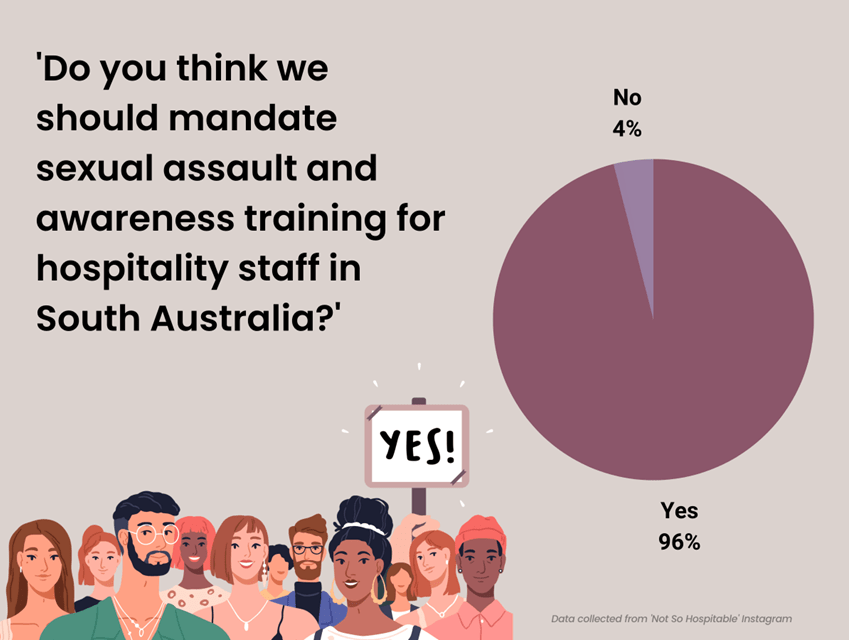
Lockwood says that if this data was representative of a health issue, the Government’s response would be completely different.
“If there was a health issue affecting half of the female population, you would expect there to be great public recognition of that as a significant issue of concern and the resources devoted to it,” Lockwood says.
“There are so many benefits to engaging in the culture change … it is challenging, it’s uncomfortable, but ultimately it leads to greater worker retention and greater worker safety,” she says.
As for the victims, Boss wants to ensure that the next 15-year-old girl walking into her first job can recognise the signs of sexual harassment, and know how to get help.
“You really need to trust your gut, and if it is upsetting you, if it is making you feel isolated, scared, or degraded, that is enough for you to take it to someone and get help,” Boss says.
“There needs to be education so that people understand it’s wrong, understand how to get help, how to identify it, and how to support people through it as well.”
In terms of the next course of action, the State Government is yet to meet with the UWU to discuss the recommendations put forward by the ‘Hospo Harassment Report’.
Bucirde says the government cannot ignore the data anymore and that they must stand up and do something.
“We’re called the festival state for God’s sake. It’s in the government’s best interest to support one of the biggest industries that is such a big driver for tourism,” Bucirde says.
“Change only comes from communities that enact the change from within.”
 ontherecordunisa.com