
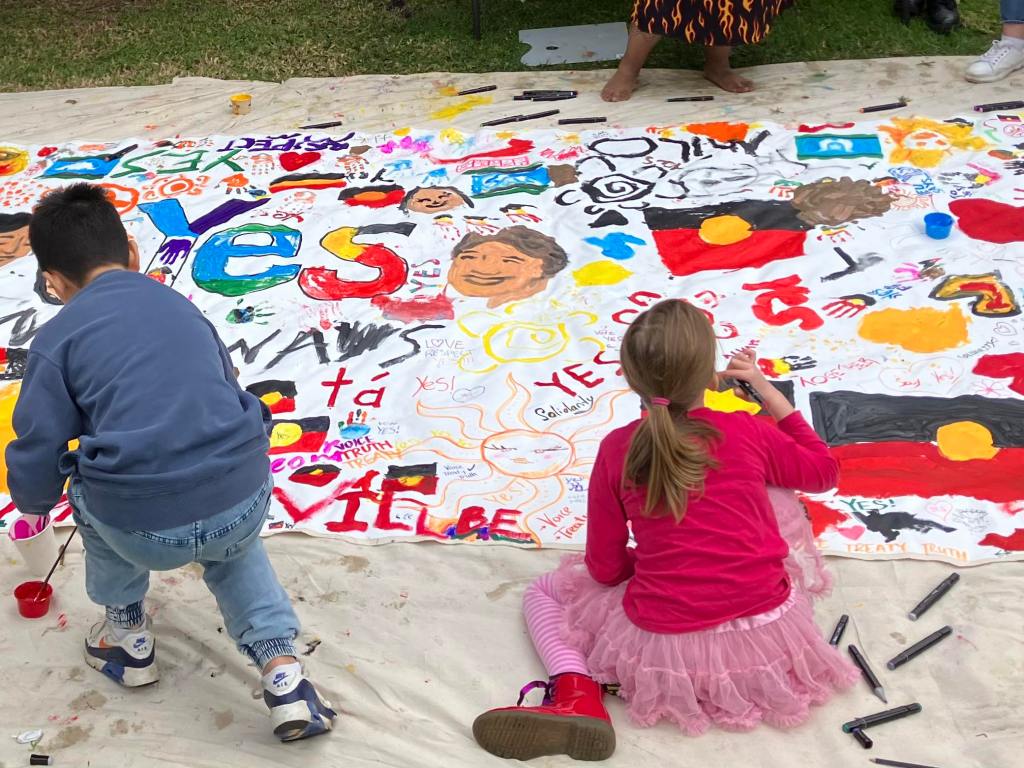
The referendum for the First Nations Voice to Parliament is coming up later this year. What is the Voice? How will it work? OTR journalist Thomas Docking explains. (Image supplied: Chrisanthi Giotis)
By Thomas Docking
What is the First Nations Voice?
The proposed Voice would be an independent and permanent advisory body, giving advice to the Australian Parliament and Government on matters that affect First Nations people.
Prime Minister Anthony Albanese said in a March speech, “Consultation through the Voice is about strengthening Parliament’s understanding — not supplanting its authority. It won’t take decision-making power away from Government or Parliament.”
“The Voice will not have a veto power, and it will not deliver programs or manage funding,” Mr Albanese said.
The referendum, if passed, will also enshrine a First Nations Voice permanently in the constitution itself, putting the Voice within the document that outlines the fundamental principles for the system of Government in Australia.
Where did the First Nations Voice come from?
The Voice to Parliament was first proposed in the Uluru Statement from the Heart in 2017 by the delegates to the First Nations National Constitutional Convention.
The Uluru Statement from the Heart calls for “the establishment of a First Nations Voice enshrined in the constitution”.
The 250-member convention was held after the 16-member Referendum Council travelled around the country, meeting with over 1200 people.
What does the First Nations Voice aim to achieve?
Special Envoy for Reconciliation and Implementation of the Uluru Statement from the Heart, Senator Patrick Djargun Dodson, said in the senate late last year, “The Voice to Parliament will be a significant shift for our nation.”
The Voice gives First Nations people “a real opportunity to advise the parliament and the government on how to do things for the better of our people,” Mr Dodson said.
Embedding it in the constitution wouldn’t only recognise the special place of First Nations people in history but also prevent it from being shut down by future governments.
“The Voice to Parliament is an invitation, an opportunity for all Australian people to walk with the Aboriginal and Torres Strait Islander people,” Mr Dodson said in a speech earlier this year.
Why is a referendum needed?
The Australian Constitution cannot be altered without “the approval of the people”, with the referendum aiming to add a new chapter titled Recognition of Aboriginal and Torres Strait Islander Peoples.
“This is an opportunity that doesn’t belong to the [politicians], it belongs to every Australian equally,” Mr Albanese said.
“All of us can own an equal share of what I believe will be an inspiring and unifying Australian moment.”
Who would elect the members of the Voice if passed?
“It will be representative of Aboriginal and Torres Strait Islander communities, with a gender-balance and include youth,” Mr Albanese said.
Members would serve fixed terms to ensure regular accountability, with no member being appointed by the executive government, but rather by local First Nations communities post-referendum.
“Members will come from every state and territory, the Torres Strait Islands and specific remote representatives,” he said.
When will the referendum be held?
The Australian Senate passed the referendum legislation on June 19, with the lower house already having passed it in May. The referendum date is undecided, but it is likely to be held on a Saturday, with the Australian Government committing to holding the referendum between October and December, 2023.
“It will be in the last quarter of this year, so it can be anytime now, from two months and 30 days and 6 months, that’s the timeframe,” Mr Albanese said.
What will the referendum involve?
Every Australian eligible to vote in elections will be required to vote in the referendum. A pamphlet will be distributed to every household at least a fortnight prior to the referendum, containing arguments both for and against a Voice to Parliament and details on the proposed constitutional change.
The ballot will read, “A Proposed Law: to alter the constitution to recognise the First Peoples of Australia by establishing an Aboriginal and Torres Strait Islander Voice. Do you approve this proposed alteration?” The ballot will ask voters to write “yes” or “no”.
Why is the First Nations Voice controversial?
The proposed Voice is controversial for a number of reasons; a main one voiced by the Liberal party is that the referendum is asking Australians to vote without fully explaining how the Voice would operate.
In an April press conference, leader of the Federal Opposition Peter Dutton said, “There are reasonable questions when the prime minister is proposing the biggest change in the constitution since federation, and it is right that the questions get answers.”
As the constitution is Australia’s most important legal document, the Liberal party has expressed concern that enshrining the Voice in the constitution will open new legal challenges in the High Court.
Historically, Australian citizens have also been reluctant on constitutional amendments; due to the difficulty of the referendum process, only eight of the past 44 nationwide referendums have succeeded.
Summary
The Voice to Parliament referendum will decide whether or not we should create an advisory body that, without veto power, directly advises the Australian Government on matters that affect First Nations people.
First proposed in 2017, the referendum is seen by many as a unifying Australian moment: a chance for all Australians to walk with First Nations people.
As the Australian Government commits to a referendum between October and December 2023, the Voice remains controversial for a number of reasons.
Notably, the referendum is the first national vote on a proposed change to the constitution in over 20 years, which is a difficult process that Australians have historically been reluctant to approve.
If passed, the constitutional amendment will enshrine a Voice permanently in the constitution, which is representative of First Nations communities and recognises their important place in history.
 ontherecordunisa.com