

Vaping in schools has become an issue of primary importance for state and national authorities, with young people rapidly becoming the biggest users. OTR journalist Jess Smith reports on the fight to combat this growing concern. (Image: Jess Smith)
By Jess Smith | @Jessmurraysmith
*Note: full names of some story subjects have been changed for privacy reasons.*
In 2020, Bridie Sampson* tried her first vape at 14 years old after one of her friends bought it from a senior student at her old high school. Sampson knew nothing about vapes at the time and was doing what many other 14-year-olds would do: trying the new trend sweeping the school.
“I didn’t really know what they were. But my mum, she smoked cigarettes and said that she was buying [vapes] to help quit smoking,” Sampson says.
“So, when I first tried it, I thought it was just to help people stop smoking and that it wasn’t so bad.”
Sampson continued to vape for the next two years. It was not until she watched a public speaker at her school from Tackling Indigenous Smoking (TIS), a group which aims to improve the health primarily of First Nations peoples by reducing the frequency of tobacco use, that she thought about stopping. At this speech, she discovered the negative health impacts nicotine vapes can have on the body.
“I was very irritated, and I would think about [vaping] constantly,” Sampson says. “I would get angry and fidgety and tense. And sometimes I’d get a bit sad or irritated. But it was constantly everything that I thought about. Always at the front of my mind.”
Sampson found out some of the immediate impacts consuming nicotine can have on the body — most notably, the addiction that is developed.
Dr Andrew Huberman is a tenured American Neuroscientist and Associate Professor for Neurobiology and Ophthalmology at the Stanford University School of Medicine. With more than 20 years of experience, Dr Huberman created a podcast called “Huberman Lab”. On September 19, 2022, in an episode titled “Nicotine’s effect on the Brain & Body & How to Quit Smoking or Vaping”, Dr Huberman outlines the impact nicotine can have on the brain and why addiction is so common among users.
Dr Huberman explains nicotine consumption releases high levels of dopamine from the “dopamine reward pathway” in the brain. This process is a main factor for why the drug is so addictive. He also notes dopamine is a chemical in the human brain that encourages motivation and reinforces habitual behaviours.
“Nicotine triggers the release of dopamine from the nucleus accumbens [dopamine reward pathway], and this is what gives nicotine its rewarding properties. It increases motivation and it gives a transient increase in wellbeing, alertness and motivation,” Dr Huberman says.
Sampson found out just how addictive nicotine was when she attempted to stop vaping for the first time.
Stories like Sampson’s are not uncommon among Australian adolescents. Across the country this year, state officials have begun to crack down on improper vape use and sales. However, this is not the first time they have attempted a crackdown.
In October of 2021, the Australian Federal Government introduced its first attempt at reducing vape use by making it illegal to import or purchase vapes without a doctor’s prescription. Those restrictions proved to be ineffective due to loopholes and a lack of policing.
The new government campaign began in April this year with a focused approach on introducing websites, advertisements, and infographics to alert the public to the adverse effects of vaping.
In South Australia, the State Government made dedicated webpages with various resources available. These websites included downloadable brochures, specifically providing information to adolescents, teachers, and parents.
State officials also made a conserted effort to target the youth of Australia, highlighting adolescent vape use as a growing concern that must be addressed. Australian Bureau of Statistics (ABS) data backs up this belief.
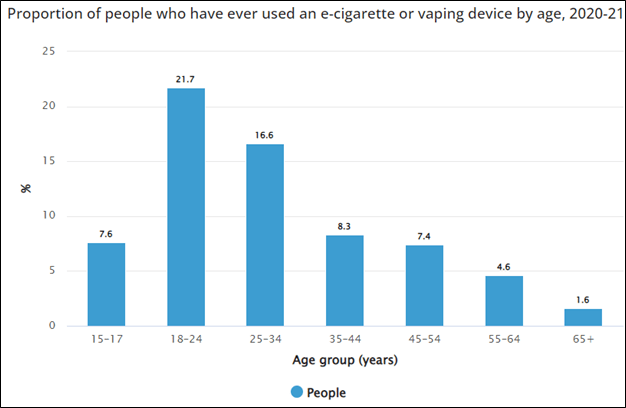
As the statistics show, young Australians are overwhelmingly the biggest vape users. New data collected by South Australia’s Commissioner for Children and Young People found these trends have only continued to expand. In this data, among those aged between 13 to 19 years old in South Australia, one in four described themselves as a regular vaper. Aditionally, Between 2021 and 2023, the number of adolescents in Australia who have tried vaping once, or regularly use vapes, has jumped from one in every 15 to in one in every four.
So, why has this new trend been embraced by so many young people? And are the efforts being made enough to combat the issue? The best way to uncover this could be to probe the source of the problem. Vaping in high schools was a key topic of conversation that initially led to Australian state governments taking action.
According to Sampson, vapes are discreet, odourless, and easy to hide, providing a perfect opportunity for students to take advantage of them at school.
Sampson notes it was common to see students vaping on school grounds, and that seniors would sell vapes to younger students who would not be able to purchase them otherwise.
“I tried my friend’s [vape] the first time, but then the first time I bought [a vape] was from my friend’s brother,” Sampson says.
Kieron Duncan, 22, has been purchasing vapes for more than a year and says it is common for vapes to be purchased and redistributed via social media.
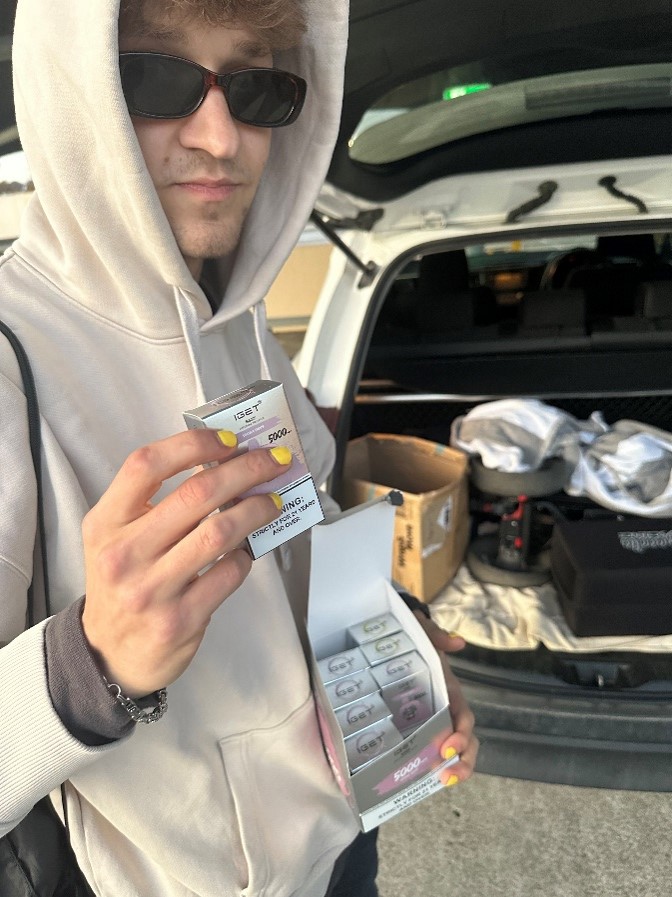
“I buy [vapes] by contacting online marketplaces like Snapchat or Facebook groups and singling out the best prices,” Duncan says.
Duncan says many of these online marketplaces offer to sell vapes by the box at a discounted rate and often buy them from overseas.
“For one [vape] let’s say you’d pay $30, and for a box you’re looking at around $170,” he says.
The discounted prices for vapes purchased in bulk could provide an explanation on why school students access them so effortlessly. Duncan says he would often see someone purchase and sell them off individually to their peers, creating the possibility for minors to purchase them. Prior to the release of the new restrictions, schools had already become increasingly alarmed by the number of students getting caught vaping on school premises.
Sampson’s school chose to implement vape detectors in toilets and other vaping hotspots. The school was also issuing suspensions and exclusions to deter students from vaping at school.
Drama teacher Pamela O’Donnell* says the move has been effective and seems to reduce the number of students getting caught.
“I don’t know how well [vape detectors] work or whether they’re just a deterrent,” O’Donnell says. “But yeah, I haven’t really heard much about kids getting caught vaping at all, whereas prior to the [vape detectors] there was a student being caught every day.”
The vape detectors, made by tech company Halo Detect, are designed to test the quality of the air around them. If the air quality falls below a certain marker, an alert is sent out to the owner. Reportedly, the vapor students exhale is noticed by the device.
O’Donnell says that although the TIS program was educational for students and faculty, it did not seem to have a lasting impact for students. According to O’Donnell, the students found the seminar focused too heavily on how students are targeted by vape companies, and not enough about negative physical and mental health implications of vaping.
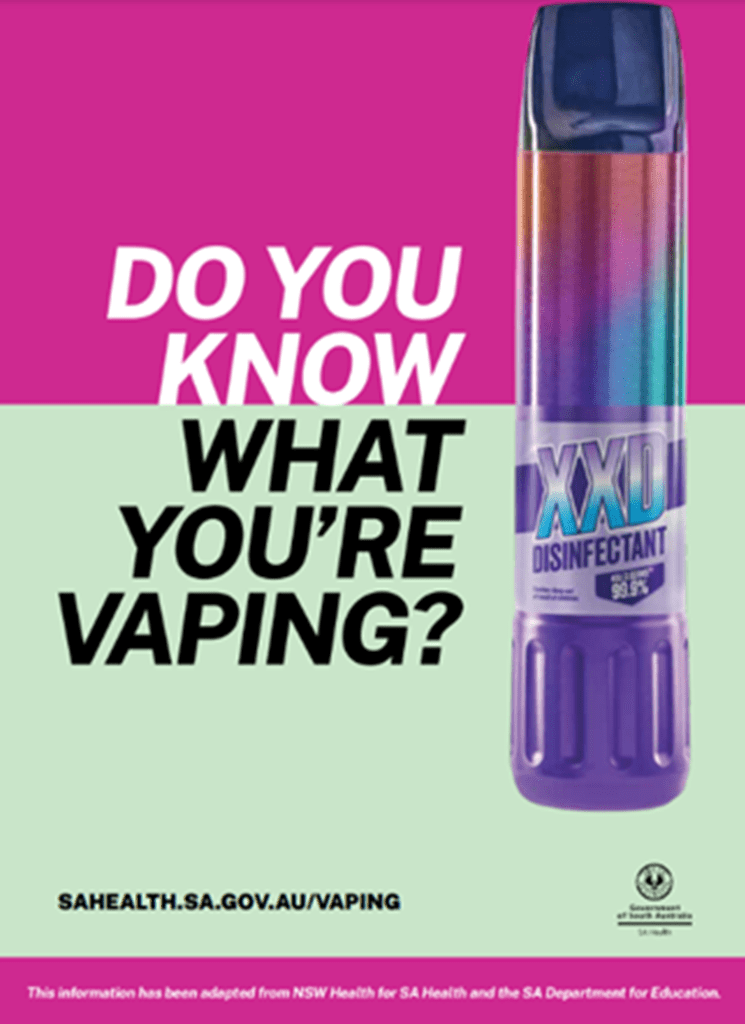
“I spoke to my students about it, and to them, the fact that [the advertisments] were targeted at kids didn’t put them off, and they thought they should have probably targeted it more at the health issues because all the kids are into fitness and sport,” O’Donnell says.
The government’s approach appears to align with the feedback O’Donnell received from her class, with the 2023 campaign heavily focusing on communicating the health issues caused by vaping.
Andrew Gohl, president of the Australian Education Union’s SA branch, says there is space in the curriculum to educate students on the repercussions of vaping.
“The union does see a responsibility of the government to invest in campaigns that help develop the stigmas that were lost when younger generations took up vaping over smoking,” Gohl says.
“Advertising campaigns and other methods could help provide a better understanding of the dangers; it is a responsibility of the government. The union does also see the roll out of vape detectors as an appropriate measure to reduce use in school,” he says.
General Practitioner Dr Natalie Bampton says while educating Australian adolescents will have some impact in creating a dialogue among the community, it will hopefully also make the conversation around addiction less taboo.
“I think it’s the actual motivation to be able to do it,” Dr Bampton says. “So, [psychologists] talk about the stages of change you need to go through in your own mind. Are you pre-contemplation? So you haven’t even thought about making that change in your life. Or are you thinking about it? So you’re at the conflict contemplation stage.
“Are you going through the steps to quit and think you are in the mindset of recognising the negative health aspects of it, and saying, ‘I’m wanting to stop.’ That’s where you must be in your mind, and it’s difficult to engage teenagers in that way because they probably don’t see themselves at 60 years old with lung cancer,” she says.
Dr Bampton says the obstacle is that it is common to see adolescents with nicotine addictions who are also living with mental health conditions or heightened levels of anxiety — the challenge being that nicotine dependency is often being used to relieve mental health challenges.
“I’ve had quite a few patients who currently vape, and as I said, most of them are in that 15, 16, 17-year-old age group,” Dr Bampton says. “And they’re just constantly vaping all day. I see a lot of them with mental health issues and it can cause a lot of anxiety.”
For Sampson, having a space where she felt comfortable to discuss this topic is what led to her mindset shifting. Now, Sampson wants others to have the opportunity to get educated the same way she has.
“It’s still a temptation, but I know that it’s not good for me … I would probably say, just don’t even try it. It’s not worth it,” she says.
“It’s honestly more admirable when someone says that they don’t vape or don’t have a vape than it is when someone says they do. It’s just genuinely not cool.”
Sampson says she has not vaped for over two months now, and wants to show young Australians they have the power to stop it, too.
 ontherecordunisa.com