
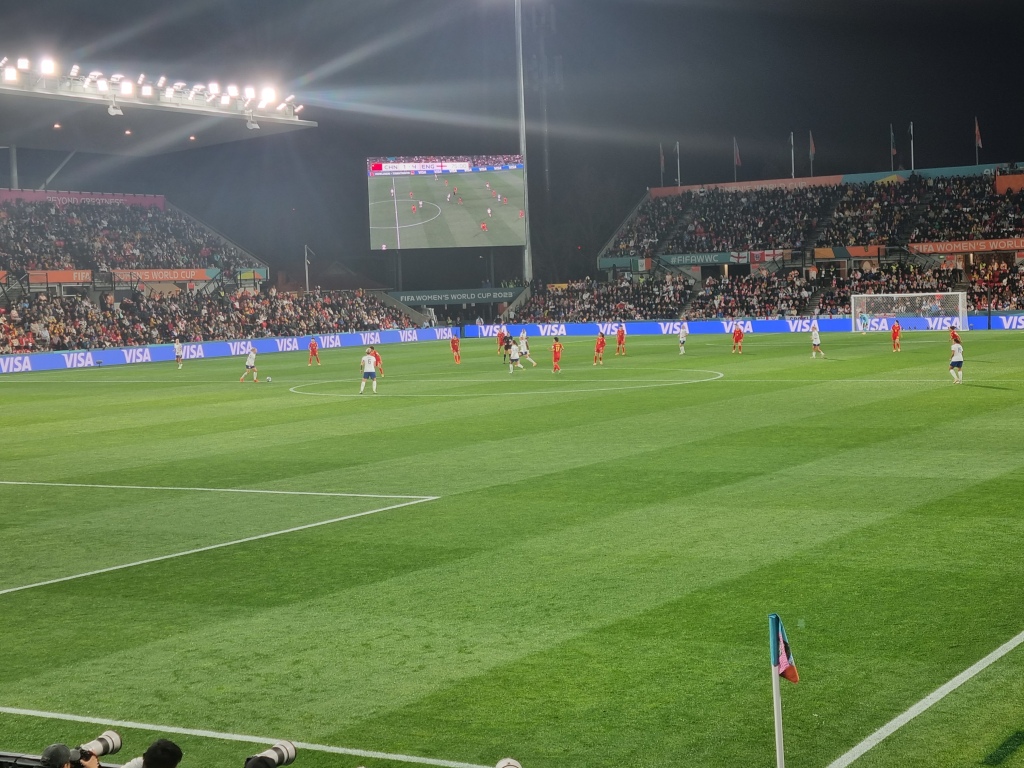
Australia finds itself immersed in the hype of hosting the women’s World Cup; and it is smashing all sorts of records. But, for OTR’s resident football nut Jacob Stevens, there’s more to it than numbers — there’s a chance to leave a lasting legacy for women’s sports. (Image: Jacob Stevens)
By Jacob Stevens | @jacobstevens__
Yes, I’m English. Yes, I’m a football fanatic. Yes, I’m biased. But you’re kidding yourself if you think any other sport on Earth has the reach that football does. And the World Cup? Well, that’s just the sport’s chance to show off. A World Cup is always exciting, it always brings together international communities, and it always showcases the most elite of the elite in the sport. With Australia currently hosting the 2023 FIFA Women’s World Cup, that’s no different.
But what is different is the way this tournament has grabbed an absolute stranglehold over the nation. Sure, you’d expect office watercooler chat during a men’s World Cup. But the women’s World Cup? Even only four years ago you would have been laughed at for suggesting it could be this big.
But it is this big. FIFA has recently announced a slew of stats and figures showing this is the highest-attended women’s World Cup in history. Over 1.7 million match tickets have been sold, and the average attendance is nearly 30 per cent higher than France managed when they hosted in 2019. These are incredible numbers.
I will never forget walking along Manton Street in Hindmarsh before England’s group stage clash with China. There I was, retro England shirt on, St George’s flag tied around my neck as a cape, surrounded by every type of person imaginable. There were families with children dressed head-to-toe in their country’s colours: whether that be China, England or even Australia. I knew then this World Cup was something special.
And as the tournament moves into the latter stages of the knockouts, with enthralling penalty shootouts aplenty, there is a chance to create something even more special than just the legacy of a World Cup — there’s a chance to inspire. To empower. For Australia to throw away this opportunity would be a devastating blow not just to football, and not just to women’s football, but to women’s sports entirely.
Football Australia recognises this opportunity. Before the tournament even began, they announced their Legacy ’23 campaign, aimed at embracing the benefits this World Cup brings to grow women’s football in Australia. In a press release from Football Australia, CEO James Johnson says: “Our purpose for bidding to host the tournament was to use the global power of the FIFA Women’s World Cup to transform our local game.”
“Football Australia has always believed in the power and potential of the CommBank Matildas and women’s football,” he says. “Their unwavering spirit and resilience resonate with our nation’s values and their success on the pitch has made them a symbol of national pride.
“To see Australians united behind this team has been inspiring.”
Some of the key focuses for the Legacy ’23 campaign are to expand community programs and increase football participation rates for women and girls. As reported by the campaign, currently only 26 per cent of football participants nationwide are female, and the aim is to achieve a 50/50 new participant gender split. With this would come greater opportunities for young girls to realise their dreams and emulate their heroes.
But an idealistic plan is just that: idealistic. Women’s sports have long been met with the classic “Why would anyone bother watching?” retort. There’s a stigma still to break, but this World Cup is chipping away at it. It’s not just in-person attendance figures that are breaking records, the broadcast numbers are astounding, too. Almost 54 million viewers tuned in worldwide to watch China take on England — the very same game I attended. In person it was incredible, but to have more than twice the population of Australia watch it live on TV speaks volumes about the support women’s sports is starting to get, and sets exactly the sort of trend that hints at a promising future.
In a recent press release, South Australian Minister for Recreation, Sport and Racing Katrine Hildyard says: “54 million people tuning in to watch the best women’s football in the world being played in Adelaide is historic and absolutely brilliant.”
“This follows decades of women advocating for change,” she says. “It is right that these magnificent sportswomen are finally receiving the recognition they deserve.
“This is a tournament of firsts, and the State Government is committed to harnessing its power and ensuring its legacy — a legacy that will advance gender equality across the globe.”
Now, after a nervy penalty shootout against France, the Matildas find themselves in the World Cup semifinal for the first time ever. And their opponents? None other than England, of course. If there was ever to be a bigger game for women’s sports, I’d be impressed. It’s the old enemies doing battle in front of a sold-out crowd for a chance to make history.
This is not something that will happen again. I urge everybody to tune in this Wednesday, August 16, and watch. Whether, like me, you’ll be gunning for the English, or if you’re hopeful for an Australian victory — it doesn’t matter. Show your support not just for your team but for women’s sports, too. After all, do you really want to be the one who has to say you missed the biggest clash not just in this tournament so far, but arguably in any World Cup ever?
I’ve mentioned the chance to leave a legacy for years to come. Well, maybe that legacy, as I’ve explained, has already been made. But this game is a chance for women’s sports to affirm that legacy and get the recognition it deserves. It has all been building towards this and I, for one, cannot wait.
To all the naysayers, the critics, the sceptics: look around you. There’s a World Cup fever around, and it’s one that will live long in the memory.
 ontherecordunisa.com