
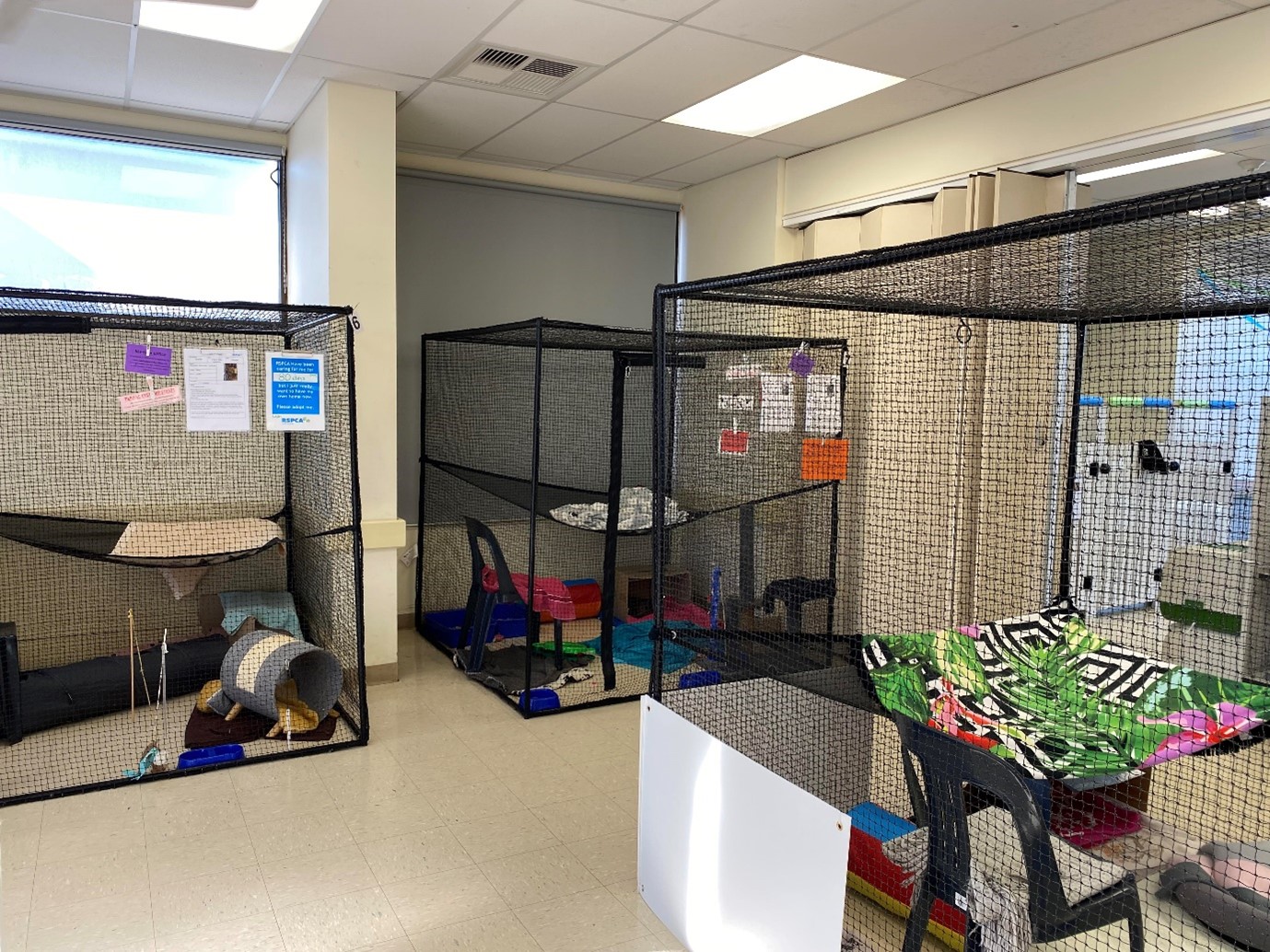
The rapidly growing population of semi-owned and unowned cats across South Australia is placing immense strain on animal welfare organisations, local councils, veterinarians and cat owners alike. Something must be done, but experts say the solution is more complex than most think. (Image: Jessica Dempster)
By Jessica Dempster | @dempsterjess_
Every Saturday morning, the walls and floor of Paws for Pets at Marden Shopping Centre are lined with cages of cats and kittens ready and waiting for their forever homes as part of the Cat Adoption Foundation’s (CAF) weekly “adoption days”.
Aspiring pet parents converse with volunteers from the CAF, who run the event. Many of these volunteers foster potential adoptees in their own homes to get them ready for new owners.
The CAF’s weekly adoption days are just one of many similar events held regularly across the state by fellow animal welfare organisations and charities, all of which currently have high numbers of cats and kittens in need of new homes.
The issue of widespread cat overpopulation within South Australia places intense pressure on metro and regional communities and councils; and despite their best efforts, animal welfare organisations are struggling to pick up the pieces. Consequently, volunteers say the welfare of cats across the state is worsening, with many coming into care under poor circumstances.
Emma Fitzgerald adopted her cat Daisy when she was a kitten from an adoption event held by Wet Noses Animal Rescue in Mount Gambier.
“Daisy was, unfortunately, found in a home with an older man who had around 100 to 120 cats within the home that were breeding out of control,” Fitzgerald says.
“Eventually, someone reported him to the RSPCA when he began drowning some of the kittens in an attempt to control the problem,” she says. “Thankfully, Daisy was rescued and placed within a rescue centre.”
Fitzgerald’s second cat Dave, who she also adopted through a rescue centre, was found wandering the streets of Mount Gambier as a kitten.
But while Daisy, Dave, and many other cats and kittens adopted through rescue programs are fortunate enough to find loving forever homes, there are thousands of cats left in shelters and on the streets of South Australia.
South Australia’s “tsunami” of cats
For the first time in 40 years, the South Australian branch of Royal Society for the Prevention of Cruelty to Animals (RSPCA) has had to turn away people wanting to surrender their animals.
The charity is at its absolute capacity in terms of space and personnel to provide for the animals in its care, and it is not alone. The Animal Welfare League (AWL) is also currently at its highest ever capacity for cats and kittens, and has had to cease intake until further notice.
With these animal shelter giants at capacity, Virginia Ducruc, a volunteer for the CAF, says smaller organisations, charities and veterinary clinics are now under even more strain trying to manage the “tsunami of cats” in need of adoption.

“The smaller rescues are already pretty full, so it has put a lot of pressure on us, and it’s to the point where some people are threatening the lives of cats to force us to take them,” Ducruc says.
“The community involved in caring for these cats is exhausted and burnt out.”
The issue is also dire in many regional and rural areas across the state. The town of Naracoorte is one of many struggling to manage their cat population.
Danielle Debarro is the head nurse at the Naracoorte & Penola Veterinary Centre. The clinic runs its own cat and kitten adoption program, but Debarro says the influx in the local cat population has made work more difficult over recent years.
“We just have a constant flow of cats and kittens coming through here,” Debarro says.
“There used to be a bit of a kitten season over the summer period, but we’re finding in the last couple of years that it’s a year-round occurrence now, and they’re just breeding out of control,” she says.
“A lot of times people will bring in a litter of kittens saying they found them and that they’re not theirs or not from their cat, but it’s very unusual to find a full litter of kittens lying around. Most likely, they’re bringing them to us because they don’t want to care for them.”
Within the last year, the clinic has enforced that anyone wanting to surrender their cat’s kittens must book the mother in to be desexed before the kittens are accepted.
“While it’s not the number one issue, there are definitely problems [with] people owning cats and suddenly having to move or having money troubles and being unable to take the cat with them or care for it … but instead of doing the right thing and surrendering it, they just leave it behind,” Debarro says.
“A few weeks ago, we had a real estate agent bring in a cat because the tenants had left him behind,” she says. “We called the owners and they said, ‘No, we have no responsibility, we don’t want it.’
“At the end of the day, it’s your choice to be a pet owner. So, if you’re not in the position to pay your vet fees or be responsible in getting them vaccinated and desexed, then that’s how the problem starts.”
Unowned and unaccounted for
While the topic of responsible cat ownership is heavily discussed regarding South Australia’s cat problems, research conducted by animal welfare groups reveals pet cats are, for the most part, a very small part of the problem — the main hurdle being unowned cats.
Community Safety Officer for the Council of Gawler Tahlia Busch says the town receives a number of cat complaints, mostly related to “nuisances caused by wandering cats”.
“Typically, the complaints are related to the damaging of property, harassment to people, animals on private properties, and the harm caused to wildlife,” Busch says.
“The current legislation makes it challenging to resolve these matters, given how limited the requirements currently are for cat owners,” she says.
Ducruc, who is an advocate for revising South Australia’s cat management legislation, says semi-owned and unowned cats are contributing most to the issue.
South Australia’s Dog and Cat Board, the statutory body who plans, promotes and advises SA’s dog and cat management practices, describes unowned cats as cats that are “dependent on human society for food and shelter, but nobody claims ownership or responsibility for them”. Additionally, the board states that groups of these cats often live together in large “colonies”.
Ducruc says the issue with these colonies is that while there are people who care for semi and unowned cats, they don’t want to claim ownership or responsibility for them.
“What usually happens is that you get a call from someone wanting us to rescue some stray cats they’ve been feeding,” she says. “You rock up expecting five cats, but in reality, it’s actually 40.”
Ducruc says the reason the semi and unowned cat population within SA can thrive is because of the state’s current legislation, which does not address the problem.
“It’s not as easy as people think to call the RSPCA or the council to handle a cat colony. Animal welfare laws tend to limit intervention unless there’s an animal that’s injured or been subjected to cruelty.”
Desexing semi and unowned cats is crucial to getting SA’s cat population back under control, Ducruc says.
Ducruc suggests South Australia could benefit from following a “trap, neuter, release” formula where, with government funding, animal welfare organisations and charities could capture, desex and rehome or release semi and unowned cats to reduce breeding.
“A lot of the time, these unowned cats do have someone out there who is feeding them or looking out for them, so it’s not like you’re dumping them back into the middle of nowhere,” she says.
“However, current legislation means you can be prosecuted for abandonment if you release a cat like that, even if it’s not your own. So, that’s something that needs to be revised down the road for these programs to work.”
Late last year, Ducruc, on behalf of the CAF and several other organisations and charities, organised an 11,000-signature petition requesting the State Government fund free desexing programs to help manage the issue. This motion was presented to parliament this year by the SA Greens.
“It’s cull, desex or nothing.”
While Ducruc says animal welfare projects like the proposed desexing program are very “time intensive”, there are no easy solutions to South Australia’s cat problem in terms of time, money and resources.
“There are really only three options: cull, desex or do nothing,” she says. “And realistically, doing nothing is not viable and neither is culling.”
Notably, research has shown catching and killing unowned cats does little to control the population long term.
“For culling to work, you first have to catch the cat … you have to train and pay people to do that. You also need to buy the traps and set them up,” Ducruc says.
“Then, you would need to find vets willing and able to cope with killing up to hundreds of healthy cats in one day,” she says. “It would have a really negative impact on people’s mental health.”
Talya Coombs has been working as a trainee nurse in a speciality animal clinic in Adelaide that also has many cats coming into its care. She says mass culling “would have a massive impact on the industry”.
“We already have a mental health crisis, I think it will definitely be a breaking point for a lot of people,” Coombs says.
Evidently, the consensus among those closest to South Australia’s cat crisis believe legislative changes must be made to South Australia’s cat management plan.
“The community involved in the care of unowned cats are exhausted and burnt out,” Ducruc says.
“Yet there is a simple solution lying in targeted free desexing programs.
“The most effective strategy, by far, is free desexing targeted at postcodes with high shelter admissions.”
A spokesperson from the Dog and Cat Board says the government has accepted recommendations made in the 2022 Review of the Dog and Cat Management Act 1995 Final Report, and approved the preparation of a draft bill to amend the act for public consultation. The draft bill will contain new rules for state-wide cat management.
A comprehensive consultation and engagement process will be undertaken with the community in 2024, the spokesperson says. Interested parties can subscribe to YourSay to stay informed about consultation opportunities.
For those wanting to learn more about upcoming policy changes, a copy of the review report can be found online.