
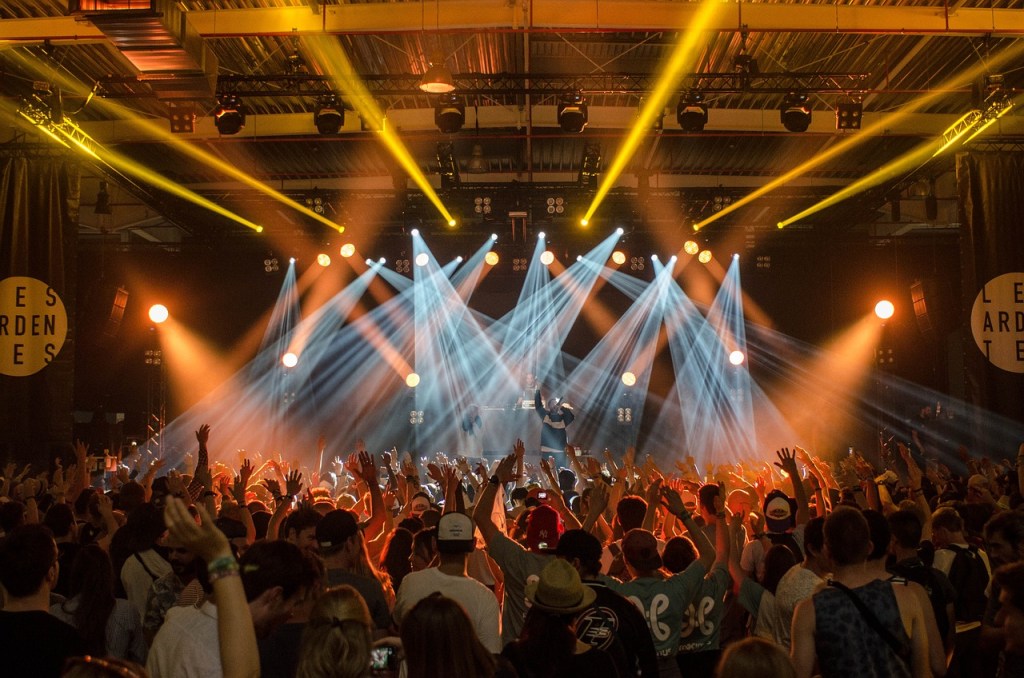
Adelaide has a rich history of live music, but international acts seem to make a habit of leaving our city out of their Australian tours. OTR journalist Jade Woollacott asks why this may be. (Image: Pexels)
By Jade Woollacott | @JadeWoollacott
When you search the drive time from Adelaide to Sydney, Apple maps suggests 14 hours. But really, it is closer to 20 hours when you take bathroom and food breaks into account. Give or take an hour or two.
How do I know this?
This is exactly how far I drove to see Harry Styles in concert early this year. Why not fly? Well, it would have involved incredibly steep airfares at the time, but that is a story of its own.
Jump forward to Accor Stadium. I am running on minimal sleep. I am exhausted from staring at the road for the last day and a half. I arrived in Sydney eight hours ago and will leave in 12. But this is okay. It is better than okay, because I am breathing the same air as Harry Styles.
Never mind my virtually non-existent savings, this seems to have become the norm for Adelaide concertgoers. As one of the lucky few who survived the Taylor Swift Eras Tour ticket war, this is something I will do all over again early next year.
This leads me to the question we have probably all asked ourselves: why do so many artists seem to skip over Adelaide on their so-called “Australian” tours?
Sick of spending copious amounts of money to travel interstate for such concerts, I decided this is something I would like to get to the bottom of.
Adelaide has always loved its live music. As the birthplace of world-class artists such as Cold Chisel, The Angels, Hilltop Hoods and Sia, we have a rich history of music. We are also, as of 2015, Australia’s only UNESCO City of Music. Adelaide prides itself as a cultural, creative hub. So, if we are already a globally recognised “City of Music”, what else must we do to attract the big names?
This year, Harry Styles, the Red Hot Chili Peppers and Lizzo have already stopped in Brisbane, Sydney, Melbourne and Perth on their Australian Tours. Paramore, the Jonas Brothers and Niall Horan will do the same for their 2023/24 tours, sans Perth. Taylor Swift is not even gracing Brisbane stages and will only be stopping in Melbourne and Sydney. And this is not even the full list.
I — and most people I discuss this issue with — find it particularly strange that artists frequently include Perth as a tour stop over Adelaide. Frankly, it stings a little. Only including Brisbane, Sydney and Melbourne is something I can understand. All of these cities are conveniently aligned along the east coast and have considerably larger populations. But Perth? I had always considered Perth and Adelaide to be one and the same. If it comes down to choosing between us and them, surely Adelaide’s closer proximity to the east coast would make us the obvious choice — right?
Well in reality, Perth’s population is approximately 670,000 more than Adelaide’s.
So maybe Adelaide and Perth are not exactly one and the same and maybe this explains why so many artists include Perth on their Australian tours. Although it seems like Perth is starting to befall the same fate as Adelaide. Still, it does not change the fact that Adelaide is missing out.
It is not as if we cannot accommodate the big names. Ed Sheeran, Lorde, Michael Bublé and The 1975 included our city on their tours earlier this year, with Sam Smith and the Foo Fighters set to visit in the coming months. Clearly, we are equipped to handle acts of such a high calibre when given the chance. So, what is the problem?
Surprisingly, when you type “Why don’t big artists tour in Adelaide?” into Google, the results are not vast. What does come up is mainly about the pandemic’s enormous impact on the live music industry. It is true, COVID-19 has had a massive impact on the live music scene Australia wide. But we cannot blame everything on the pandemic. Artists were skipping Adelaide long before 2020.
So, I thought the best place to start looking for answers to questions regarding touring in Australia would be an Australian touring company. Unfortunately, I never heard back.
Next, I considered venues. The places hosting such large artists and crowds must have some insight into why a lot of artists tend to skip over Adelaide. I got in contact with Adelaide Venue Management (AVM), which oversees the Adelaide Entertainment Centre, Coopers Stadium and the Adelaide Convention Centre. I sent through my questions and luckily, this time, heard back from the General Manager of the Adelaide Entertainment Centre and Coopers Stadium Kate Russo. She did not really give me any clear answers but did give me some things to think about.
Russo says touring schedules and travel times can be tricky to balance; so maybe this is why Adelaide often gets skipped over and Perth does not. She also posits that locals may be spending too much time thinking about what they miss out on rather than what they do not.
“We’re rightly quick to give ourselves a hard time when we occasionally miss out, but perhaps don’t celebrate our many wins as much as we should at times,” Russo says.
While I can appreciate this glass-half-full attitude, it does not feel like we are only occasionally missing out. We could simply put it down to our inherent nature as human beings to want what we can’t have, but I think there is much more to it than that.
Russo, however, does not agree with this supposed complexity, posing that “Adelaide does incredibly well for a city of our size”.
“We simply need to continue to show up for the artists … so they want to return,” she says.
In other words: keep doing what we are doing. But I would argue that what we are currently doing is not enough and that if we want to see change, we need to make change.
As a city that prides itself on its arts and creativity, I wondered if the government was doing anything towards this effort. And if in the wake of the hardest hit the live music industry has ever taken, the government is doing anything to help the industry that felt — and is still feeling — the effects of COVID-19 more than any other.
Last June, the South Australian Government announced See it LIVE: a $10 million package geared towards supporting the recovery of local musicians and venues in the wake of COVID. As a part of the package, the ‘Premier’s Live Music Advisory Council’ was announced and officially formed in March this year. This is a council whose sole purpose is to, as the name suggests, advise the government on the live music industry. Comprised of local venue owners, promoters, musicians, producers and people who have a wealth of experience in the music industry, the council’s diverse 12 members offer perspectives on virtually all facets of the industry. Any one of these people, I thought, might be able to give me some answers.
I was fortunate to be able to chat with the council’s chair, Christine Schloithe, who also happens to be MusicSA’s CEO. Schloithe has worked in the music industry in some capacity for virtually her entire career. She studied technical production for theatre and did tech work for bands at night to pay the bills. Schloithe has toured the country as a roadie and worked in theatre, specialising in cultural festivals such as the Adelaide Fringe. More recently, she was working in the state government’s arts and culture sector until she moved into her current role at MusicSA just over a year ago.
So, in other words, if there is anyone in Adelaide who might hold some answers to my question, it would be Schloithe.
My question, she says, is a complicated one with “a lot of moving parts”. Based on my lack of answers so far, this is what I had anticipated. Although, she says it was not always this way. There was a time, decades past now, when big contemporary acts like U2 and Midnight Oil frequented Adelaide.
Schloithe says one of the biggest determining factors in whether artists visit a city is ticket sales, or more importantly, pre-sales. This makes sense; artists must be able to guarantee they will have an audience to play to. And the fact is, Schloithe says, “Adelaide has always been a bit lazy about its ticket purchases”.
We’ve all been guilty of it: “They won’t sell out. I’ll get a ticket later”.
But if we want more artists to include us in their tours, we need to show them the demand is there.
However, the blame is not all on us, the audience. Schloithe says we have a huge discrepancy in venues.
“Adelaide… doesn’t have a large-scale venue that works for a lot of artists,” she says.
While we do have Adelaide Oval, which can accommodate an Ed Sheeran-sized crowd, Schloithe says it is not a venue that was really designed for music. Our next biggest venues are Coopers Stadium and the Adelaide Entertainment Centre, which she says are not really cutting it anymore.
They simply do not have the capacity for such enormous crowds, Schloithe says. Therefore, if an artist does not, for instance, want to play at Adelaide Oval, or cannot because it is already booked, their only alternative would be multiple shows at a smaller venue like the Entertainment Centre, which is “just not financially viable”.
One large-scale venue, which does not compare to the size of interstate stadiums and is already booked for sports for six months of the year, is not enough.
Shloithe says it can also just simply come down to scheduling. Sometimes stopping in Adelaide between the Eastern Seaboard and Perth does not line up, because while to us it may seem like a small detour, it can add multiple days to a tour. Add to that Adelaide’s venue availability (or lack thereof) and we really do not stand much of a chance. While we hate to keep hearing about it, COVID-19 really has changed the way artists tour. Costs for everything are extremely high, Schloithe says, and the added shortages of labour and equipment mean artists are being extremely selective with their touring schedules.
While scheduling and new venues might be out of our control, we can help change this narrative in our own way. We can start showing up. We can prove there is a demand for live music in Adelaide and that if artists do include us, we will be there. We can buy the tickets early and show the government there is a need for more venues.
Yes, we are in a cost-of-living crisis. But we do not have to be coughing up hundreds of dollars every month to go and see the big names. We can support our local acts to prove the demand is still there.
And with someone like Schloithe chairing the Premier’s Live Music Advisory Council, whispering in the government’s ear, maybe change is not too far away.
 ontherecordunisa.com