
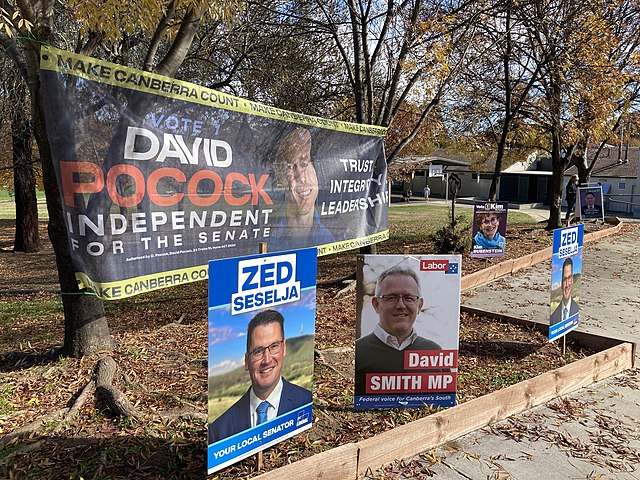
The South Australian Parliament has enacted a ban on the display of election corflutes on public infrastructure, citing environmental concerns, visual pollution and safety. But the ban isn’t that simple. (Image: election corflutes in a park in the ACT. Sourced from Nick-D, licensed under CC BY-SA 4.0)
By Robert Hicks | @_roberthicks
Displaying election advertisements on public infrastructure is a thing of the past in South Australia under law changes targeting corflutes (plastic election posters) came into effect on February 21, 2024.
The Electoral (Control of Corflutes) Amendment Bill 2023 amended both the Electoral Act 1985 and the Local Government Act 1999 to ban the display of all electoral advertising on public roads, infrastructure and in road-related areas.
Road-related areas are defined in the Road Traffic Act 1961 as footpaths, nature strips, and areas that are not roads which are open to the public and designated for use by cyclists or animals.
Breaking the law will result in a $5,000 fine.
The law does not restrict displays on private property.
The bill confirms that the public can reuse electoral posters for protests on public property and carry electoral advertising posters in public.
Additionally, a limited number of A-frames at events such as community fairs or polling days are allowed.
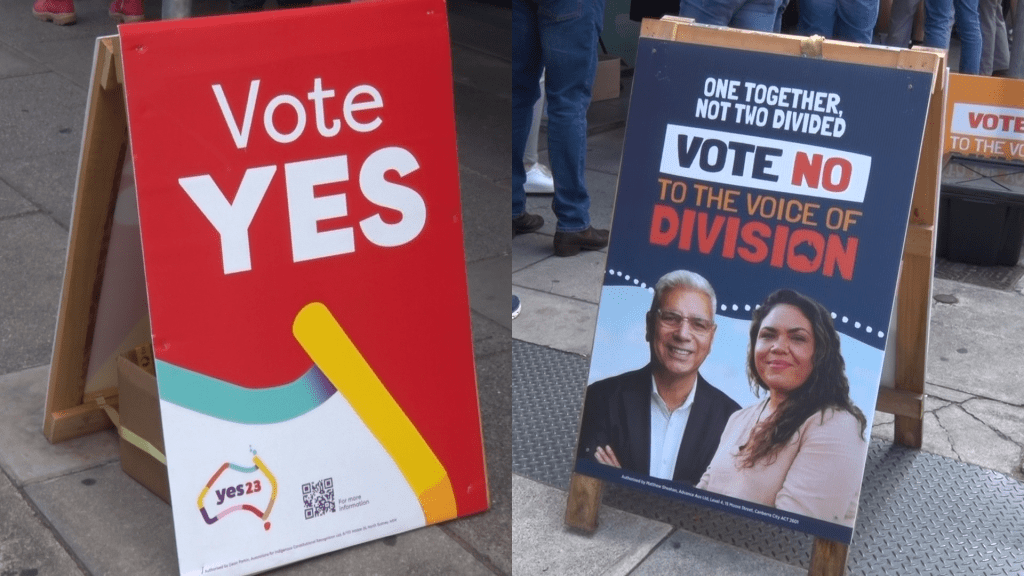
A-Frames displayed during the 2023 Voice to Parliament Referendum (source: Robert Hicks)
At polling booths during state elections, a limit of 12 posters per candidate running for election in either the House of Assembly — the lower house — or the Legislative Council — the upper house — will be allowed.
This limit will be in place during the Dunstan by-election on March 23.
The Australian Electoral Commission has confirmed that these restrictions will not affect federal events.
In essence, these laws mean political parties, who often run candidates in both houses, can put up 24 posters at polling booths during state elections, whereas independents, who can only run in one of the houses, are limited to 12.
This disparity was discussed amidst a failed amendment introduced by SA-BEST MLC Connie Bonaros, to rectify what she saw as disadvantageous to independents.
“There is no reason why an Independent person running for election should be disadvantaged by comparison to either of the major parties or, indeed, any of the minor parties,” she said.
However, University of Adelaide Professor Clement Macintyre says corflutes don’t sway the minds of voters.
“I think having 12 there was put into the bill to reassure some anxious members that a few pictures could go up to remind voters,” he said.
“But I don’t think corflutes made a huge difference to start with.”
University of Adelaide Professor Lisa Hill also noted that the price of corflutes already posed a barrier to entry, and the limit levelled the playing field.
“It is unlikely that this would disadvantage [minor parties and independents] because corflutes are expensive and small parties have less money to spend on them than bigger parties,” she said.
Green credentials?
Corflutes are a corrugated lightweight plastic utilised as signage because of their durability in a range of weather conditions, including hot summers and wet winters. Some are UV resistant, preventing fading.
In essence, they are the perfect material for a temporary sign. Conversely, they are anything but perfect for the environment.
Due to how they are displayed, other plastic waste by-products are generated, including plastic zip ties used to affix them to infrastructure.
While some politicians and candidates reuse previous corflutes, many do not due to the nature of politics; attack lines and slogans change each election, alongside candidates in most cases, says Leader of the Opposition David Speirs.
“Some members do re-use them but many do not, and the ones that have single messages associated with elections, of course, do not get re-used again,” Mr Speirs said in parliament
Attorney General Kyam Maher said that, while election advertising will still be present at polling booths, it’s possible that they will be made of an alternative material someday.
“In terms of Green credentials, I am sure we might even see the Greens having their posters on some sort of hemp fabric or something else in the future,” he said.
Delay, delay, delay … pass!
Although passed last month, the bill is not new, having been introduced in May 2023 by Mr Speirs.
The 2023 bill traces its origin to an earlier bill introduced during the middle of the Marshall Liberal Government’s term in 2020.
That bill was curtailed by a single vote due to more significant efforts at electoral reform, namely introducing optional preferential voting in the lower house.
After the current bill was introduced in May, it was delayed ten times until February 7, where, on ABC Radio Adelaide, Deputy Premier and Environment Minister Susan Close indicated her personal support and noted it may come to an internal Labor party discussion that day.
“We’re going to have to work quickly, but we’ll have some internal conversations this morning and see what we can do about that,” the deputy premier said.
Work quickly they did.
The bill breezed through both houses of parliament and passed the next day.
Despite the lengthy delay in debating the bill, Mr Speirs said he was delighted it had finally passed.

Leader of the Opposition and Leader of the SA Liberal Party David Speirs (source: Government of South Australia, licensed under CC BY 3.0 AU)
“This has been something that I have been advocating for, for the best part of five years now. I think it is fundamentally in step with the views of the South Australian public,” Mr Speirs said.
“They generate tonnes of single-use plastic pollution every electoral cycle, and their time has come.”
Safety and visual pollution were other motivations for the ban passing.
“It has been pointed out by many that they are often a danger and a distraction while driving on our local roads,” Shadow Treasurer Matt Cowdrey said.
“In a view to find a way to make the amenity of our suburbs better, it would make sense to not have these up anymore.”
Volunteers climbing ladders to put corflutes onto high-up Stobie poles was mentioned as a risk by Infrastructure and Transport Minister Tom Koutsantonis.
“I am surprised that no-one has been killed putting up election signs,” he said.
“It is dangerous and we should not allow it, so I think this is a good improvement for the people of South Australia.”
 ontherecordunisa.com