
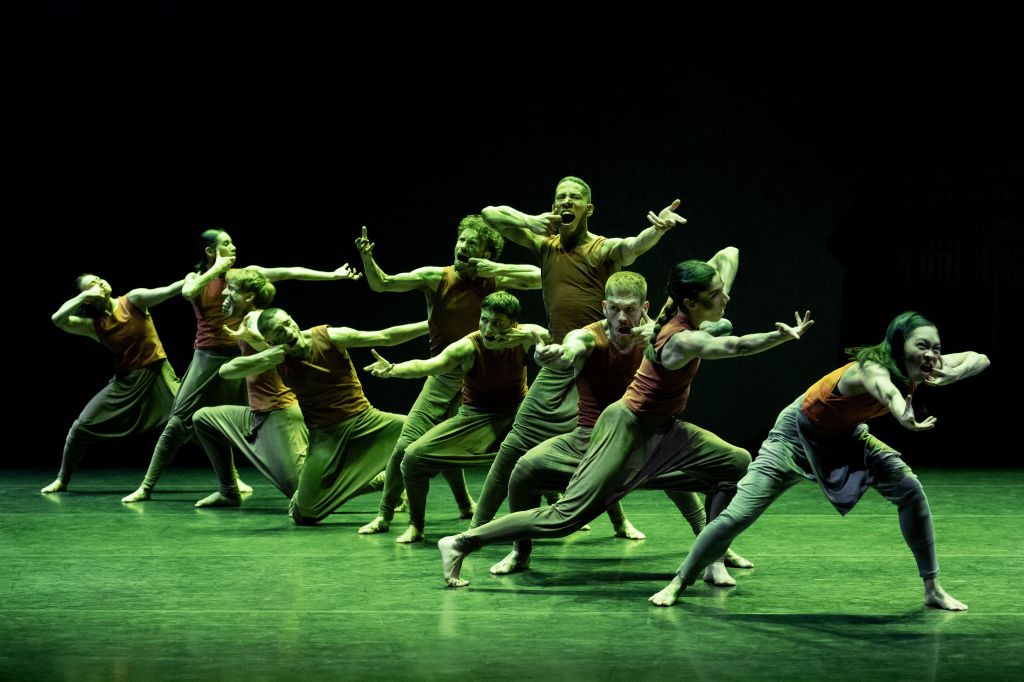
Akram Khan Company‘s Jungle Book reimagined deservedly received a standing ovation during its Adelaide Festival run as its critiques on climate change hit close to home. (Image: Camilla Greenwell)
By Jade Woollacott | @JadeWoollacott
Akram Khan’s London-based dance company brought their take on the Walt Disney classic The Jungle Book to the Adelaide Festival for its closing weekend.
This reimagination takes the original story, sets it in the 21st century and doesn’t shy away from the hard-hitting issues the present entails.
The performance centres around humankind’s disruption of nature, utilising climate change as a motif throughout its entirety. Sea levels surge to inhabitable heights and force humans from their homes in favour of higher ground.
While the dancers’ animalistic movements do a lot to bring the story to life, intentional lighting, graphics and a perfectly considered score all work together to transport the audience to the apocalyptic world Khan creates.
Deviations from the original tale begin as soon as the performers take centre stage, but the bones remain. A young girl, Mowgli, has been displaced from her family and is taken in by a pack of wolves. But she did not appear out of nowhere; she was lost to the rising sea as her family fled on rafts and pontoons.
The audience is presented with a mirage of the world’s greatest wonders – the Eiffel Tower and Big Ben – as they too become lost to rising sea levels. At this stage in the performance, the audience is unsure of what exactly is going on, but as Mowgli drifts through the water it becomes abundantly clear.
The ocean is almost black. Rubbish and debris litter the water: a dirty mask. There has been no dialogue save for scared, distant murmurs and a montage of news reports. Greta Thunberg’s voice cuts through them all. “How dare you,” echoes throughout the theatre, along with other grabs from her infamous speech.
Instead of shaking trees for fruit and relying on “the bare necessities”, animals scavenge for food in abandoned supermarkets. Instead of a lavish, vibrant jungle, cardboard boxes and rubbish litter the background of each scene.
The dancers are so convincing in their animalistic movements that it is easy to forget they are human. Their strong lines and sharp movements effectively differentiate them from the clean, fluid movements of the only “human” dancer.
As can be expected from a dance company, much of the storytelling is visual; however, the original score fills in any blanks the audience might have. Dramatic drums, impactful strings and perfectly toned vocals build to a crescendo at points and pull back at others with the push and pull of the narrative.
Dialogue is embedded within the score and, although it is sparse, it facilitates the storytelling and helps the audience to follow the narrative. Yet, most of the meaningful communication between the animals and the lone human occurs through their movement, particularly when they move together as one.
All these elements work together to create a powerfully emotive performance. Such impactful, pressing topics are confronting, disturbing and, above all, saddening. Yet the audience is still made to smile and even laugh at times.
Jungle Book reimagined is a performance truly deserving of a standing ovation.

 ontherecordunisa.com