
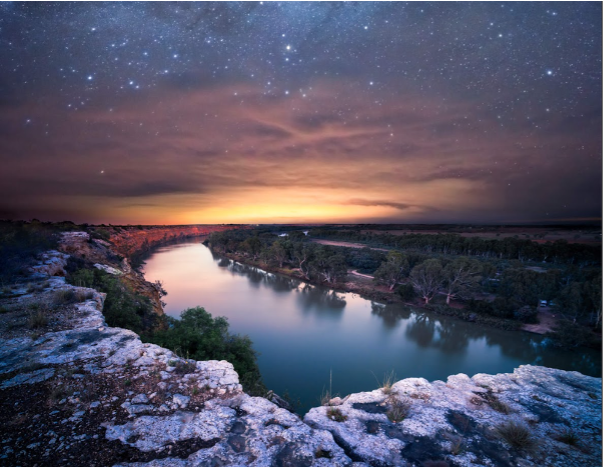
South Australians can visit one of the darkest skies in the world located only a 90-minute drive south-east of the Adelaide CBD. While the sky may be the main attraction of the region, it is its community that shines through. (Image: Kelly Khun)
By Jess Smith | @jessmurraysmith
My phone pinged at 10am with a message from owner and tour operator of Juggle House Experiences, Kelly Khun. The text read: “CONFIRMED, Dark Sky Tour tonight.”
I had waited over a month for a chance to see the River Murray International Dark Sky Reserve as issues with cloud coverage had delayed the trip.
Mannum
After the short drive from Adelaide, I arrived in Mannum where we were set to meet. The rapid change from rolling hills to a bustling main street lined with buildings gave me a sense of refuge, as if I had stumbled upon a desert oasis.
The River Murray International Dark Sky Reserve achieved its “dark sky” accreditation in 2019, marking the area that spans 3,500 square kilometres of the River Murray, Riverland and Barossa Valley regions as one of the 21 darkest skies in the world.
When I spotted Kelly, who stood waiting in front of a black, star-speckled van, I knew for certain that I was in the right place. She made introductions with myself and the two couples who would be joining us for the six-hour tour as we climbed aboard the van to escape the intense Mannum spring heat.

On the road near Mannum, South Australia (Image: Jess Smith)
As the reserve had to close shortly after its accreditation for the pandemic and the Murray River floods, we are among the first 3,000 people to take the tour. While the tourism destination is still in its infancy, I thought to myself how effective its pull of astro tourism could be for a rural location like the River Murray.

Juggle House van (Image: Jess Smith)
Tourism Development Manager of Murray River Lakes and Coorong, Bill Nehmy, sees the Dark Sky Reserve as an international pin on the map.
“I believe that astro tourism has a huge potential not only in our own region but, that it’s a big game changer with the opportunity for the state and Australia itself,” he said.
Nehmy believes if the market can be utilised to its fullest potential it would benefit the growth of the entire region. This is why many of the advertisements for the Dark Sky Reserve highlight other local tourist attractions such as Monarto Zoo and The Bend.
As we left Mannum, Kelly gave us a rundown on how the day would play out. There was potential for poor weather and cloud coverage: not optimal conditions for stargazing.
She popped open a bottle of bubbly for her guests as she explained the constant battle her tours have with the weather.
As cloud coverage makes stargazing nearly impossible, Kelly and her team have to carefully assess every forecast before they confirm each tour. Cloud movement can be unpredictable and requires a trained eye on a radar to determine whether stargazing is possible.
Regardless of this, Kelly said the astronomy aspect of the tour is only the “icing on the cake”.
“You definitely get to eat the cake and hopefully we get some special icing at the end,” Kelly said.
I found this sentiment puzzling. How could the stars and their visibility only be the “icing on the cake” when that was the entire reason we were there?
As we began our journey, Kelly gave an induction on the area and local towns. As we got acquainted we drove past the first sign for the reserve: “International Dark Sky Reserve, enjoy the stars.”
Forster Lookout
Forster Lookout is situated on the cliff face of the Murray River and has views of the horizon that stretch across kilometres of farmland.
Just below the cliff face, wetlands bordered the river, which Kelly said locals describe as the “lungs” of the Murray — largely because they are vital for the breeding of local species.
Birds were high in the sky and pelicans glided across the water in search of fish. It may have been the starry sky that had attracted us to Kelly’s tour, but the diverse experience of sights on the ground had already given us an experience that felt like much more.
I was starting to understand the metaphorical cake I had begun to eat.
“It’s a great opportunity for people to bond. The nature of the tour; it’s very intimate. It’s a great way to show tourists the culture of the region,” Kelly said.
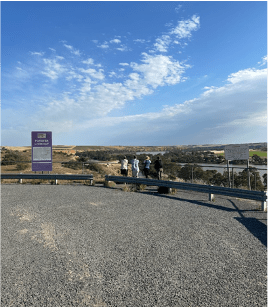
Juggle House Experience guests at Forster Lookout (Image: Jess Smith)
As we departed from Forster Lookout, we passed a small old building on the side of the road. Kelly explained it had recently been bought and renovated by a young couple.
During the renovations they added a small spa that sits close to the side of the road, which they named “Spagazing” in tribute to the Dark Sky Reserve.
This is not the only instance of local communities embracing the Dark Sky Reserve. Kelly also mentioned artwork that has been erected on the Mannum Pipeline and at the Swan Reach Hotel as just one example of the ways the surrounding communities celebrate the “dark sky”.
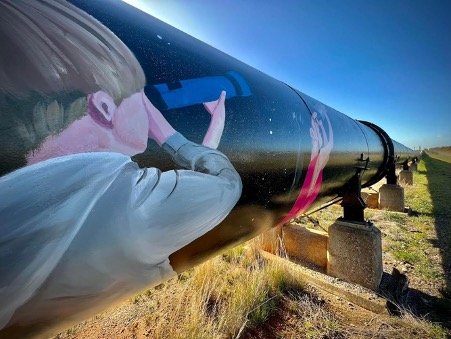
Dark Sky Reserve mural on the Mannum Pipeline (Image: Kelly Khun)
Founder of the Dark Sky Reserve Chris Tugwell began the application for accreditation to help generate funds for land care in the area. After almost four years of working with the council and astronomers, and lodging a 400-page application, they finally received their accreditation.
He said he never could have envisioned the impact the reserve has already had on the local community and how much it continues to grow its influence.
“It’s not just about tourism. It’s about [the local community] finding their own culture again and restoring it and preserving it. That’s been a really lovely side effect,” Tugwell said.
Swan Reach Hotel
The van weaved its way along the riverbank of the Murray River as we travelled towards the Swan Reach Hotel. On our way, we made a quick stop at the Big Bend lookout: one of the more notable attractions along the river.
Media often take advantage of the stunning views of the golden cliff faces when documenting the area, which Kelly explained are the sheerest and longest stretches of cliffs along the Murray River.
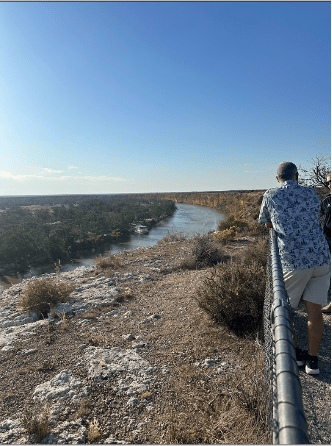
Big Bend Lookout (Image: Jess Smith)
The “Proud Mary” docked below provided a picturesque photo opportunity. The river cruise does two-, five- and seven-night tours of the Murray, which Kelly assured us are very indulgent experiences for guests to enjoy the peaceful bliss of the river and its surroundings.
Yes: that does also include an opportunity to view the night sky.
At the Swan Reach Hotel, Kelly delivered a presentation about the reserve that captured its development process and the positive impact it has had on the local community and small businesses.
The group took a moment on the balcony to enjoy the sunset. It was almost time to experience one of the darkest skies in the southern hemisphere, but not before one last stop.
Ngaut Ngaut
Located just outside of Nildottie, the Ngaut Ngaut Conservation Park has documented occupation by the Nganguraku people dating back over 8,000 years.
The sacred site is positioned along the cliff faces of the river and is home to many ancient Aboriginal carvings and Dreaming stories.
We were greeted by Nganguraku Elder Aunty Ivy, who took us on an hour– long tour of her Country.
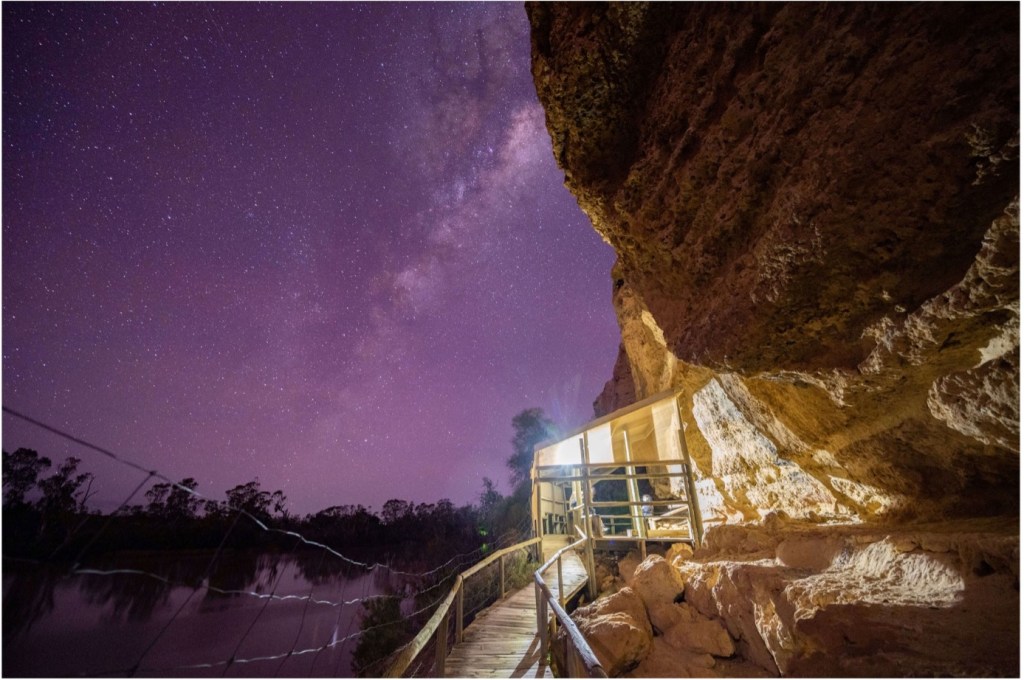
Ngaut Ngaut sacred site (Image: Kelly Khun)
Before we began, Ivy stopped us at the entry to the site and urged us to close our eyes to be present with the wilderness.
As Ivy guided us through Ngaut Ngaut, she explained the stories of her ancestors who lived in camps at the bottom of the cliffs. Their knowledge of the area, which has been passed down through generations, was made evident by Ivy’s deep understanding of every intricate detail of the environment.
She showed us a hollow tree that would have been stripped back to make canoes and a small berry tree that was used medicinally as nature’s very own laxative. Every part of the environment served a purpose and its resources were utilised meticulously so they could be sustained.
Ivy lead us to the rock carvings etched into the bottom of the cliff face. Each one has a story and Ivy knows them all. There are carvings of the night sky imprinted on the cliffs, indicating that the Nganguraku people are some of the earliest astronomers in human history.
As she concluded the tour, Ivy said she believes the site belongs to every Australian who chooses to respect it.
“If you call yourself Australian then this site is also yours; we just look after it,” she said.
Walkers Flat
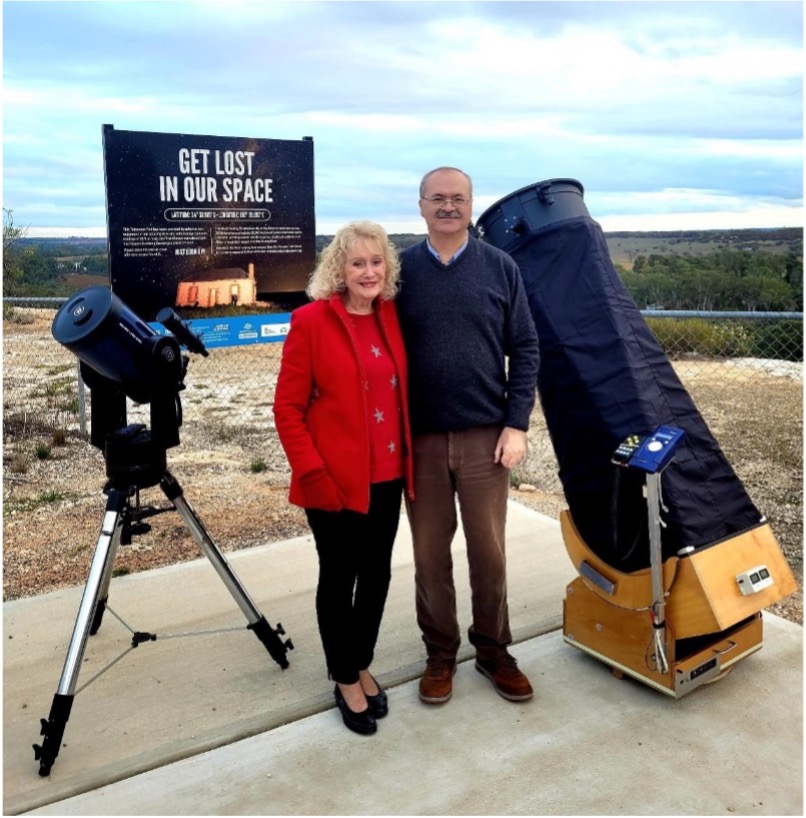
Joe and Lyn Grida with their telescope (Image: Joe Grida)
Finally, we arrived at our final stop in Walkers Flat where astronomers Joe and Lyn Grida were set up and awaiting our arrival.
By now the sun had disappeared below the horizon and as we approached the meeting spot Kelly said her fears of bad weather had come to fruition.
“We need to hope for a bit of luck and hold some faith it will clear up,” Kelly said.
Mr Grida already had his telescope aligned waiting for a break in the clouds to see Saturn. Unfortunately, the weather was not cooperating. The wind increased to a loud howl as we all stood around with the hope that we would get an opening to see the stars.
After waiting for almost an hour, our optimism was not rewarded and the opportunity had passed for the night. Kelly was very apologetic and began organising new dates for us to come back for the astronomy viewing.
I thought there may be a hollow feeling amongst the group if the inevitable did become a reality; however, everyone’s spirits were unphased.
Kelly said it from the beginning: the daytime tour was the metaphorical cake and the astronomy would be the icing on top. She had proved herself right by the end of the night.
We may not have had the icing on top, but we still had a full serving of cake. Beautiful destinations, fascinating cultures, caring communities and educational experiences made this six-hour tour worth every second.
As we finish the tour, I chat with the four other guests about what led us to meet here today. One couple are from North Carolina in the USA while the other couple are from Far North Queensland. The chances of us all meeting and becoming acquainted would be zero if it wasn’t for the reserve.
There was a clear bond within our group as we returned to where we started six hours ago. The experience brought us all together and gave us a true taste of rural Australian culture.
I find it remarkable that such a small section of sky in outback Australia is capable of connecting people from all over the globe; it truly earns its status as an International Dark Sky Reserve.
 ontherecordunisa.com