
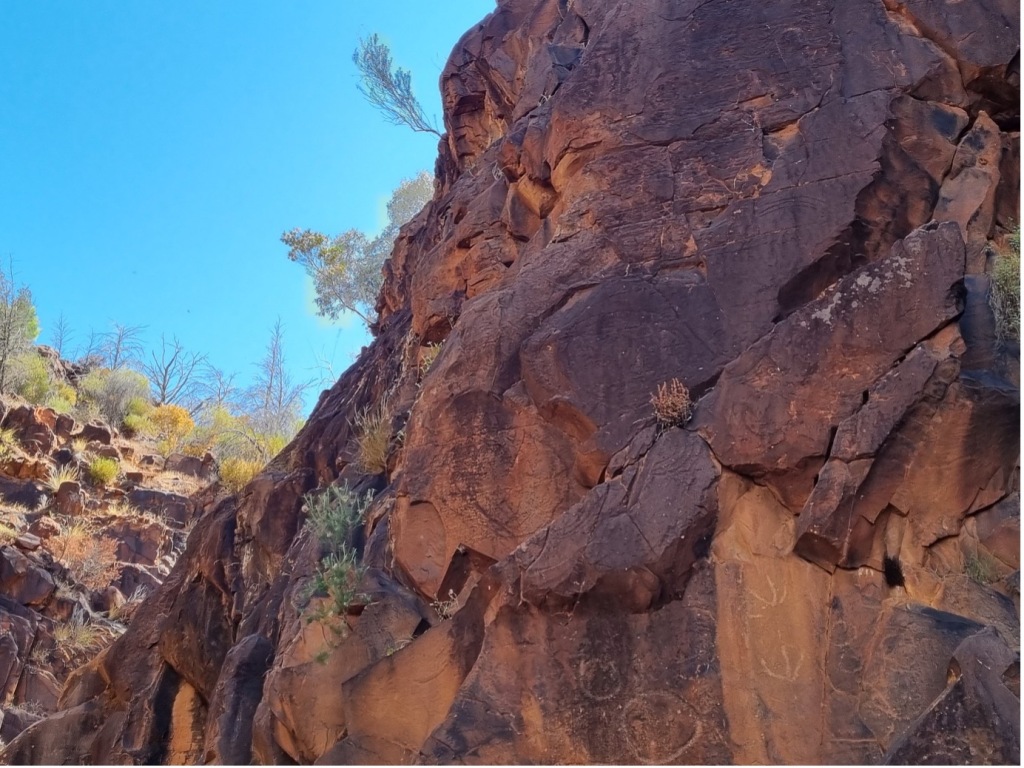
Ikara-Flinders Ranges National Park in northern South Australia is home to the Sacred Canyon: a site rich with the culture and history of the Adnyamathanha people. (Image: Jacob Stevens)
By Jacob Stevens | @jacobstevens__
“Sacred. What does sacred mean to you?”
There was an apprehensive silence. Nobody wanted to say the wrong thing.
We were in the Ikara-Flinders Ranges National Park 400 kilometres north of Adelaide.
More specifically, we were at the end of the Sacred Canyon, a site of spiritual significance for the local Adnyamathanha people that can only be accessed on an Adnyamathanha guided tour.
Surrounding us was a mighty wall of rock, five or so metres tall, its red surface a stark contrast to the blue, cloudless sky.
River red gum trees dotted the top of the wall, with some so brave as to sprout from the bed of the dried up creek itself.
Our group of ten tried to find what little shade we could to escape the torture of the mid-afternoon sun. Flies, seemingly in their millions, swarmed my face: no amount of swiping or swatting helped.
The walk so far had been fairly easy, but nonetheless gruelling in the 30-something degree heat.
Our guide, an older Yura (the name given to Adnyamathanha people living on Country) man by the name of Mick, looked unphased.
“Don’t be scared. Can’t be wrong,” he said.
A brave American tourist chimed in: “Sacred to me means something with a special meaning or purpose.”
“Okay, great. What about secret?” Mick asked.
Again, silence settled over the group, the only sound was the wind as it whistled overhead.
The same American spoke up again: “A secret is something you don’t tell anyone.”
Mick gave a small nod. Not one that suggested the American was right, but one that showed he acknowledged the answer.
The interrogation continued.
“Do you see why I’m asking these things?” Mick asked.
We could not. At least, not yet.
“Oh never mind. It will all make sense later.”
Our journey had started a few hours earlier, in a truck parked just outside the Wilpena Pound Resort Visitor Centre.
Mick invited me to sit next to him up front. Sweet relief for me: I had an air vent blowing cool air directly into my face.
It was obvious just how well, as a Yura man, Mick knew the land: the Country known in Adnyamathanha language as Yura Mulka.
His weathered hands danced across the steering wheel as he drove our group towards the entrance of the Sacred Canyon site, avoiding the potholes in the washboard gravel track as he smoothly changed between gears.
It was an almost subconscious display of his intricate knowledge of this place.
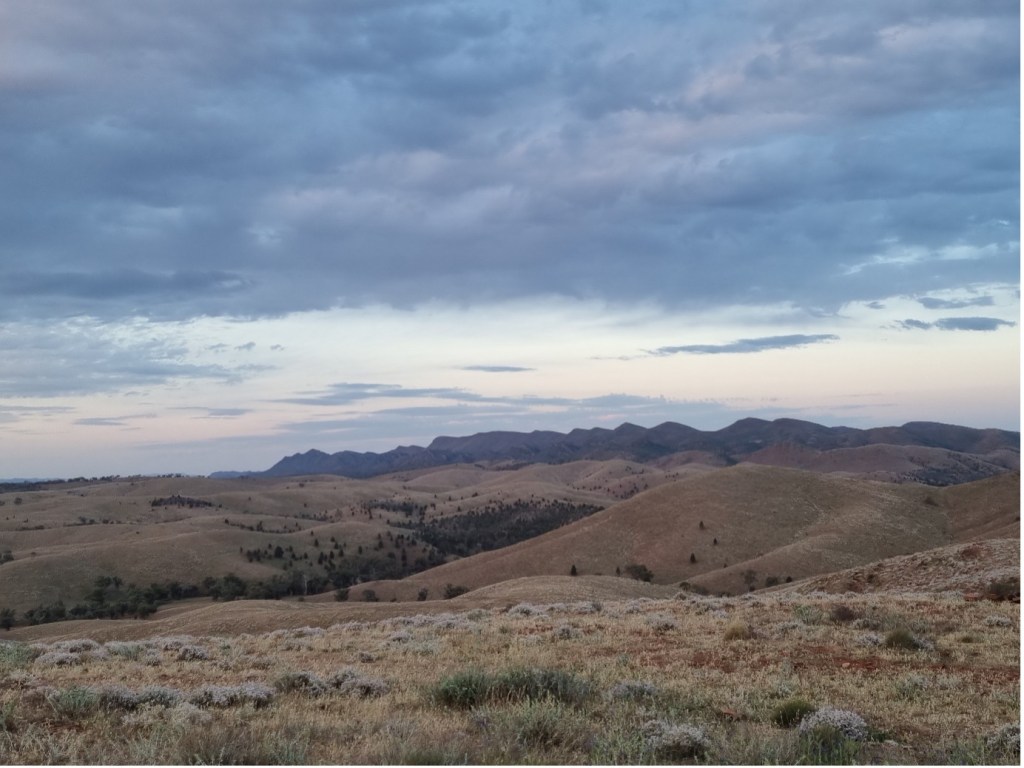
The landscape itself was remarkable.
Harsh rock formations jutted from the dry, dusty earth.
River red gums were dotted sparsely, increasing in density as we crossed various ephemeral creeks that cut their way across the horizon.
Large red kangaroos lounged in vivid purple, yellow and white wildflower, which carpeted the ground thanks to recent rains.
Mick suddenly slammed on the brakes, the truck creaking and groaning under its own weight. A small bearded dragon scurried across the track in front of us.
“Sorry about that,” Mick said through the truck’s tannoy system.
“There was a little beardie.”
As quickly as Mick got the truck back up to speed, he stopped it again.
This time, a large metal gate blocked our path. A reminder of humankind in an otherwise arid landscape.
“This is your job.”
Mick motioned towards the gate as he handed me a small green tag with a key attached.
“Why do you think I got you up the front?” he chuckled.
The gate was also a reminder of humankind because of its raison d’être. In April 2020, the South Australian Department for Environment and Water announced that there would be restricted access to the Sacred Canyon, which was previously open to the public.
National Parks and Wildlife Service spokesperson Stuart Paul said that it was a necessary measure to secure the future of the site.
“Sacred Canyon is an area of great cultural significance to the Adnyamathanha people and is part of our national heritage, containing some of the oldest rock engravings in the world,” he said.
“It’s essential we preserve these ancient engravings so the Adnyamathanha people and future South Australians can continue to learn about our cultural heritage.”
I couldn’t quite understand just how necessary this measure was. It’s in a very remote location: a long drive across rough terrain and then a fair walk along a sandy, crumbling riverbed to reach the end.
Mick assured me that it was necessary.
This became obvious when we finally reached the Sacred Canyon site.
Right at the start of the trail was a small wooden information board, faded and weathered in the sun.
It was the only written information at the site. Everything else had been passed down through stories over many generations.
A few minutes into the walk, Mick stopped and pointed at a carved circle, a clear white against the red rock all around us. It was the first carving we had seen on the walk.
He traced the circle with his index finger, carefully so to not touch the carving itself.
“This here catches your eye, doesn’t it?” Mick said.
“It’s so well defined because people used to come here and do this – do what I’m doing.” Again, he traced the circle with his finger.
“They wanted to show people the carvings, but over time they wore away the original. This is vandalism. It’s a forgery.”
And this vandalism is exactly the reason for the gate. It’s not vandalism in the inner-city sense of graffiti and spray paint, but rather the wearing away of the original artwork, whether through malice or ignorance, to make it more visible.
From this point on Mick told us to keep our eyes open: to not be drawn to the obvious, but to look instead for the fainter carvings.
These, he assured us, would be the originals.
As we wound our way further along the canyon’s path, navigating tricky loose rocks and deceptively crumbly ground, we kept our eyes peeled for these carvings.
Every now and again I found myself looking at portions of rock that were entirely empty, hoping to see something the others had missed.
But before long, we came to a dead end—the end of the canyon itself.
Before us was a great wall of rock. It was unbroken save for a small sandy crevasse made by the flow of the creek that, over thousands of years, had formed this canyon.
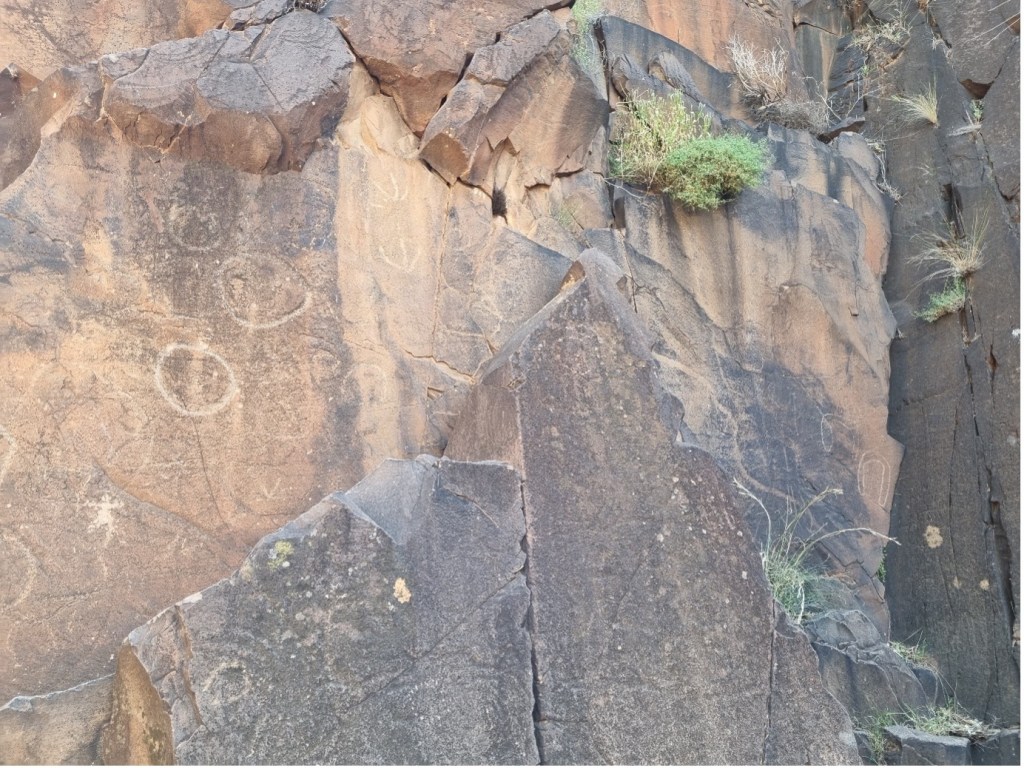
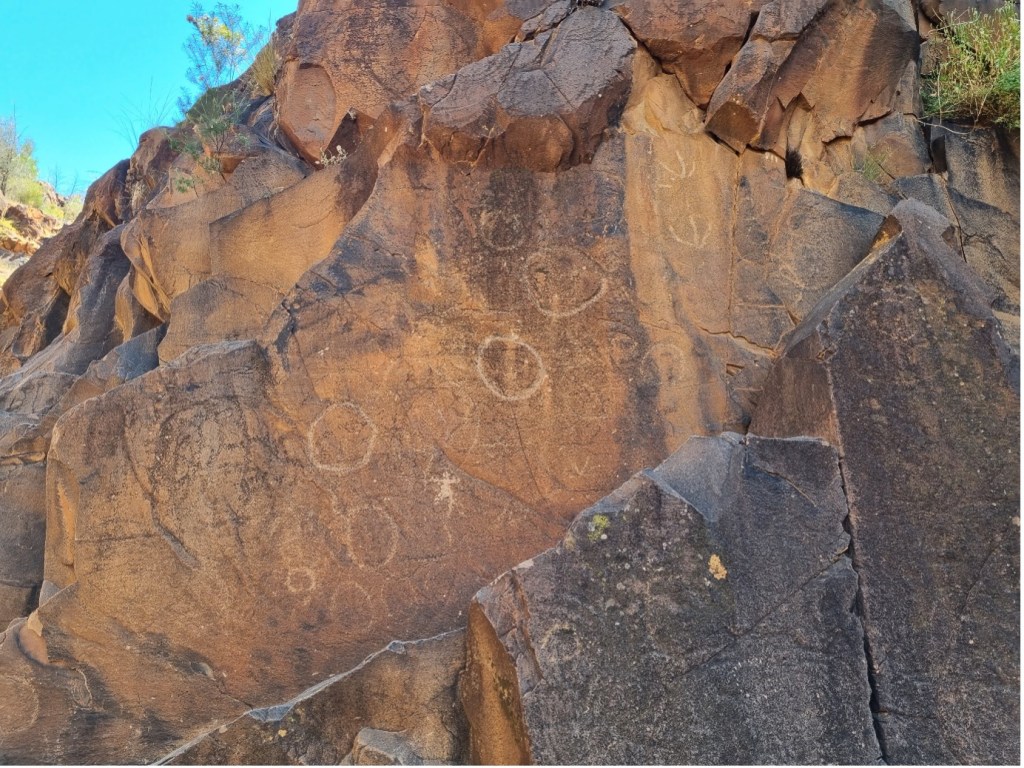
It was covered in carvings and symbols, from eye level reaching up into the sky.
Circles formed the backbone of many of these carvings: semi-circular arches and horseshoe-shaped carvings represented shelter and windbreaks; numerous concentric circles denoted waterholes; a singular circle outline was a camp; and a circle outline with a dot in the middle was an oven.
The very top of the wall, some five or ten metres up, had some of these carvings.
It was almost baffling to see; how could someone have reached up that high, or rappelled themselves down from such a height, to carve these symbols?
At this point Mick grabbed the broken branch of a nearby river gum from the ground and pointed towards the western part of the wall.
He traced a faint line, visible to us only now that he had pointed it out. The line started about a metre from the ground, and continued up the wall past what the eye could see.
The sheer scale of this one continuous carving was as intimidating as it was fascinating.
“To me,” Mick said, “this one is the most important.”
“Scientists like to debate how long we’ve been here for. Was it 30,000 years? Sixty? Well, this is one line that we have maintained. Think about how long it must have taken to form this canyon. And then look at this line.”
It made sense. This line served almost as a calendar — a timeline of the Adnyamathanha people’s history in this region.
The beginning of the line wasn’t, as we’d thought, at the bottom of the wall: it was at the top. And as erosion wore down the rock to create the canyon, the Adnyamathanha continued the tradition of carving the line.
“I show people this, and usually they say, ‘Oh that means your people have been here for so many thousands of years.’ Why does it matter? Why can’t we just say we’ve been here since the beginning?”
This put into perspective the scale of the artwork before us.
It wasn’t large simply in the amount of rock face that it covered, but also in that it had traversed tens of thousands of years to get to this point.
Mick let us ponder that thought for a brief moment, before turning and pointing out another hidden piece of art. This was something I had spotted before, but I couldn’t tell, at the time, exactly what it was.
With a wave of Mick’s stick, it all became clear.
“A tail, a leg, a head,” he stated.
“It’s a lizard. A goanna. And just below it…”
He pointed at an adjacent carving: an outline of a circle with a filled in dot in the centre. It was an oven.
Mick turned to face us, a large grin upon his face. He had one last question for us.
“If you go somewhere and they give you something that lists food and how it’s cooked, what do you call that?”
“A menu,” I answer.
Mick nodded again. This time it wasn’t just to acknowledge, like it was earlier with the American, but instead because there was a correct answer—and I was right.
“It’s quite possibly the world’s oldest menu,” he added.
It was kind of funny.
These carvings we had strained our eyes and necks to spot were not just telling stories. They were not just a historical timeline. They were glimpses into the culture and habits of the Adnyamathanha people.
As it turns out, that’s why Mick had asked what we understood “sacred” and “secret” to mean. It was a subversion: it challenged our preconceived notions of what those words attached to a place meant.
It also put the relationship between Aboriginal culture and modern tourism into perspective.
The gate was a necessary evil, and the subversion of our understanding of sacredness merely displayed the ignorance that, despite even the best of intentions, still creeps subconsciously into nearly everybody’s mind at some point.
And for Mick, making these experiences accessible is the best way to combat ignorance.
“I want a virtual experience, one where people can see the canyon, they can hear the wildlife, they can hear me telling stories,” he said.
“The best way to learn is to experience. I want to give the chance for people who can’t access it to experience it.
“That’s what I see as the future.”
 ontherecordunisa.com