
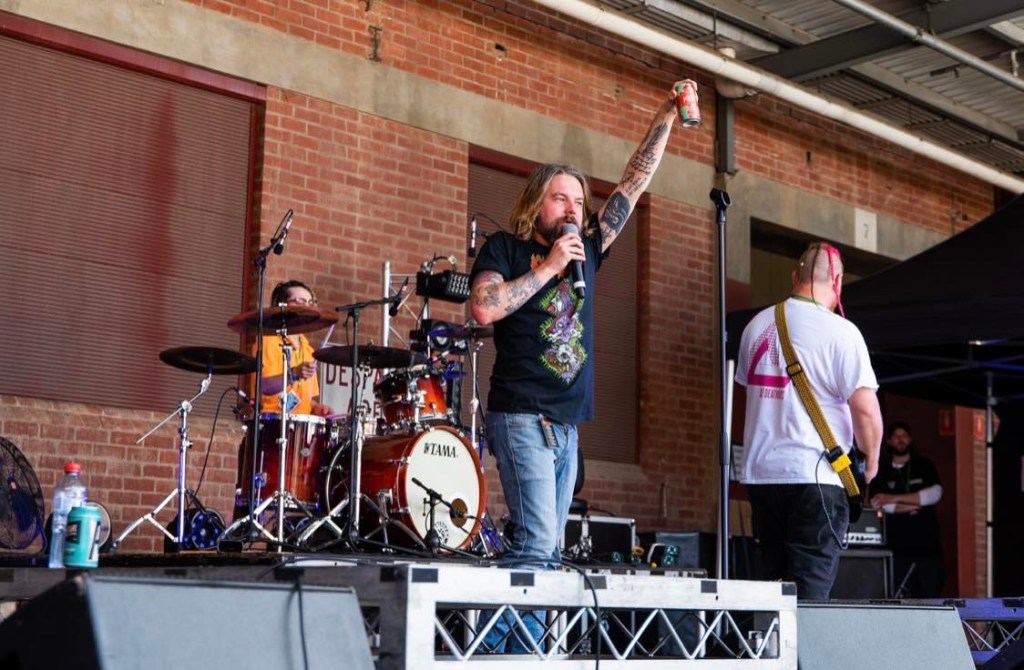
“There’s a whole world out there, just try and experience it. There’s nothing wrong with hitting a speed bump and trying something else once even if it doesn’t work out.” Will Oakeshott reflects on an eclectic career in music. (Image: Dave Rubinich)
By Chelsea McLean | @chels.mclean
Trapped in an endless cycle of daytime work and nocturnal writing sessions, Will Oakeshott quickly realised that sleep was no longer an option to make a name in music journalism.
Sitting opposite me on an outside bench, Oakeshott tucks back his stringy bleached hair in preparation to spill it all: the raw, the ugly and the long climb to success in music journalism.
“It trips people out when I tell them everything that I’ve done and what’s still coming ahead,” he says with a slight smirk.
Oakeshott’s unwavering happiness is cemented in his deep smile lines. His big grin radiates happiness through his frizzy beard, too.
“So, what’s it like being a music journo?” I ask impatiently. Oakeshott’s smile drops; it’s like my question had ruined his day.
“It’s unstable,” he says.
He proceeds to list the careers he’s endured in his fight to pursue journalism: “pathology, handywork, radiology, stand-up comedy, hospitality and communications … I had to work these jobs because journalism doesn’t pay the bills on its own.”
Oakeshott’s admirable work life makes his humble demeanour feel awkward. This is the same man who nicknamed himself a “Will-idiot” on his social media, despite being an award-winning music journalist.
He says his journalism career “sparked from a love for local live gigs”, making him a treasure to Adelaide’s music scene.
Oakeshott is a man you just can’t diss, even in his typical band tee and skinny jeans. Sitting right in front of me, he is the perfect blend of professionalism and rowdiness.
He isn’t the kind of person who stops, even in his early 40s.
His productive, artistic impulses have found him as the harsh vocalist of the heavy metal band SwordfishTrombone.
“I’ve been in a lot of bands, actually,” he says. “My first horrible band was called The Seduction Code. Yes, you can shoot me for that one.”
When The Seduction Code’s guitarist moved to London, Oakeshott and his fellow vocalist Alex made a new band called AAAGH! COBRAS! (taken from The Simpsons).
“That band really blew off; we would play on Triple J weekly,” he says.
“We supported The Amity Affliction.” (Ok we get it, you’re cool.)
After AAAGH! COBRAS! disbanded due to a missing drummer, Oakeshott was pushed into stand-up comedy.
“I love the adrenaline rush of performing, but stand-up comedy was not an adrenaline rush. It was stress, it was anxiety, it was worrying,” Oakeshott says, nervously picking at a greyscale rose tattooed on his right arm.
Anything performance-based beyond the topic of music is a big no for this guy.
When Oakeshott performs with SwordfishTrombone, he is usually screaming on top of a speaker or hugging a person in the crowd. This leaves the other band members concerned.
He says his energy on stage is like a light switch: “When the music starts, I start. I’m getting crazier with age.”
Kayla Hamilton, a music journalist, was hugged by Oakeshott at one of his performances years ago.
Little did she know back then how much he would impact her life.
“I met Will when he was fronting his band SwordfishTrombone at a festival I was reviewing,” Hamilton says.
“I thought this dude was unhinged but so energetic.”
It was fate when Hamilton re-connected with Oakeshott last year when he mentored her for the Music Writer’s Lab in South Australia.
The Music Writer’s Lab is an initiative to elevate emerging music journalists, like Hamilton, across Australia.
“Being mentored by Will felt like meeting a kindred spirit,” Hamilton says.
“He was somebody I felt like I needed in my life because he was doing all the things I wanted to do.”
Hamilton now works with Oakeshott at Wall of Sound magazine.
“Will’s connection at Wall of Sound got me my job,” she says. “I name-dropped him and that got me through the door.”
Despite being an identity in Adelaide’s music scene, Oakeshott had his own fangirl moment when he interviewed the American rock band Thrice.
“I remember when Dustin [the vocalist] released a four EP series called The Alchemy Index and dB Magazine actually got an interview with him,” Oakeshott says.
“I begged for the interview, and they gave it to someone else. I was distraught about it; I was just so upset.”
Wall of Sound magazine eventually came in clutch and gave Oakeshott the opportunity to interview Dustin.
He got dressed in his corporate attire to interview Dustin over Zoom before attending his shift in radiology.
“I remember listening back to the interview and there was so much stuttering on my end, way too complimentary,” Oakeshott says, giggling.
You’d think a guy who has interviewed his all-time favourite artists feels ecstatic about being a music journalist, but the field is unstable, as reflected by Oakeshott’s many career changes.
The instability takes a toll. “If anything, if no work is hitting me, I get more stressed. I feel like I’ve done something wrong.
“It’s a very vulnerable thing to do, and you can break some hearts with it. You can get some haters too; I’ve had it in the past. Actually, I got chased out of a bar once in Melbourne because of my honest review about a band.”
Oakeshott sometimes feels he might be trapped in music journalism, but despite the misgivings he always gets drawn back.
“Every time I try to take a step back from it, I get an itch and I feel like I’m not doing enough. Whether that’s insanity or not I don’t know.
“Would I like to be doing this at 90? I would say no, but I probably will, and I’ll probably still be excited by it. It’s the only thing that really excites me.”
Oakeshott currently co-manages a tattoo studio, and he will soon be a passport application adviser (I know, random but cool).
It takes a music enthusiast in skinny jeans to show that music journalism is about taking the long way to the top.
He’s done all the crazy stuff like building an eclectic resume, getting chased out of a bar and starting a million bands.
He says his doctor friend would have preferred to do what Oakeshott has done — and with this, I say that Oakeshott has won in life.
“I remember running into some friends when I was leaving from my job at the blood service, and I was taking off my lab coat. They were like, ‘Will? I thought you were a journalist?’, and I said: ‘Yeah, I do that too.’
“There’s a whole world out there, just try and experience it. There’s nothing wrong with hitting a speed bump and trying something else once even if it doesn’t work out.”
Oakeshott has made it pretty clear that music journalism isn’t so glamorous after all.
He has learned how to adjust to the challenges of the industry and develop a positive mindset.
Oakeshott’s mediocre income does not correlate with his tapestry of a resume.
Is he an “Will-idiot” for dedicating his life to climbing his way up in the music journalism industry? Definitely not.
In fact, Oakeshott’s struggles and many jobs have provided him with thrilling experiences.
He gets to look back on his articles and remember each story behind them.
If that’s what his sacrifices and sleep deprivation brought him, then it was worth every second.
 ontherecordunisa.com