
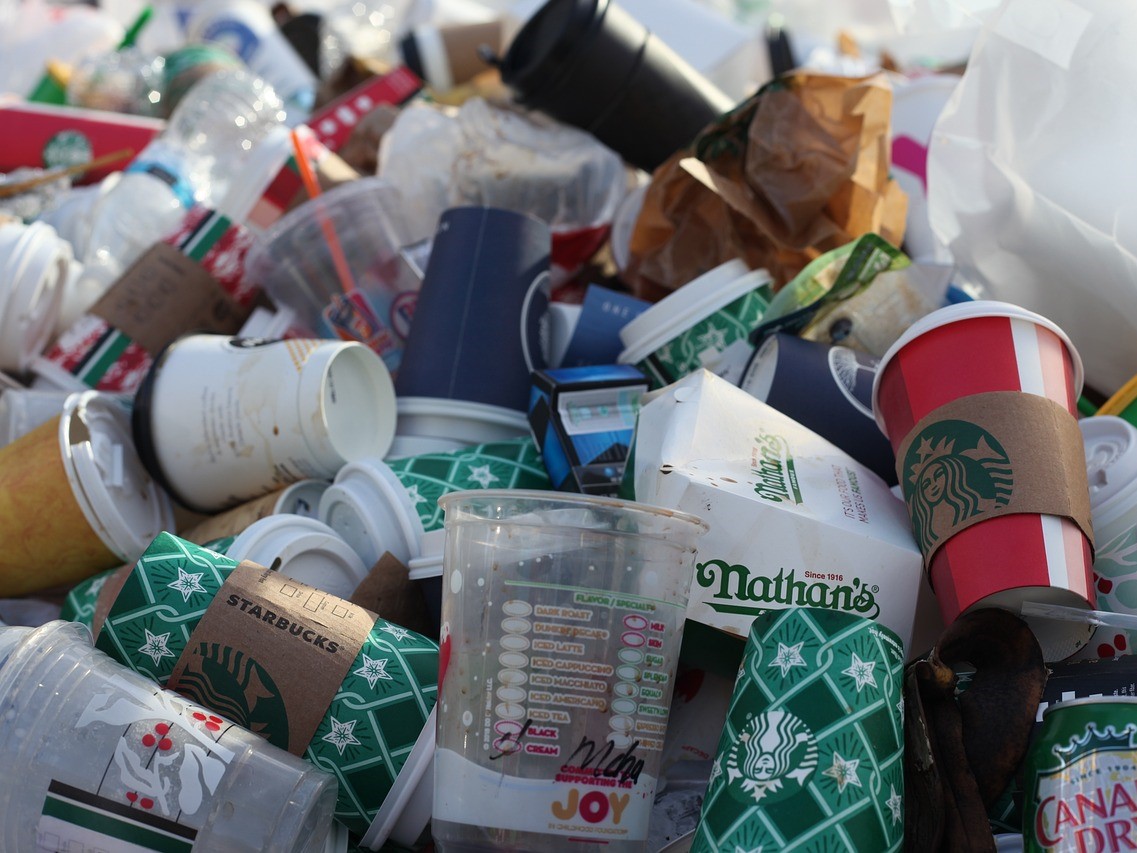
New bans on single-use plastics come into effect from September 1 in a bid to reduce waste, but not much will change for sustainably focused Bowden cafe, My Grandma Ben. (Image: Filmbetrachter)
By Sophia Lattas | @SophiaLattas
A range of everyday single-use plastic items like beverage containers — including coffee cups — will be banned in South Australia from September 1.
Businesses must replace banned items with compostable, reusable alternatives and anyone who is unsure how to manage excess stock can contact SA’s Environment Protection Authority.
Those who fail to comply with new rules risk penalties including hefty fines of up to $20,000.
This comes as the fourth stage of SA’s Single-use and Other Plastic Products (Waste Avoidance) Act 2020, passed by the state government on September 9, 2020.
However, My Grandma Ben co-owner Taylor Peplow Ball says she does not think the bans will affect trade for their sustainably focused Bowden eatery.
Peplow Ball says My Grandma Ben has operated without single-use takeaway cups and have also had a focus on reducing food waste, since opening six years ago.
“It’s a pretty significant part of our business,” she says.
They try to reduce plastic use where they can. Peplow Ball says My Grandma Ben works with Plastic Free SA who advise whether their packaging is lined with plastic or is recyclable.
“We’ve had everything that we use checked by [Plastic Free SA] which is not much — it’s just [our] food containers, napkins, stuff like that,” she says.
My Grandma Ben also implemented Fleurieu Milk’s milk tap — a sustainable initiative in collaboration with Tasmania-based The Udder Way — earlier this year.
Their milk supply is delivered to the cafe in 18-litre kegs and returned to Fleurieu Milk once empty for sterilisation and refilling. One keg eliminates nine two-litre plastic bottles.
“We got in touch [with Fleurieu Milk] as soon as [milk on tap] became available in South Australia,” Peplow Ball says.
My Grandma Ben has been sustainable since its conception in 2018, when Jessie Spiby opened it as a brick-and-mortar space for her catering company.
“Ben was Jessie’s gran,” Peplow Ball says.
“Her name was Betty, but all the grandkids — when they were little — heard Betty, gran, nan and morphed it into the nickname of Ben.
“So, she was known as ‘granny Ben’ [by] family and friends.
“[The name] My Grandma Ben is less of a tribute specifically to her, but to women of that time: slowing down, making things from scratch, eating in season, pickling, preserving, fermenting, and just enjoying where our food comes from.”
My Grandma Ben has since grown into the sustainable cafe it is today.
Peplow Ball, who now co-owns the cafe alongside Spiby and Jodie Zerna, says she thinks sustainability is “something that can be lost in our busy lives”.
“We will never claim to be zero waste because it’s incredibly difficult in the hospitality industry, but we’re constantly growing and evolving to reduce our food and plastic waste,” she says.
Peplow Ball says they utilise everything they possibly can in the kitchen in an effort to avoid unnecessary food waste.
She says she does not think the upcoming single-use plastic ban is going to “affect retailers at the end of the day”.
“Think about it this way: if takeaway cups didn’t exist, everyone would still drink coffee, [they’d] just bring in a reusable cup [instead],” she says.
Peplow Ball says she thinks while the plastic ban is a good start, “there’s always more that can be done” to avoid waste.
“We really need to rely on the government to implement all the right changes possible because businesses always have to adapt and consumer behaviour will change accordingly,” she says.
Why is it easier to adopt some sustainable habits, but not others?
PhD candidate at the University of South Australia and reformed fast fashion addict Erin Skinner says she has always considered herself “really environmental”.
As Skinner got older and moved out of home, she says she started making decisions around how she wanted to live her life and tried to be more sustainable.
“Here I was feeling [like] such a superstar, but at the same time I was an undergrad working a hospo job and absolutely obsessed with fashion — as any normal mid-20s person is,” she says.
Skinner says every paycheque went to fast fashion brands like Cotton On and Princess Polly and it never “clicked” until she saw a video on Facebook that outlined the lifecycle of a t-shirt.
“The standard white t-shirt you buy from any shop in any country in the global north today usually follows the same trajectory,” she says.
“[It] goes through many different countries [where it] is tainted with a lot of environmental and social issues throughout, and then we [eventually] dispose of it.
“How can I hold this identity as someone who’s environmental and then continue to engage in this behaviour which is so clearly against that?”
Skinner says her “behavioural change” was not immediate. Months went by where she kept buying fast fashion — she just felt bad about it.
“I put my wants before the little voice in my head that was saying ‘this isn’t who you are’,” she says.
Skinner says habits are difficult to break and finding more sustainable ways to replicate addictive feelings is challenging.
“It’s the anticipation [of] waiting for your parcel to come to your door,” she says.
“It drives us crazy.
“If you just take away [these addictive feelings] from someone they’re gonna have a hole there and they’re gonna want to go back to it because you haven’t replaced it with anything.”
While Skinner’s doctoral research focuses on fashion consumption from a conservation psychology perspective, she says it is “not dissimilar to the psychology behind consumption of goods in general”.
“Things like belonging, emotional gratification, and identity are key motivators behind many behaviours not just in the environmental context but others as well,” she says.
“For example, health, like conservation, is often dealing with trying to modify human behaviour for improved outcomes in populations who are largely equipped with the knowledge to do so.
“We all know that we should eat [healthily] and exercise, like we know we should try and act in certain environmentally friendly ways too, but that doesn’t mean we actually follow through.”
Skinner says there is a “myriad” of reasons why people engage in some sustainable behaviours and not others which are a “complex interplay” of many factors like attitudes, knowledge, social approval and worldview.
She says even with knowledge, positive attitudes and the intention to engage in a certain behaviour, there are always barriers that may be stopping people from following through.
Skinner says that “we’ll never be able to remove every barrier for every person” but there are “things that can be done to encourage more responsible consumption”.
“For some people, this may be a lack of awareness of [sustainable] alternatives,” she says.
“In many cases though, this will need change at the societal or systemic level.”
The plastics ban is an example of how government can assist in removing barriers so that more people can, or will, engage in sustainable practices.
“Other changes are at the societal level but occur more organically through shifts in social norms,” Skinner says.
“Think of the shift in social acceptability of second-hand clothing from 20 years ago to today.
“What we as a society deem as desirable [versus] undesirable is particularly important in the context of consumerism.”
Skinner says more people would engage in “sustainable practices” if they had the time and resources to do so.
“When your time and energy are spread thin trying to make ends meet in a cost-of-living crisis, considering the sustainable option is not top of mind,” she says.
Becoming more sustainable does not have to be a complete lifestyle change. Instead Skinner says to just “do your bit where you can” and don’t “beat yourself up about ticking every box”.