
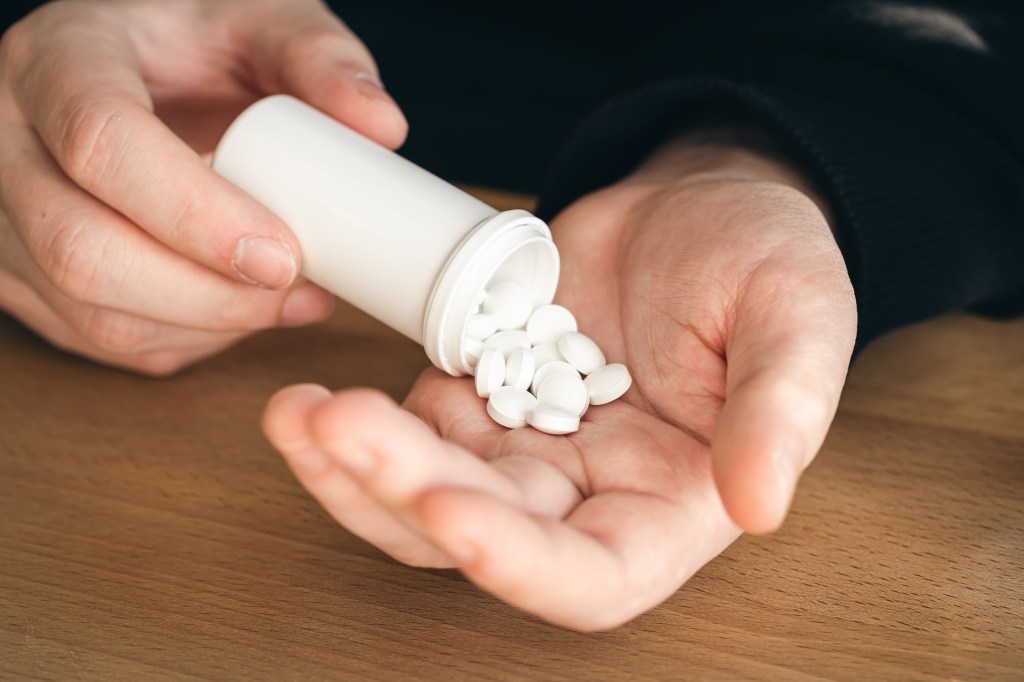
Recreational use of the illicit drug ketamine has increased nationally over the past decade. Experts say the drug is not yet fully understood, discussing both its dangerous effects and medical applications. (Image: pvproductions).
By Luna Voelcker-Sala | @gatito.cult
“I love ketamine, she’s my one true love,” Jack Ward*, a 20-year-old hospitality worker from Adelaide, says.
Since starting to dabble with the drug earlier this year, Ward has found his new vice of choice.
Recreational use of ketamine — “K”, “Ket”, “special K”, “wonk”, “horse powder” or “cat Valium” — across the nation has been rising since the early 2000s.
The proportion of people in Australia who had recently used ketamine jumped from 0.9 per cent in 2019 to 1.4 per cent in 2022-2023, according to the National Drug Strategy Household Survey.
In 2023, CanTEST, Australia’s “first fixed-site drug checking service”, reported ketamine (13 per cent) was the fourth most commonly used drug behind cannabis (50 per cent), MDMA (37 per cent) and cocaine (14 per cent). Ketamine also had the highest testing rate behind MDMA and cocaine.
The Australian Federal Police (AFP) also reported a total 882 kg of ketamine was seized in 2023 — more than double the amount seized the year before. This was also the year of the largest ketamine seizure in Australia’s history, which resulted in the arrest of three men.
In response to the record seizures, AFP Acting Commander Kristy Scott warns ketamine is a highly dangerous and addictive drug.
“Ketamine is a dangerous and illicit sedative,” Scott says in a statement.
“Its dissociative effects block sensory brain signals and can cause memory loss, feelings of being detached from one’s body and prevent their ability to perceive danger.”
The deadly effects of ketamine were seen late last year, when Friends star Matthew Perry died from “the acute effects of anaesthetic ketamine” according to his autopsy report.
What exactly is ketamine?
Ketamine is a sedative that was first synthesised in the 1960s as an anaesthetic for American soldiers during the Vietnam war.
It is known as a “dirty drug” or a “dissociative” by scientists, meaning it does not just target one system in the brain, but dozens.
The below video explains ketamine’s neurological effects:
Ketamine is classed as a hallucinogen when used illegally and is usually administered by snorting a crystal–like powder form of the drug. It can also be found in a liquid or tablet form.
Legally, it is primarily used by doctors and veterinarians as an anaesthetic but it can also be used as an analgesic (painkiller) and as a treatment for various mental illnesses.
At the ripe age of 60, ketamine is still a relatively unexplored drug. Its potential is not entirely clear, given its effects on various parts of the brain.
Royal Adelaide Hospital (RAH) professor of anaesthesia Guy Ludbrook and Head of the University of Adelaide’s Discipline of Psychiatry Scott Clark describe ketamine as a drug with a range of potential applications.
Together, Clark and Ludbrook are hosting a world-first clinical trial using ketamine to treat depression. The trial uses a tablet form of ketamine that releases the drug gradually into the bodies of patients with treatment-resistant depression.
Clark says the drug’s effects on the brain’s synapses are what make it beneficial for mental health issues.
“We think the mechanism allows increased plasticity in the brain and that helps people move from any sort of negative internal rumination to a more flexible way of thinking,” Clark says.
This is an effect that Ward has also noticed.
“You get this sort of head-space-y-ness where you’re not overthinking; you’re just living in the moment,” Ward says.
Ketamine as a party drug
Recreationally, ketamine has commonly been known as a party, rave or club drug. Electronic DJs, such as Australian DJ Partiboi69 or the UK’s KETTAMA, commonly reference the drug in their music.
Ketamine Dreams music video. (Source: Pariboi69 on YouTube)
The correlation between drugs and music has long been documented. In the UK, The Guardian reported that ketamine was linked to an offshoot of the dubstep genre “wonky”, with users often referring to taking ketamine as “getting wonky”.
A 2014 US study found preferences for drugs and music frequently coincide, which can “crystallise” into distinctive taste clusters.
Professor Ludbrook notes that in lower doses, ketamine could heighten the effects of music and provide enhanced visual stimuli.
“It is also possible that ketamine could provide users the euphoria they crave to lose themselves in a club or party setting — but the dissociative effects come with all sorts of dangers,” Ludbrook says.
A VICE article highlights the dangers of using ketamine in a club or rave setting and notes DJs are starting to warn against using the drug in a party environment.
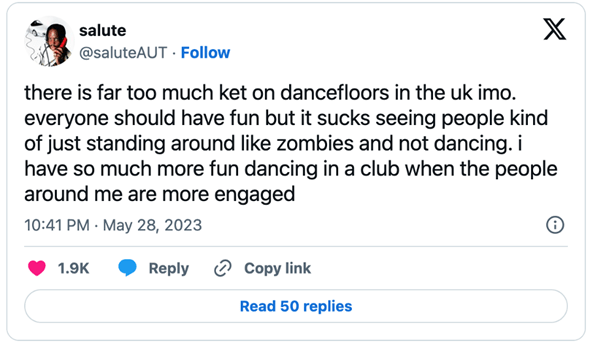
Popular Australian DJ Salute posted on “X”, or Twitter, about his distaste for ketamine on the dancefloor.
Wastewater data from 2019–2020 across New South Wales festivals playing electronic dance music (EDM) shows ketamine was the third most detected drug behind MDMA and cocaine. This data is in line with Canberra’s CanTEST findings in 2023-2024, where ketamine was the third most expected drug in their testing service.
Oliver Watson*, 28, is an Adelaide-based DJ who has attended many techno and house music events across the city and has a vast experience of experimenting with hallucinogenic drugs.
“I’ve definitely noticed an increase in [ketamine] use at festivals, probably because it’s cheaper for younger people to get their hands on,” Watson says.
The average cost per gram of illegal ketamine — according to the 2023 Australian Drug Trends report — ranges from $100 to $250. This is a noticeable difference from drugs such as cocaine, which costs more than $350 per gram.
“You don’t need much [ketamine] to feel its effects, which makes it more inexpensive,” Watson says.
“For me though, if I’m taking ketamine at a rave or festival, I want to be mixing it with some sort of stimulant.
“All my positive experiences in public places have been when I was high on other drugs [along with ketamine], in a festival setting — like on the dance floor — and in very low doses, so just bumping it.
“Otherwise, you can land into a ‘k-hole’.”
A “k-hole” is a colloquial term for when a high dose of ketamine leads to intense dissociation.
Ward says when he mixes ketamine with other drugs, such as MDMA or cocaine, he feels the “upness” of the stimulants along with “floaty” sensations and the hallucinatory effects of ketamine.
But mixing ketamine with other substances, like any poly-drug use, can increase the chance of an overdose or future health complications. Drinking while using ketamine has been found to increase the drug’s effects.
Research published by the National Library of Medicine earlier this year found “drug-related deaths at music festivals in Australia typically involve young people using multiple illicit substances in combination with alcohol.
Avoiding going down a “k-hole” by mixing ketamine may result in something worse.
Ketamine as a “chill” drug
During COVID lockdowns in 2020 and 2021, ketamine use in Australia rose by 21 per cent.
Research by the Australian Institute of Health and Welfare found a decrease in cocaine and ecstasy use as people were not able to socialise and party. In the absence of parties, people turned to ketamine as a new way to let go in the comfort of their own homes.
The pandemic may have established a lasting preference as ketamine continues to rise in popularity. When social settings such as festivals and clubs started reopening, ketamine stuck around.
Users like Watson and Ward, along with nationwide data, have suggested an alternative setting for taking ketamine.
Ward and Watson say they prefer to use ketamine in a “chill” environment.
“The idea of not being able to control my body, specifically in a public setting, makes me feel uncomfortable and unsafe,” Ward says.
Watson agrees. “Ketamine feels like a home drug to me,” he says.
“If I’m going to a party, then I’ll take coke or MDMA or even acid.
“If I want to chill at home with friends and music, I want to get ‘wonky’ and have some ketamine.”
Professor Ludbrook says interactions with the environment are extremely important for a user’s individual experience.
“I can’t say I’ve been to a rave for a very, very long time, but I presume it is quite an intense, stimulating environment which would be a very different experience than being at home in a quiet place with little visual or auditory stimulation,” Ludbrook says.
Watson and Ward describe the effects of ketamine as “euphoric” at home. For these users, ketamine’s effects on physical mobility can cause them to “melt” into their environment.
“It feels like you’re sinking into the couch,” Watson says.
“I’ve been with friends [on ketamine] before and we all dared each other to stand up for as long as possible.
“We were all standing up, feeling like we were hanging from the roof with our feet weighing us down — it was a really weird experience.”
According to the United States Drug Enforcement Administration the term “baby-food” describes this stage of the ketamine high, where users sink into a blissful, almost infantile inertia.
Ward says his preference for ketamine over other drugs is also due to the timespan of the high.
“I find the effects [of ketamine] aren’t super long, so you’re not committing yourself to a full five hours of experience,” Ward says.
“You can have a short 45-minute experience if you want to.
“Time also feels like it’s not moving at all.
“Your sessions feel a lot busier even though time is actually going slowly.”
Availability and effects
Ward and Watson say they feel ketamine is a relatively pure, safe substance and easy to obtain.
“Even just six years ago, you would have heard of ‘ket’ but you didn’t see it anywhere as much as you do now,” Watson says.
“It’s circulating a lot more and is much easier to obtain.”
According to a 2023 report on Australian drug trends users perceive ketamine to be higher in purity and availability, yet researchers like Clark warn against this assumption.
“It may be that the risk of doing something potentially dangerous like ketamine is better managed at home, but that doesn’t mean the danger is completely eliminated,” Clark says.
CanTEST’s 2023-2024 drug testing service report found that many samples of what users perceived to be ketamine were in fact mixed with other substances or were an entirely different substance altogether.
Last year, Australian National University discovered a new drug which has been labelled “CanKet” because of the qualities it shares with ketamine, although its composition is entirely different.
“It’s risky to take ketamine recreationally because you don’t know what you’re taking; it’s nice to think things are safe and okay but you never really know,” Clark says.
Professors Clark and Ludbrook also warn the effects of ketamine are highly individualistic and can be more permanent than expected.
“Even in our trials, it’s not for everyone — some people will have an aversive response,” he says.
“People’s bodies are very different, and drugs get metabolised in different ways.”
Research has shown that ketamine can negatively impact bladder function causing irreversible damage and can have long-term effects on memory and personality.
“How much you need to take to have that risk, we are not sure,” Ludbrook says.
“It might be less than originally thought.”
Like any drug, ketamine can be addictive and its effects on the body are still relatively unknown.
Non-prescribed ketamine’s unknown purity, along with its common pairing with other drugs and alcohol, raises significant concerns amid its rise in popularity across the nation.
Users like Watson and Ward are trying to minimise their risks and maximise their experience by taking the drug in a relaxed, private environment, and in low doses.
If you do plan on taking ketamine recreationally — and Professors Clark and Ludbrook advise that you do not — they suggest being sensible and assessing your risks.
K-holes, as Ward says, are “fucking scary”.
*Names changed for anonymity
For more information and helplines:
Ketamine Harm Reduction Information
Alcohol and Drug Hotline: 1800 250 015
Family Drug Support: 1300 368 186
 ontherecordunisa.com