
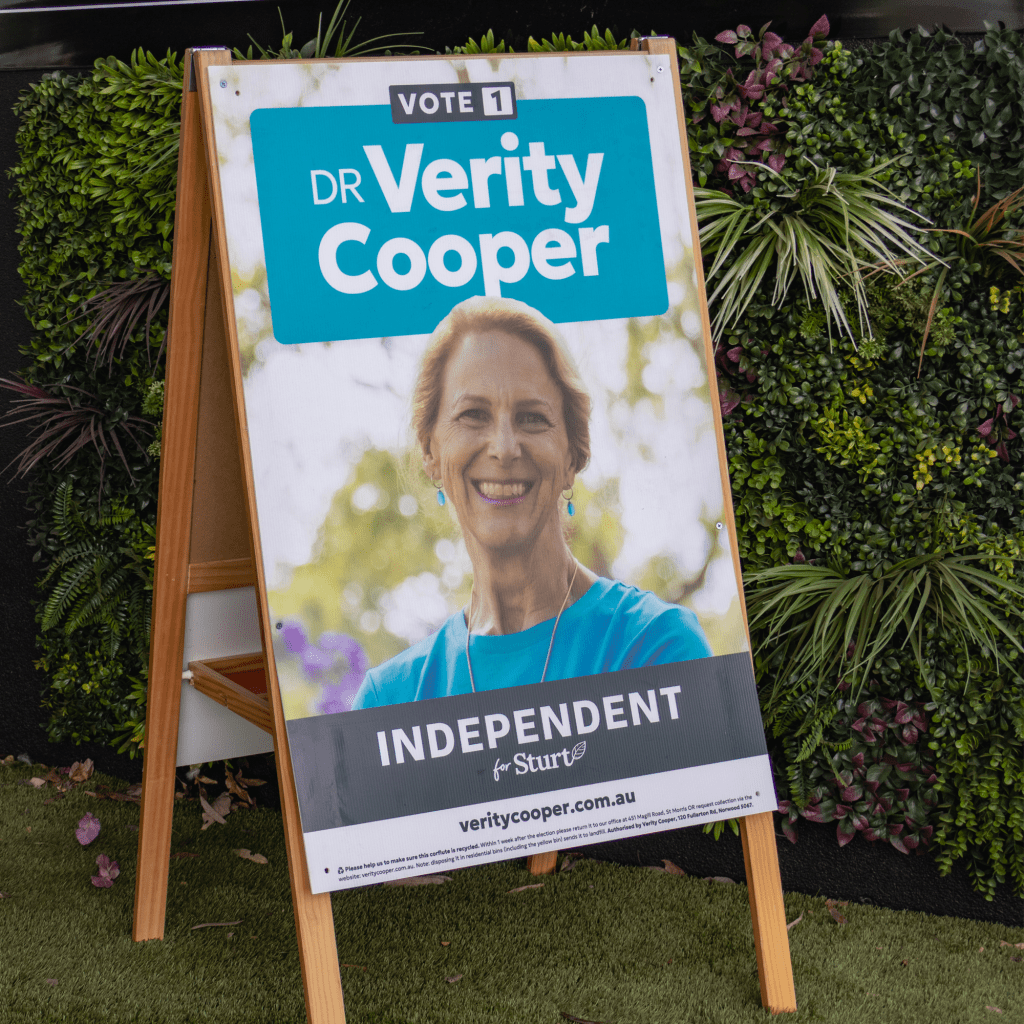
Dr Verity Cooper is taking on the most marginal seat in South Australia as a ‘teal’ independent backed by Climate 200 and community group Independent for Sturt. She’s in it to win it on a platform of integrity in politics, better climate protections, and making Australia fairer. (image: Robert Hicks).
By Robert Hicks | @_roberthicks
Dr Verity Cooper ran her GP practice in Parkside for 35 years; she’s now running for the inner-city seat of Sturt in Adelaide’s east.
She is angry about inequality and the failure of successive governments in Australia.
“If you ask me why, after a year or so of retirement, why am I going into politics? It’s because I am, to quote Richard Dennis, ‘fuelled by rage’,” she said.
“I want to do something about this.”
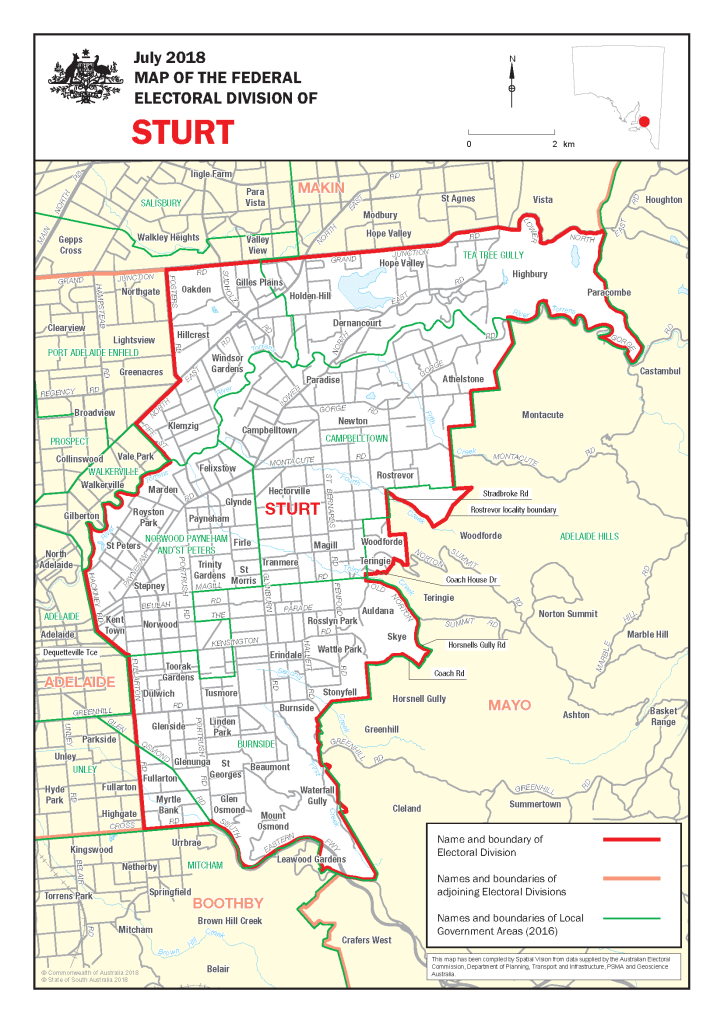
Map of the electoral division of Sturt (image: Australian Electoral Commission)
Sturt stretches from Grand Junction Road in the north to Cross Road and the South Eastern Freeway, and west from Fullarton and Hackney Road to the base of the Adelaide Hills.
At the 2022 federal election, Sturt was won by the Liberal’s incumbent James Stevens.
Stevens held Sturt on a knife’s edge margin of 0.5 per cent after Labor challenger Sonja Baram inflicted a swing of 6.42 per cent after preferences.
But Sturt shows much of the same characteristics of inner-city seats won by ‘Teal’ independents at the 2022 election: an educated electorate, a slipping primary vote for the Liberal Party, and a strong — but not strong enough — vote share held by left-of-Liberal parties to provide the grounds for an alternative to contest the seat.
“… I’ve had a few comments from Greens members who are disappointed because they say, ‘you’re splitting the climate vote’ … but then I realised there are rusted on Liberals and Labors who are never going to vote Green,” Dr Cooper said.
“But they might just vote for an independent who is concerned about climate change — who is speaking common sense and pointing out where the major parties have let them down.”
What it means to be independent
Dr Cooper is critical of both the Labor and Liberal parties but says that independents “can take the best ideas from everyone” for the benefit of all.
“Occasionally the Liberals come up with a good idea, like reserving some of our own gas for our own use,” she said.
“I mean, no brainer, really. Buy back at domestic prices — that would shrink your energy bill.”
In Sturt, freight trucks going down Portrush Road are a major local issue because of the congestion they cause.
Cooper says the Greater Adelaide Freight Bypass, one stage of the High Productivity Vehicle Network project, is “going to be great” but also “very expensive”, and backs in the Liberal plan for the federal government to fund the vast majority of the project.
“That was a good Liberal plan to say we’re going to build it 80/20.
“With Labor, at least they came to the party and said 50/50. But where is our state government going to get $525 million when we’ve just engaged with the Whyalla steelworks?
“The Labor plan was good; the Liberal plan is better. So obviously on that particular measure, if it came up in federal parliament, I would vote with the Liberals because it is better for the people of Sturt,” Dr Cooper says.
But, in general, she says Labor policies “align more with the values of Sturt and seem to have more in them for the people of Sturt.”
“[But] not all of them,” she said.
“I won’t be voting with Labor on everything.”
Who would Dr Cooper back in parliament?
In the event of a hung parliament, where no party gains a majority in the House of Representatives, government is formed via confidence and supply agreements with minor parties and independents. 2010 was the last hung parliament — Labor, led by Julia Gillard, formed government with now-Greens leader Adam Bandt and three independents.
When I asked Dr Cooper who she’d be backing in the event of her election and a minority government, she said she would not back either side or make any deals because it would remove her independence.
“It removes my ability to vote for the people of Sturt,” Dr Cooper said.
“I’m going to look at every piece of legislation that comes through, through the lens of ‘is it going to be good for Sturt?’”
But she’s not just focused on Sturt. She’s focused on the bigger picture and on tackling big issues.
“Is it going to be good for future generations? Does it have a climate trigger?”
“And … ‘does it have a kindness lens?’ — ‘is it going to be good for ordinary people?’ rather than ‘is it going to be good for corporates?’”
This sort of transparency is of utmost importance to her, even if it may be detrimental, and she leads by example. Her and her media advisor “agreed to part ways” following some discord on what her public and private stances on ‘hot button’ topics should be.
“[Cooper’s media advisor] said, ‘you cannot touch Gaza, do not even go there.’,” she said.
“But there’s a lot of people who are really concerned about Gaza.
“Of course, it won’t win over everyone. It’s not a bread-and-butter issue, but it’s a moral issue and people care about this.
“I know it’s a hot potato — but I think politicians [have] stopped being leaders.
“Politicians have become managers and they’re looking for votes, so they’re avoiding the moral issues and they’re avoiding the hard issues — the issues that we need to look at.
“… when I did on my campaign launch … I promised people that I would always tell the truth, even if it was hard to hear. I promised that I would not be bought by corporate interests or rich donors. And I won’t.”
Making Australia fairer for all
Dr Cooper was not impressed with what she sees as Labor’s lacklustre measures to address cost-of-living or welfare.
“You know, frankly, I was so disappointed in the budget and the budget plan — not one mention of increasing welfare for Jobseeker,” Dr Cooper said.
“How can it be $100 below the poverty line?
“Seriously? We are a rich country. We should be ashamed of ourselves.”
Welfare, however, is expensive — and, in the future, there will be more older people requiring welfare than young people paying tax to support it.
Her solution to this is “really nasty” but seeks to address general inequality and the inequity that comes from a shrinking tax base being a major funding source for social welfare programs.
“We need to talk tax reform.”
“If you wanted to devise a system that would worsen the intergenerational divide you could not find a better one than Australia’s tax system …”
“It screws you guys; it gives us all the benefits because we know that if you’re just relying on individual taxation that is getting a narrower and narrower base … we’re going to run out of that tax base.”
“And the welfare base is going to get bigger and bigger and bigger with our ageing population.”
Dr Cooper cites Wentworth MP Allegra Spender’s ‘Tax Green Paper’ as her inspiration, noting five key points that will address this and other inequalities: taxing multinationals, increasing the petroleum resource tax, limiting negative gearing to one investment property, reducing or removing capital gains tax, and removing stamp duty, albeit she notes this latter issue as a state problem she can advocate for as an elected federal representative.
“There’s more ideas in the Green Paper but those are five ideas that we can start with,” she said.
A spark of hope for Australia’s changing climate
“[Labor] cancelling that EPA (Environmental Protection Agency) legislation was a disaster,” she said.
“If Queensland was a country, it would have the second highest rate of deforestation in the world. We had the highest rate of mammal extinction in the world and under Labor it’s gone 86 per cent over targets.
“We’re still logging native forests and burning 60 per cent of those logs because we can’t export them.
“It does my head in and I think it would do 70 to 80 per cent of people’s heads in if they understood what’s happening.”
‘Teal’ independents are often targeted politically for being seen as too green in their stances on climate change. Some attack ads go so far as characterising ‘teal’ independents as members of the Australian Greens in disguise.
For Dr Cooper it’s only half true. She quit the Greens because she found their methods too obstructionist.
“I was a Greens member; I was really pissed with them for delaying the housing fund. We needed to start that housing so much earlier,” she said.
“[But] there’s a lot of Liberal, mainly Liberal, ads against the independent … the ad about Alex Dyson (independent candidate for Wannon) pulling open his shirt to show the Greens t-shirt.”
“I mean, honestly. They go on attack and it’s really dispiriting for a lot of people to see and so you get why people disengage.
“They don’t want to see or hear or be around that negativity, so I’m trying to create more positive things.
“I find this a difficult balance — I want to tell people what is going on, but I also don’t want to be that ranting woman who just keeps being negative all the time because I’m fully fuelled by rage.
“I want to give people hope.
“I want to give young people hope that there’s actually going to be a planet for them to live on.”
 ontherecordunisa.com