
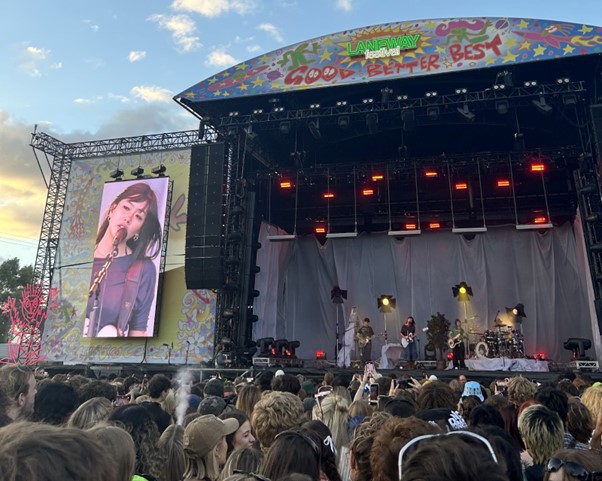
Most music festivals in Australia are an all-day event. Tampons shouldn’t be left in over eight hours. There are no sanitary bins in the toilets. What are menstruating attendees left to do? (Image: Leia Vlahos)
By Leia Vlahos | @leiavlahos_
A 2024 study found that 77 per cent of Australian women experience bothersome menstrual symptoms, while almost half of women reported missing days of work or study because of their symptoms.
Music festivals, such as Saint Jerome’s Laneway Festival, have been accused of not providing adequate sanitary products, such as sanitary bins, to attendees of the festival.
Music festivals often hire portable toilets, many of which include very basic equipment and services.
Flushing sanitary products such as pads and tampons can clog sewerage pipes and enter septic tanks — it’s not recommended under any circumstances.
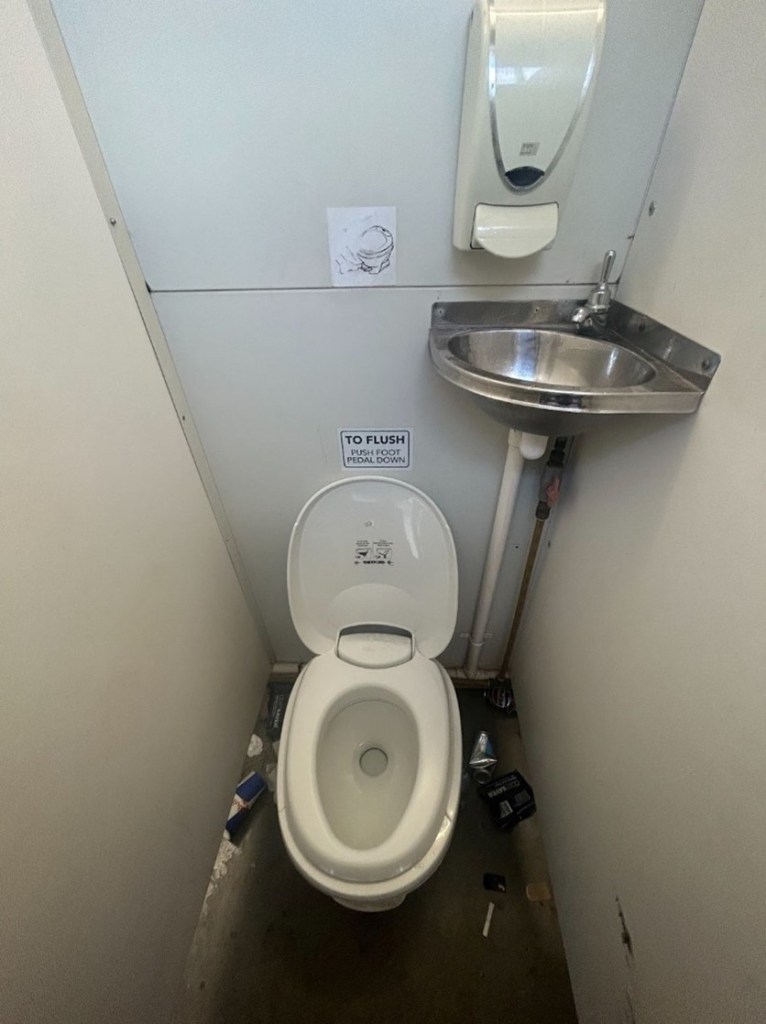
The bathrooms at Saint Jerome’s Laneway Music Festival in Adelaide were minimally equipped for its attendees (image: Leia Vlahos).
Creative Australia reports that 50 per cent of music festivals in Australia are an all-day event.
Most tampon manufacturers advise that their products should not be kept in for over eight hours.
Cramping the vibe
Live-music fan Talia Herbst attended Laneway Festival at Adelaide back in February while menstruating.
Herbst knew that she had gotten her period but chose to ignore it due to the line for bathrooms being too long.
“I was somewhat concerned about how I would approach [having my period at the festival] in terms of whether to use pads, tampons, or period undies without getting toxic shock syndrome or feeling gross,” she admits.
Toxic Shock Syndrome (TSS) is a bacterial infection that is commonly prevented by practicing good period hygiene.
If left untreated, TSS can lead to respiratory distress and heart problems at the mildest, and liver and kidney failure, septic shock, and death in the worst cases.
It has a mortality rate of 30–70 per cent.
While waiting in line for the toilets, Herbst saw other attendees get tired of waiting, and instead chose to “relieve themselves in the bushes”.
In future, Herbst suggests providing a “menstrual station” that provides separate bathrooms, and period products for those who menstruate.
“I love music so my period can never stop me from anything, really,” she says.
Laneway’s 2025 headliner, Charli xcx also finds periods “a nightmare”.
“Sometimes, it’s so f***ing up and down all around and you don’t even know what’s going on and you’re on your period sometimes, and it’s a f***ing nightmare,” she sings.
All three of Laneway’s 2025 headlining acts identified as women.
Leading up to the 2025 lineup announcement, the festival teased this year was catered “to the girls”.
Regardless of the all-female headliners, can Aussie music festivals say they’re doing enough?
Thea Martin and their band Twine performed at Adelaide’s Laneway festival for the first time in February after winning Triple J’s Unearthed competition.
It was also the first time they had access to the backstage artist area and its bathrooms.
They said the bathrooms were the same as the audience portable toilets, except with a minimised wait.
“I’ve been to festivals where they’ve provided condoms but not period products,” Martin says.
Martin attended music festivals as a teenager and describes them as a positive formative experience.
In the last few years, Martin has noticed a rise in discussions surrounding festival appropriate behaviour.
They say it’s a cultural issue across the board, stemming from how we value people, their safety, and their needs.
“Period poverty and taboos are still a very real thing in Australia,” Martin says.
Some women at music festivals place their used tampons in a ziplock bag and dispose of it in the communal rubbish bins outside of the toilets.
Approximately 49 per cent of festival goers in Australia identify as female.
The equality of infrastructure
Val Caceres is a member of Period Justice, a South Australian initiative founded by the Commissioner for Children and Young People SA.
Caceres and Period Justice helped the University of Adelaide create an on-campus vending machine that supplies free sanitary products.
She believes that if you are menstruating and cannot go to the closest bathroom to change, you’re at a disadvantage.
Caceres recently read Invisible Women: Data Bias in a World Designed for Men by Caroline Criado Perez.
She reflects on a finding in this book that stuck with her: 50:50 isn’t an equitable distribution of bathroom space.
This book finds that approximately 65 per cent of bathroom space should be allocated to women to ensure an equitable experience for all, regardless of their gender identity.
“Women in particular use bathrooms longer than men do, there’s more things you’ve got to be doing,” Martin adds.
Caceres believes everywhere that has access to toilet paper, should also have access to period products.
“One third of people menstruate, so if you’re going to have a barrier around those who do, then that’s not equality,” she explains.
To promote period justice, Caceres encourages event organisers and attendees alike to dismantle ideas and question why things are the way they are.
She believes a one size fits all idea of an audience isn’t realistic anymore.
Martin and Caceres both noticed and commended Laneway for providing a low sensory space for its audience members.
Caceres believes the best way to serve your audience is to consult them about the matters that impact them – just like Laneway’s low sensory zone.
“Young people are so good at thinking about these kinds of things, it’d be great to see those [values] reflected,” Martin adds.
Adelaide is Australia’s first and only UNESCO city of music.
In a city that values music, many listeners still feel their basic needs are overlooked and not accounted for.
“If you menstruate, you shouldn’t suffer because of it,” Caceres says. “A period-just world is possible … we just have to act on it.”
Saint Jerome’s Laneway Festival did not reply to On The Record in time for publication.
 ontherecordunisa.com