
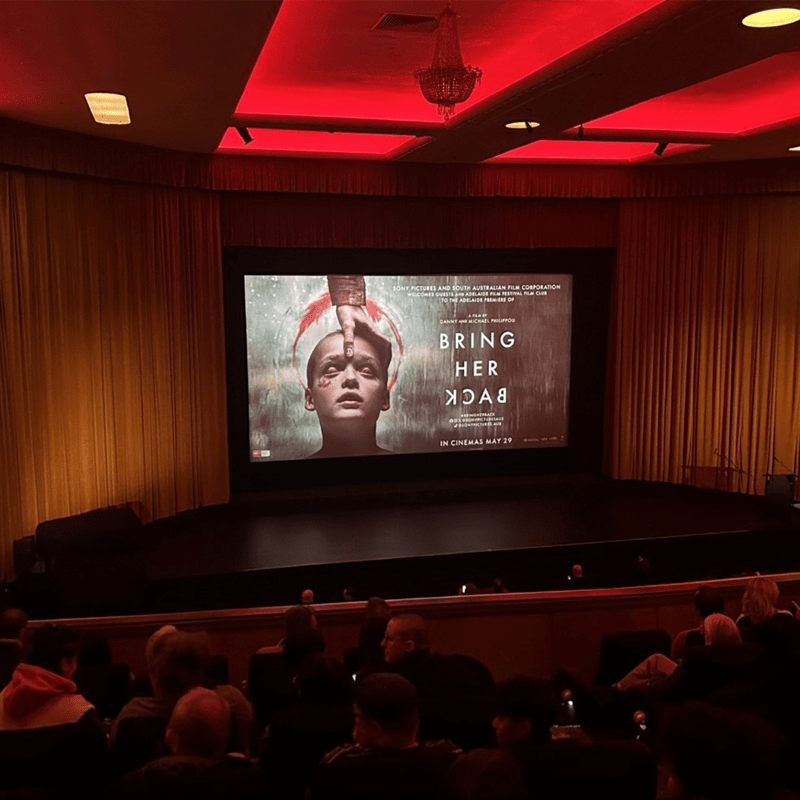
After Talk to Me’s whopping success, South Australian directors Danny and Michael Philippou nail their signature “little sibling horror” trope with their latest film, Bring Her Back. (Image: Leia Vlahos).
By Leia Vlahos | @leiavlahos_
The Capri Theatre was bustling on Monday evening to celebrate local directors Danny and Michael Philippou’s sophomore film Bring Her Back.
Bring Her Back is Australia’s newest supernatural horror, and was filmed, set, and screened right in our backyard.
The movie, filmed at the South Australian Film Corporation’s Glenside studio in 2024, is nothing short of a terrific showcase of how powerful local filmmaking can be.
The Philippou’s brothers’ debut film Talk to Me was also supported by the South Australian Film Corporation and quickly became a smash hit.
With a budget under $7 million AUD, Talk to Me earned $139 million AUD at the global box office and propelled their names through the industry.
The directors situate their films in a nightmarish version of South Australia — the type of nightmare where dream and reality seem too alike, making it all the more sinister.
Bring Her Back tells the story of stepsiblings Piper (Sora Wong) and Andy (Billy Barratt) as they uncover a horrific ritual in the home of their new foster mum.
The film discusses the grief of losing those close to us — the audience is left to ponder how it impacts ourselves and others through our darkest times.
Writers Danny Philippou and Bill Hinzman discuss the difference of a child losing a parent and a parent losing a child — and how these two sides use each other to heal.
It poses the question: just how far away are our lost loved ones?
Do they live on only through our memories, or is there a world beyond death?
Beyond the eerie parent-child dynamic, the film carries a different story than their past work but still an interchangeable trope… little sibling horror.
Little sibling horror plays on an eldest child’s greatest fear — a fear of the awful and deranged afflicting our younger siblings.
This trope becomes twice as ironic and horrific when Danny and Michael Philippou spend every press package attached at the hip.
Before the film begins, a clip of the Philippou brothers smiling and giggling about the making of the film plays on the silver screen.
Their liveliness is contagious, yet so contradictory to the horror they played to the audience just minutes later.
Tread carefully, this film is nothing short of a shocking, crushing, and unimaginable tale of body horror.
Body horror is a subgenre of horror that focuses on grotesque mutations of anatomy.
This subgenre relies heavily on visual storytelling yet Bring her Back elevates this with chilling diegetic sounds.
The theatre’s speakers blast reverberating noises of teeth crunching, bones snapping, and flesh peeling.
I’d ask you to consider if you’re good with gore, as Bring Her Back takes gruesomeness to a level beyond covering your eyes.
This world transforms into something twice as terrifying when you walk down the very same streets each day.
Similarly to their first feature film, Talk to Me, Bring Her Back isn’t just set in Adelaide.
It’s a nod to day-to-day life in South Australia.
From signature drinking games to Holden Commodores and Adelaide Metro buses, the Philippou brothers know how to crawl under an Adelaidean’s skin.
The film touches on Australia’s drinking culture and issues that are often unrepresented in major commercial films.
Like Talk to Me, Bring Her Back displays an intoxicating montage of underaged drinking as a method of coping with grief — for better or worse.
Thrillingly, the film provides an exemplary soundtrack with even better needle drop moments.
The film boasts an all-Australian music lineup featuring Daddy Cool’s “Eagle Rock”, highlighting the director’s attention to details.
Even more so, The Veronica’s track “Untouched” stole the show during a horrific scene filled with possession, convulsions, and a sinister home video.
Bring Her Back builds a foundation of stellar audio mixing and mastering.
It draws you into legally blind Piper’s reliance of senses — heightening the jump scares and goosebump-inflicting moments.
The performances of the young actors in Bring Her Back perfect the vulnerability and desperation we hold when it comes to family.
Barratt delivers a monologue that becomes even more crushing as it’s fed back to the audience from the perspective of his stepsister.
The role of Laura (Sally Hawkins) is played with a chilling sincerity that displays a masterclass in range, from family-friendly to horror performances.
Despite the villain of the story being tremendously unnerving, the tale brings a human perspective that so many horror films fall short at.
The last scene leaves the audience empathising with the protagonist and antagonist alike, signifying how exceptional the film’s writing and acting are executed.
Bring Her Back’s final scene is all consuming, leaving the audience in pieces.
With this new offering, the Philippou brothers have cemented themselves as some of Australia’s best visual storytellers.
I anticipate that Bring Her Back will equal the commercial success of Talk to Me.
Bring Her Back must be the scariest flick of the year, with the Philippou brothers on track to become the “it” horror directors of the decade.
They deserve a reputation not so far off Ari Aster’s for their disturbing, yet distinctly stylised, horror flicks.
The film is gory as ever but serves a purpose far stronger than other scary movies released this year.
Bring Her Back is sure to set your heart alight with anxiety, compassion and grief.
Just think twice about buying that large bucket of popcorn; the contents of this film make it hard to stomach.
Bring Her Back will hit Australian cinemas on May 29. Do yourself a favour and grab a ticket to 2025’s standout horror flick.
 ontherecordunisa.com