
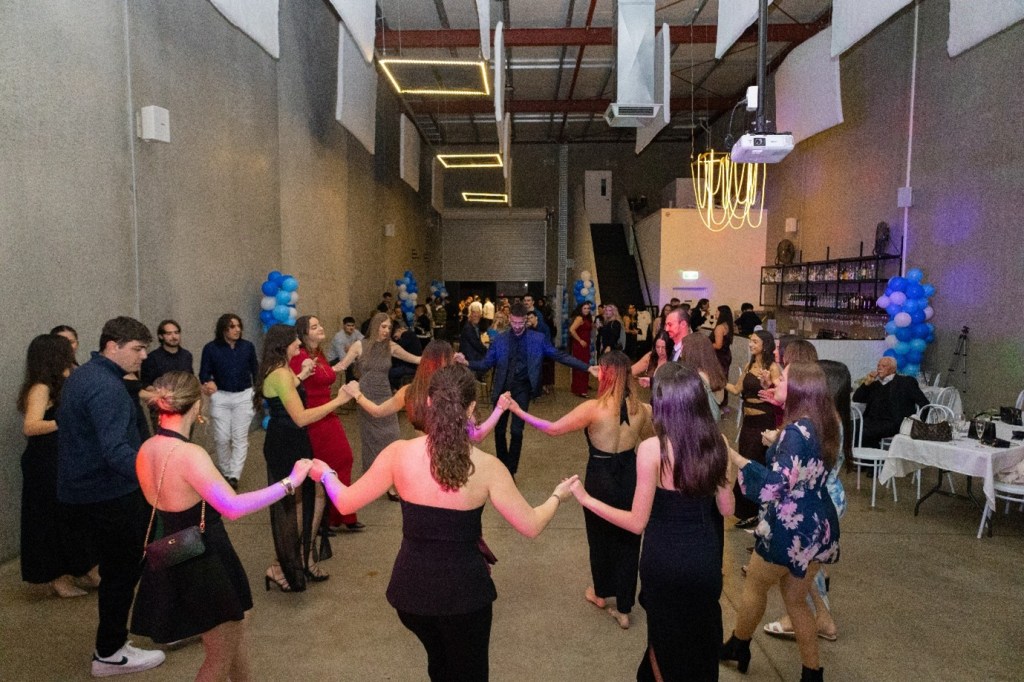
A new local not-for-profit has emerged amid cultural division and controversy. The Greek Youth of South Australia group aims to reconnect Hellenic Adelaidians with their heritage and culture (Image: Johnny Bediavas).
By Leia Vlahos | @leiavlahos_
A new youth group aims to bring together Adelaide’s Greek community, which has long been divided by competing churches.
The Greek Youth of South Australia (GYSA) officially launched in May 2025 as a fresh, not-for-profit organisation that strives to blend tradition with modern values.
Members of Adelaide University Greek Club (AUGC) and the Flinders University Hellenic Association (FUHA) came together with a purpose greater than themselves.
Organisers say the GYSA was founded to create a nexus for those aged 18 to 30 with an interest in Greek culture beyond university affiliations.
GYSA emphasises that unlike AUGC and FUHA, members don’t need to be students — they can be in trades, working, or on a gap year.
The GYSA hopes to maintain a non-partisan environment through its events and community amid pre-existing religious divides.
This follows the Greek Orthodox Community of SA facing controversy after it failed to meet the voter threshold to unify the two sides of the church in October 2024.
The South Australian Greek Orthodox church split in 1960 due to disagreements with church officials and SA remains the only state where a widespread division exists.
This divide is between the archdiocese and the κοινότητα (community). Both groups are named after the clerical way their church is controlled.
GYSA president Anthony Hagidimitriou says the group is open to collaborate with other clubs and organisations, stating they don’t intend to monopolise Greek identity in Adelaide.
“We’re not picking and choosing who to work with … if you want to work with us, we’ll hear you out,” he says.
AUGC president Demetre Bougessis adds that this applies to both church groups.
“Our door is open to everyone; we’re not shutting anyone out, so if anyone wants to work with us let’s have a conversation.”
Hagidimitriou says the GYSA are prioritising community, culture, and collaboration through their monthly calendars of Hellenic events across Adelaide.
However, Hagidimitriou and Bougessis maintain the not-for-profit’s non-partisan approach by refusing to advertise either church’s liturgies.
“In terms of the church … yes, there is that schism, but we want to show that there’s people on both sides, we’re both human, we’re both a part of something great,” says Bougessis.
“We can start building bridges across that divide and would love that; we want to be a meeting ground and mixing pot of everyone.”
The club executives speculate that this sensitivity is part of why South Australian university Greek clubs have struggled in the past.
Communions and the student union
The National Union of Greek Australian Students (NUGAS) was established 55 years ago, but Adelaide’s branch dissipated during the COVID-19 pandemic and hasn’t recovered.
In 1989, the second volume of the Australian Greek University Association’s publication AGORA focused entirely on the churches’ schism and its impact on the community throughout the decades.
Back in October 1989, AGORA’s Editor in Chief Ross Karavis wrote: “Trying to get key players from both sides to talk about the Split has been like trying to get over the Berlin Wall.”
“How long can the Greek community keep incurring the costs of the Split before the costs become too great for the Greek community to bear?” Karavis wrote.
The Berlin Wall fell only a month later — yet 35 years on, the rift between South Australian Greek Orthodox churches continues.
The GYSA launch event responded to that schism, garnering a strong community turnout of over 120 attendees, with several special guests including the Consul-General of Greece in Adelaide, Alexandra Theodoropoulou.
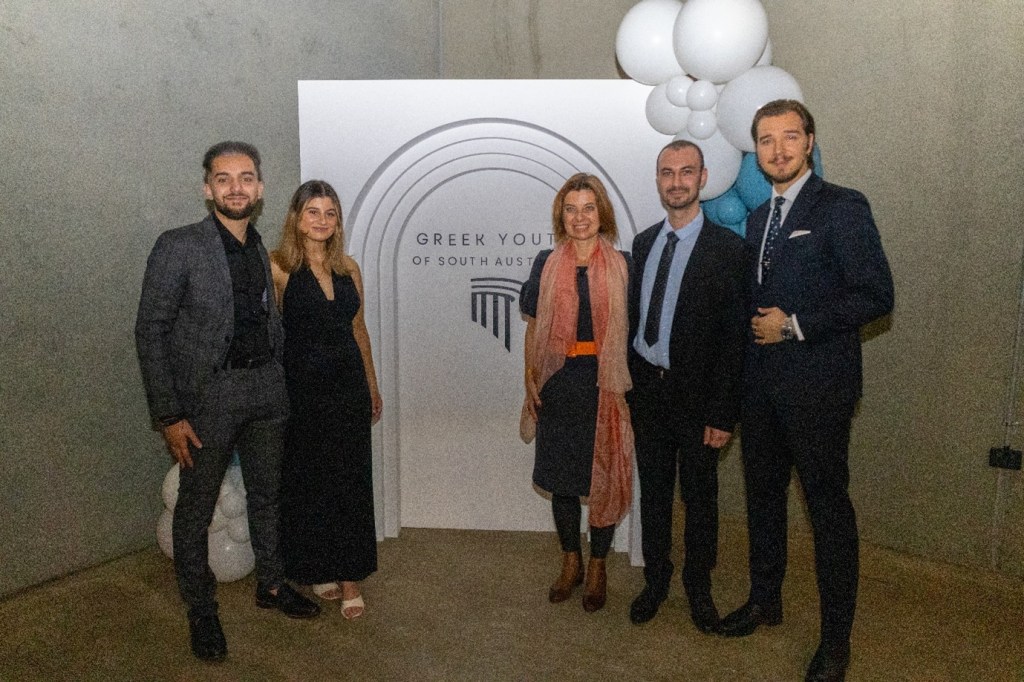
Left to right: GYSA Treasurer Athanasios (Athan) Rodas, Social Media Coordinator Victoria Paneras, Consul-General of Greece in Adelaide Alexandra Theodoropoulou, President Anthony Hagidimitriou and Secretary Demetre Bougessis (Image: Johnny Bediavas)
Flinders University Student Association (FUSA) president Nathaniel Winter says that while all clubs are important to student life, cultural clubs are the life blood of FUSA.
“Our cultural clubs allow students to meet and socialise with other people who have experienced what they are going through and often times come from a shared cultural background,” says Winter.
FUHA president Victoria Paneras says her club allows university students to connect casually and encourages young people to join GYSA for a deeper understanding of Greek culture.
“We want our committee to talk to people, welcome people, just be there … so please take our opportunities,” she says.
Despite the separation of the two churches causing unrest for some, GYSA sets a clear goal of uniting Adelaide’s Greek community.
“We want everyone to be a part of this; something bigger than all of us,” Hagidimitriou says.
“So just come along and give it a go.”
 ontherecordunisa.com