
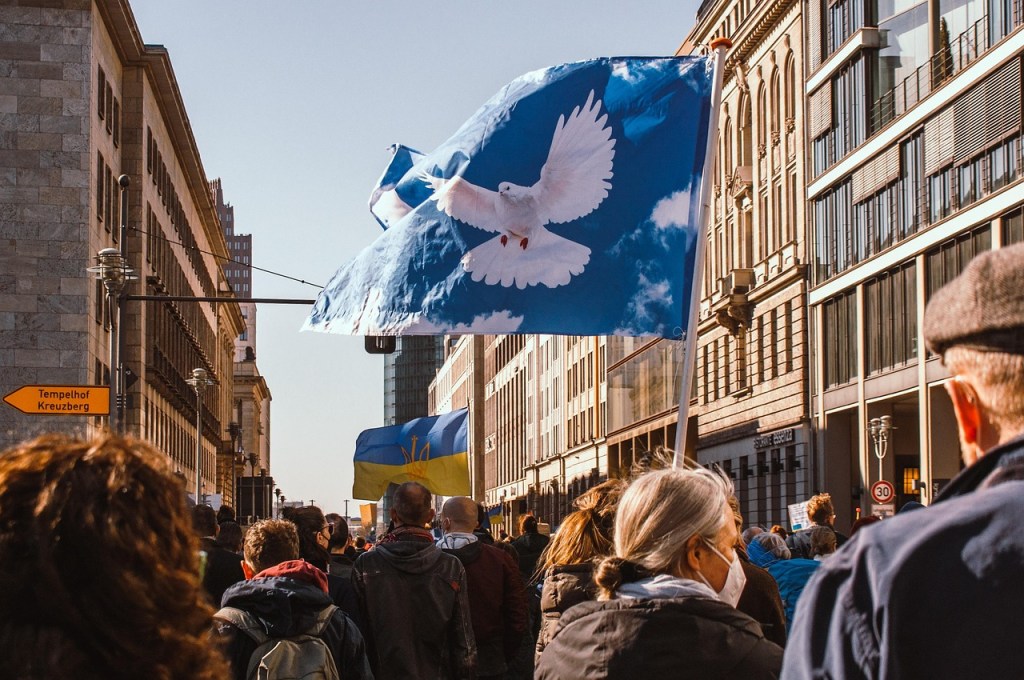
Like all Ukrainians, the full-scale Russian invasion of Ukraine in 2022 came as a wake-up call for Dr Oleksandra Zviagnia. (Image: @wal_172619)
By Andrew Clinnick | @AndrewClinnick27
Warning: This story contains content some readers may find distressing.
Dr Oleksandra Zviagnia has faced several challenges as a Ukrainian refugee living in Warsaw.
Her story is part of a global conflict.
It’s really happening, part 1
February 24, 2022, 5:00am
“What a stupid joke!” Zviagnia says.
Zviagnia drops her phone on the benchtop, dismissing the ‘silly’ social media post.
She is a young Ukrainian woman who left the Donbas at the start of the war in 2014 to study her doctorate in Warsaw.
Zviagnia shivers in her dressing gown as she stands in the kitchen of her Warsaw flat, eyes puffy with sleep.
It’s nearly spring in Poland, but it still feels like winter. The central heating hasn’t switched on yet. It’s dark outside.
As she waits for the water to boil so she can make some coffee, she picks up her phone again.
The kettle just boiled, but Zviagnia has forgotten about the coffee…
She’s scrolling frantically through her friends’ Facebook posts.
It’s an avalanche of shocking photos showing Russian missile strikes on shattered Ukrainian cities.
Panicking, she calls her mum in Ukraine.
This is really happening! Zviagnia thinks.
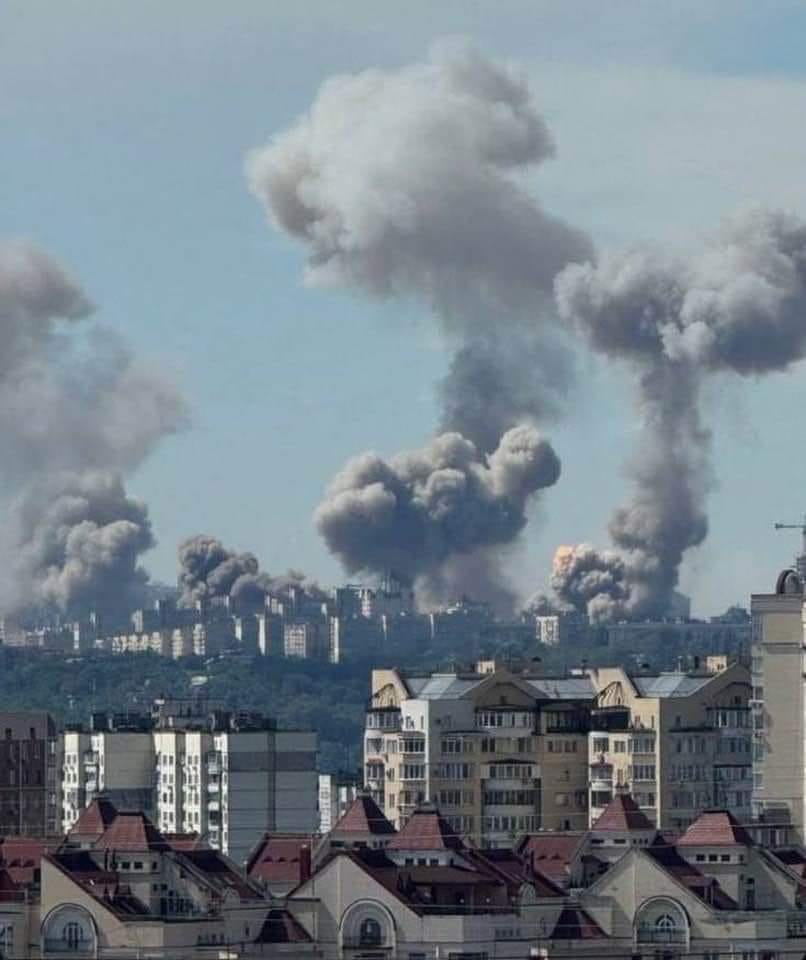
Russian missile strike on Kyiv causes 32 deaths. (Image: Svitlana Paschenko, July 8, 2024)
The global response
There is a saying in Ukraine: ‘to guard as the apple of the eye’.
Simply put, it means the importance of supporting a friend in need.
The truth is Ukrainians wouldn’t have been able to defend their country against the illegal Russian invasion if not for the ongoing support of the international community.
Ukrainian writer Dr Olesya Khromeychuk wrote The Death of a Soldier Told by His Sister about her brother who was killed in combat in 2023.
Before he died, he told her that the war was really a ‘European war’, Khromeychuk writes in her book.
She’s half-right — this is really a global war now.
As many as 20,000 foreign fighters from all over the world have volunteered for the Ukrainian army’s International Legion.
Countries worldwide contribute to Ukraine’s war effort by sending equipment and helping to train Ukrainian troops.
Professor Serhii Plokhy teaches Ukrainian History at Harvard University and is the author of The Russo-Ukrainian War.
In his book, he argues this war can be traced back to the collapse of the Soviet Union in 1991, when Ukrainians voted to leave the USSR and become an independent country.
Plokhy explains the problem is Russia wants to rebuild its empire, and the only way it can do that is by taking control of Ukraine.
But Ukraine has every right to “defend its right to existence”, he states.
The right to exist
Dr Piotr Długosz is the director of the Centre for Youth Research in Poland.
Długosz says that, as of 2022, there were as many as 2 million Ukrainian refugees in Poland.
His research into the psychological challenges facing young Ukrainian refugees is alarming, suggesting 73 per cent suffer from “anxiety disorders and PTSD”.
Długosz concludes the trauma experienced by refugees is made worse by the stress of trying to fit into a new society, with women suffering worse than men.
Professor Maciej Duszczyk and Dr Paweł Kaczmarczyk both work at the Centre of Migration Research, University of Warsaw.
They found the biggest crisis facing Ukrainian refugees in Poland is housing.
Most Ukrainians who arrived in Poland in 2022 relied on the generosity of Polish people who took them into their own homes.
But a minority of Ukrainians were fortunate enough to be able to afford their own flats, they concluded in their research.
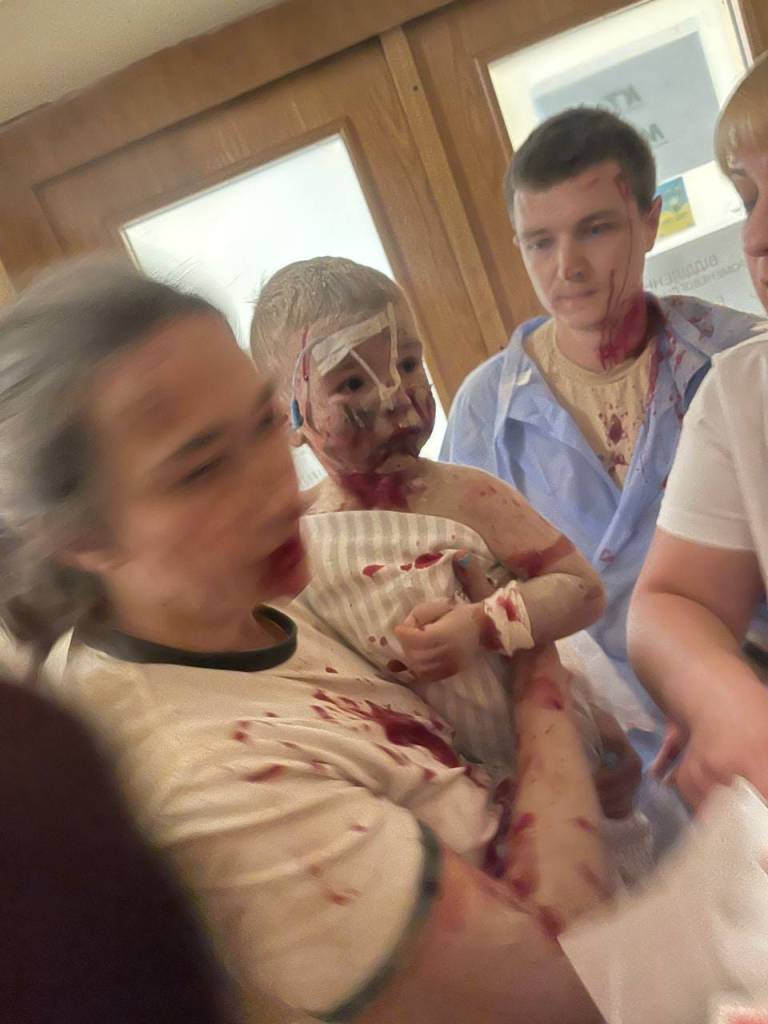
Russian missile strike on Children’s Hospital, Kyiv, Ukraine (Image: Svitlana Paschenko, July 8, 2024)
It’s really happening, part 2
February 24 2022, 7:00am
Zviagnia still doesn’t know what to do after speaking to her mum earlier this morning.
She doesn’t realise it yet, but she’s in shock.
So, she contacts her Ukrainian friend, Nikita Kupchuk, who also came to Warsaw in 2014.
He comes straight over.
Both Kupchuk’s mum and her parents live in the Donbas. When the war started in 2022, Ukrainians had to find a way to help each other.
“That was the only way,” Zviagnia says.
“The first day was such a shock. Nikita came to my house, and we drank whisky. We couldn’t believe it,” she says.
“Nobody could believe it…”
The Polish situation
Nikita Kupchuk first left his home in the Donbas and came to Poland in 2014 to study accountancy at the University of Warsaw.
Kupchuk says that, unfortunately, not all Poles are happy with the Ukrainian refugee ‘situation’.
“It’s frustrating for people in Warsaw. There are a lot of rich Ukrainians who can afford more than Poles. It does irritate a lot of Poles, it’s understandable,” he says.
“In 2022 [the Poles] accepted a lot of people from Ukraine, they are very open-hearted. But the reality is right now the level of acceptance is lower.”
Kupchuk says Poland has given Ukrainian refugees significant financial support.
“But when Polish people see a minority of rich Ukrainian motherfuckers driving around in luxury cars they can’t afford themselves, it makes them wonder do they really need our help?” Kupchuk says.
“That’s why the Polish people are so frustrated,” he says.
Kupchuk says he is grateful for the normal life he has in Poland.
“I try to accept Polish culture. I have to respect it,” he says.
But Kupchuk is lucky — he’s not only white, but male.
Associate Professor Natalia Zawadzka-Paluektau is a researcher at the Polish Academy of Science.
Zawadzka-Paluektau says that although the Polish media typically portrays Ukrainian refugees in a positive way (wealthy Ukrainians in luxury cars notwithstanding), they sometimes “discriminate” against Ukrainian women.
Despite this, the Poles have done so much for Ukrainian refugees.
The apple of Poland’s eye
Dr Elżbieta Ociepa-Kicińska is a researcher at the University of Szczecin. She researched the impact of Polish aid on the millions of Ukrainian refugees arriving in Poland since 2022.
She says that on March 12, 2022, Poland created the ‘Aid for Ukrainian Citizens’ act, meaning any Ukrainians fleeing war in their country would be granted permanent residency in Poland.
The official website for the president of Poland provides a seemingly endless list of statistics on Poland’s aid to Ukraine.
But the main points show, as of January 2025, Poland had provided aid to 1.5 million Ukrainians crossing over the Polish border — more support than any other country.
The Poles haven’t just guarded the apple of their eye.
They’ve created a whole orchard for these new apple trees — and tended their branches and watered their roots. They’ve cared for the apple of their eye more than any other country has done.
But only time will tell if these uprooted trees, so scarred by war, will take root in the new soil, and one day grow to reach their full potential.
It’s really happening, part 3
February 24, 2022, 10:30am
After drinking whisky with Kupchuk, Zviagnia recovers her senses.
She rushes out to the pharmacy and buys some painkillers and lots of bandages because she saw on Facebook there are hundreds of injured people in Ukrainian hospitals.
The hospitals need medical supplies. They need everything.
The Ukrainian Art Foundation — a charity — puts up a tent near the bus station in central Warsaw to collect donated medical supplies from the public to send to Ukraine.
Even though it’s bitterly cold, and there’s ice on the ground, and Zviagnia is shivering, there are hundreds of people there.
Zviagnia says they all had the same sort of ‘stuff’. She had to stand in line for half an hour just to give the stuff to charity.
“There weren’t just Ukrainians, there were a lot of Polish people standing there,” she says.
“It was the first step — I understood how important it was.”
Australia’s support
How does Australia’s support for Ukraine compare to Poland’s?
Nadia Mencinsky is the communications officer at the Australian Federation of Ukrainian Organisations (AFUO).
Although the AFUO is privately funded, it did receive a “small” Federal government grant in 2022, Mencinsky says.
“The AFUO also works closely with the various Ukrainian organisations in Australia, as well as [humanitarian] aid organisations overseas,” she says.
“The AFUO is the peak body of all Australian Ukraine organisations.”
“With our help, 4,000 Ukrainians have been offered full-time citizenship since the war began.”
Meanwhile, the Minister of Foreign Affairs Penny Wong’s office has offered support by sending some military equipment to Ukraine, and the Australian Defence Force (ADF) has helped to ‘train’ Ukrainian soldiers.
But Australia could do a whole lot more…
For starters, the Australian government could supply the Ukrainian military with more equipment to help them defend their homeland.
The government could also accept more Ukrainian refugees into Australia, and they could give some more grants to the AFUO.
But for that to happen, it would first take the Australian public to put pressure on the government.
So, what’s stopping us?
Polska jest moim domem
When the war started in 2014, Nikita Kupchuk “lost everything”.
He came to Poland and worked hard, learning the Polish language, but he still hasn’t been granted citizenship.
However, Kupchuk says that with the full-scale invasion of Ukraine in 2022, many of the refugees who came to Poland were granted full citizenship.
“[It’s] a bit unfair. But on the other hand, I’m happy because my mother also came to Warsaw and she currently lives here,” he says.
Kupchuk has finished his studies and is working for a financial company in Warsaw.
He says the Polish authorities have finally granted him long-term residency status.
“In two years, I will become a Polish citizen,” he says.
“Poland is my home now.”
It’s really happening, part 4
It’s now May 2025…
Zviagnia is in her flat watching the news on TV.
The war is still going, but there is hope as long as foreign countries continue to help Ukraine resist Putin’s illegal invasion.
Zviagnia is now a project manager at the University of Warsaw.
She says her mum and dad are still in Ukraine but they’re ‘safe’ for now.
“I speak to [them] every day,” Zviagnia says.
“The first year of the war was really stressful. The army didn’t have enough equipment, clothes, shoes, etc. We had to buy those things ourselves and send them to Ukraine. But I knew I was helping them.”
Zviagnia has learned a crucial lesson from the Poles: in times of crisis, supporting your friends is everything.
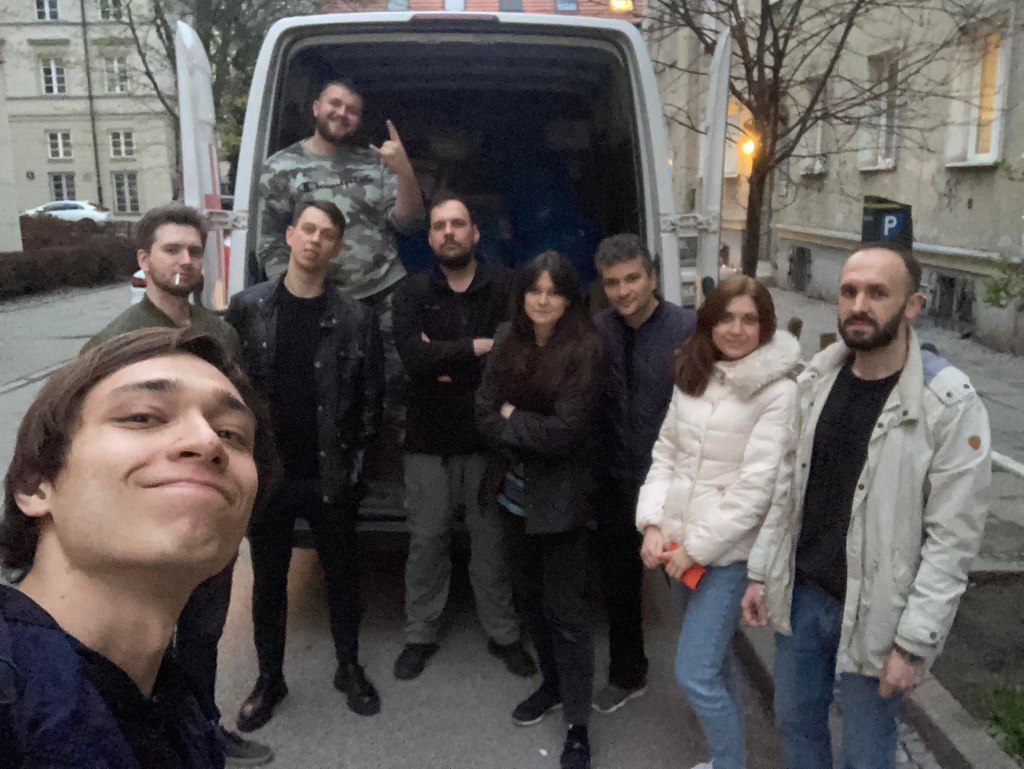
Dr Oleksandra Zviagnia (second from right) and other volunteers prepare supplies to be sent to Ukraine. (Image: Oleksandra Zviagnia, May 2022)
Andrew Clinnick is a second-generation Polish Australian who holds a PhD in Literature from Federation University Australia. He is currently studying at the University of South Australia. Opinions expressed within his article are his own.
 ontherecordunisa.com