
Experts say multicultural communities are falling through the swimming and water safety education gap with devastating consequences. (Image: chunwing ng)
By Bree Lambert | @breelambertt
Beyond the ripples of the water in the swimming centre, where teenagers scream with joy and children learn their first strokes, others sit by the pool.
This is not by choice; it’s a reminder of South Australia’s gap in water safety access.
For major risk groups, like multicultural communities, access to swimming lessons and water safety education is unreachable, leaving them vulnerable to drowning.
The 2024 National Drowning Report by Royal Life Saving Australia revealed that of the 323 people who drowned in Australia in 2023 and 2024, 83 (25.6 per cent) were born overseas.
However, the report estimates the rate of drowning deaths involving people born overseas is as high as 34 per cent.
This is a slight overrepresentation compared to the 31.5 per cent of Australia’s population who were born overseas, as reported by the Australian Bureau of Statistics in June 2024.
Issues disproportionately affecting diverse communities in Australia include limited access to swimming and water safety lessons, language and financial barriers, and a lack of culturally tailored education.
Surf Life Saving South Australia (Image: Bree Lambert).
Leila Nazimi, multicultural community programs officer at Surf Life Saving South Australia (SLSSA), is working hard to bridge the gap through culturally-tailored education programs and direct engagement with migrant communities.
She ensures individuals not only learn crucial swimming and water safety skills but understand how to safely navigate South Australia’s beaches and waterways.
Two organisations, Nazimi’s SLSSA and Royal Life Saving South Australia (RLSSA), have implemented programs to reduce drownings in multicultural communities.
Both focus on basic swimming skills and water safety knowledge by providing programs that teach South Australians to enjoy pools, beaches and waterways safely.
But according to Royal Life Saving Australia, enrolling in swimming lessons is not a priority for new arrivals in Australia.
Even if it were, there are existing barriers, including cost, transportation and the need for culturally-appropriate facilities and programs that prevent South Australian multicultural communities from receiving swimming and water safety education.
Data reported by Royal Life Saving Australia reveals China, United Kingdom, and New Zealand as the top three countries of birth of people who died in Australia by drowning over 10 years.
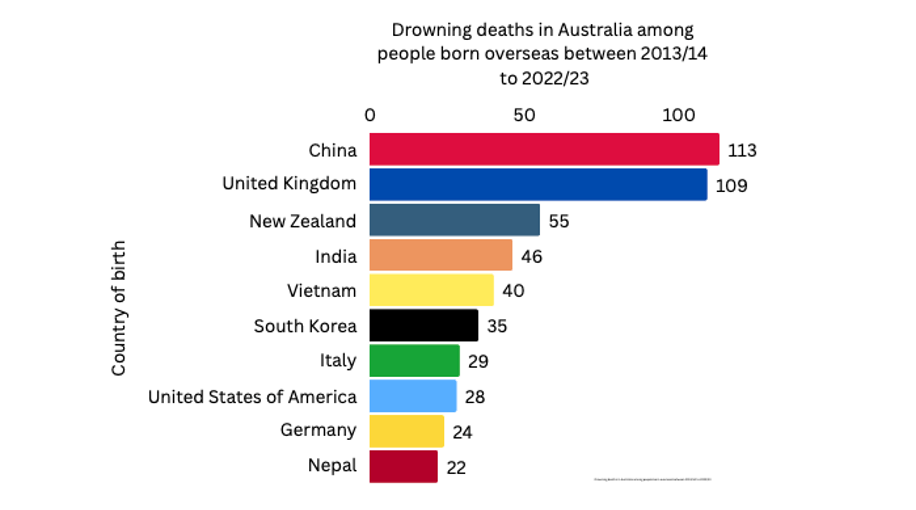
Drowning deaths among multicultural communities in Australia (Data source: Royal Life Saving South Australia, 2024 National Drowning Report)
RLSSA recognises this and involves people from different cultural backgrounds in their programs, including Indian, Chinese, Nepalese and African.
Both RLSSA and SLSSA are working to close South Australia’s water safety gap by identifying and reducing barriers and fears in multicultural communities, so they too can enjoy the water safely.
Programs that save lives
SLSSA provides three learn to swim programs for South Australia’s multicultural community: Welcome to SA Shores, International Students, and New Migrants.
Each program has helped individuals from multicultural communities feel safe on South Australia’s shores and coastline.
‘Welcome to SA Shores’ is a six-week program designed to build water confidence.
“The Australian lifestyle is very centred around time at the beach and other open water locations,” Nazimi says.
“The first five weeks focus on pool-based skills, culminating in a final beach session to learn about beach safety and the role of Surf Life Saving SA”.
The ‘New Migrants’ program provides a one-off water safety session for migrants new to South Australia’s coastline.
For many international students, this is both an exciting and unfamiliar part of their experience in Australia.
It’s one of the reasons why the ‘International Students’ program has grown in popularity.
The program has tailored water safety sessions designed to meet the specific needs of international student groups, with the most popular style being a combined theory and practical session at the beach.
This provides essential water safety knowledge and skills, and an introduction to one of Australia’s most iconic cultural experiences.
But there are still many missing out on support.
According to Lauren Sibley, children under five and people in rural and regional areas are struggling because they don’t receive a thorough education or have access to adequate facilities.
As community programs manager at Royal Life Saving South Australia, Sibley plays a key role in designing and delivering aquatic safety initiatives for culturally and linguistically diverse (CALD) communities, new migrants, women, children, regional populations, and vulnerable groups.
For multicultural individuals, “communication with lifeguards or other authorities can be challenging and intimidating,” Nazimi says.
Qualified pool lifeguard Jessica Inglis has noticed a multicultural gap in water safety.
As a Loxton local, she has observed that fewer people are attending the local swimming pool, and more are heading to the river.
But while rivers are scenic and free to access, they present many dangers.
Strong currents, submerged objects, and a lack of lifeguard supervision make water safety education even more important than ever.
This worries Inglis.
“Those from overseas may not be as familiar with different safety precautions and may be less likely to have grown up around open waterways and, hence, be weaker swimmers,” Inglis says.
There is a need for tailored water safety programs in regional areas, and Sibley has recently won a grant for a Naracoorte migrant program.
This comes after the 2024 National Drowning Report revealed the Limestone Coast had the highest number of drowning deaths in South Australia.
RLSSA has secured funding to offer Naracoorte migrants a bus to travel to a local Mount Gambier pool every Sunday and participate in a six-week program.
“There will be about 30 adults attending,” Sibley says.
However, this isn’t the only program making a difference.
With the assistance of the Office for Recreation, Sport and Racing (ORSR), RLSSA has been able to deliver five of its six-week Multicultural Aquatic Pathway Program.
Government funding from ORSR reflects a growing recognition of the need for inclusive swimming and water safety education for multicultural communities.
“We’ve been able to implement 350 participants in those five programs,” Sibley says.
Through the Multicultural Aquatic Pathway Program, students who are competent swimmers and possess stroke development can go into swim teaching, pool lifeguard and other aquatic pathways.
Breaking barriers
In the summer, groups of friends gather to enjoy South Australia’s warm sun and inviting beaches.
One of these groups included Pujun, a Nepalese man living in South Australia.
While the waves crashed and rolled onto the shore, Pujun sat on the sand, watching his friends effortlessly swimming and enjoying themselves in the ocean.
Pujun’s story shows multicultural individuals living in South Australia lack confidence in or around water.
In a video posted by RLSSA on the 2025 Multicultural Aquatic Pathway Program, Pujun says, “I feel I was left behind”.
RLSSA community programs manager, Sibley, works with the Australian Refugee Association and the Multicultural Communities Council of South Australia (MCCSA) to reach participants like Pujun and involve them in programs.
When Pujun joined the Multicultural Aquatic Pathway Program, he had one goal — to float. Since completing the six-week program, Pujun can float, swim independently and is developing his freestyle, backstroke and breaststroke.
In the same video posted by RLSSA on the 2025 Multicultural Aquatic Pathway Program, Pujun says, “I can confidently say that I am more confident with water now”.
“Of course, six weeks is never enough, but it’s a good starting point,” Sibley says.
At SLSSA, Nazimi’s role focuses on engagement and participation in water safety education among individuals from diverse cultural and linguistic backgrounds.
Each day, Nazimi stands beside the pool deck, eyes fixated on the water.
She watches the SLSSA instructors welcome multicultural participants, empower them with confidence and competence in the water and create a positive impact in their communities.
During a program, Nazimi watched a hesitant participant struggle to get into the water.
The participant’s journey to Australia was a frightening one.
The boat she arrived in Australia on capsized, and she has been fearful of water ever since. Week after week, she remained persistent with the program, determined to overcome her fear.
Since completing the program, she has gone on to become a swimming instructor and can teach bilingually and actively encourage members of her community to learn to swim.
Witnessing success stories solidifies the importance of these programs for Nazimi.
“Individual success stories, such as past participants becoming swimming instructors within their communities, provide powerful qualitative evidence of our program’s impact,” Nazimi says.
Successful programs run by RLSSA and SLSSA rely heavily on government funding.
Sibley says RLSSA receives funding for the disadvantaged or CALD communities, but only for six-week programs.
This allows programs to run at no cost to participants, removing any financial barriers stopping them from learning essential life skills and gaining confidence around the water.
Sibley says that funding is so inconsistent that they have had to scale some of the six-week programs back to four weeks.
Funding allows only enough for these programs to run.
“What happens after it stops?” Sibley says.
Challenges and the path forward
Despite recent wins, the path forward is a challenging one for SLSSA and RLSSA to keep these programs running, expanding and improving.
According to Nazimi, these programs need increased funding to reach more multicultural participants, develop culturally specific resources and provide translated materials.
While SLSSA has invested in training for its instructors to better understand interculturalism and develop their cultural intelligence, there is more that could be provided to improve participation.
Nazimi says there is a need for culturally-appropriate facilities, as some individuals feel uncomfortable in mixed-gender swimming environments.
“The absence of gender-specific swimming sessions or culturally sensitive instructors can be a deterrent,” she says.
The funding and lack of opportunities for new programs, instructor training and facility improvement are inconsistent because they are not implemented federally.
Sibley says RLSSA has consistently spoken with the Department of Home Affairs and the government to raise concerns about gaps in access and funding for multicultural-focused programs.
There has been no response actioned.
“More funding could help increase participation and also decrease drowning statistics too,” Sibley says.
In the Australian Water Safety Strategy 2030 report, the Australian Water Safety Council highlights the need for increased funding of water safety programs and multilingual resources to reach their goal of reducing drowning by 50 per cent by 2030.
Increased funding would also allow for fundamental instructor training to improve effectiveness, cultural awareness and sensitivity in how instructors teach water safety education to multicultural participants.
RLSSA has provided training to equip their teams of instructors with adaptability and cultural sensitivity by working with MCCSA, who teach cultural cue training.
In the afternoon at the iSwim@Immanuel centre, the sound of loud but simple and direct instructions drown out the noise of splashing water.
The class listens intently, but the instructor uses more than words to communicate.
The students watch closely as he uses his legs and feet to demonstrate the fast, up-and-down motion of kicking.
The instructor signals to the students. It is their turn to mirror his actions to kick their legs and feet.
The students’ faces light up with smiles as he offers words and a thumbs up to cue encouragement. This body language creates a safe and inclusive atmosphere for individuals learning to swim.
Swimming and water safety instructor Eddy Newberry regularly uses demonstrations and physical corrections to teach multicultural students in his swimming classes.
But as a Department of Education-employed instructor, Newberry has not received the same cultural cues or cultural sensitivity training for his classes.
He worries these potentially life-saving tools are not being used by all South Australian swimming instructors.
“Swimming teachers should be provided with extra training and regular upskilling, as they are required to teach critically important skills, aiding in an individual’s development,” he says.
Along with the organisations RLSSA and SLSSA, swimming and water safety instructors are instrumental in closing the gap in South Australia’s water safety divide.
Tharindu Samarathunga was 31-years-old when he enrolled in swimming lessons at South Australia’s Thebarton Aquatic Centre.
Samarathunga moved to Australia from Sri Lanka four years ago.
He used to swim as a child sometimes, but since moving to Australia, he decided to learn to swim again because “it seemed like a good option”.
He remembers feeling both excited and nervous when he first entered the pool.
“It was something new,” he says.
At first, he struggled to put his face in the water. But with patience, practice and help from swimming and water safety instructors, he swims comfortably in the shallow end of the three-metre-deep community pool.
Samarathunga was brave enough to find his way to swim classes and was lucky in receiving instruction from knowledgeable teachers, but this does not mean more could not be done.
“Swimming and water safety programs are arguably the most effective drowning prevention strategy,” Newberry says.
Making South Australia’s water safe for everyone
SLSSA and RLSSA are working towards making South Australia’s water safe for everyone.
Both drowning prevention organisations understand the need for accessibility and are removing the barriers keeping multicultural communities from attending swimming and water safety programs.
Sibley says RLSSA have no definite goal set for 2025 participation numbers, but the organisation is hoping to get as many multicultural individuals involved as they can.
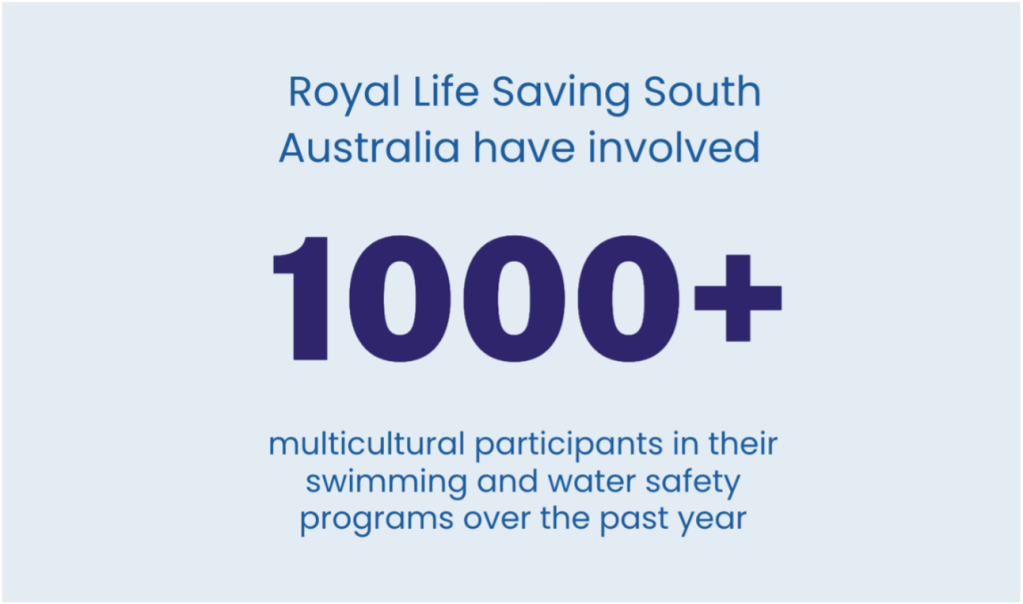
Number of multicultural participants involved in water safety programs (Data source: Lauren Sibley).
While RLSSA and SLSSA representatives Sibley and Nazimi advocate for secure funding for multicultural swimming and water safety programs, everyday South Australians can also aid in drowning prevention.
“Educate, volunteer, communicate, talk about what opportunities there are and always mention programs available,” Sibley says.
She believes drowning among multicultural communities is preventable, but only if we take action to close the gaps.
Efforts to create awareness and increase funding for programs bring us closer to saving lives in multicultural communities and lowering South Australia’s drowning statistics.
Interested in joining RLSSA’s free multicultural programs?
 ontherecordunisa.com