
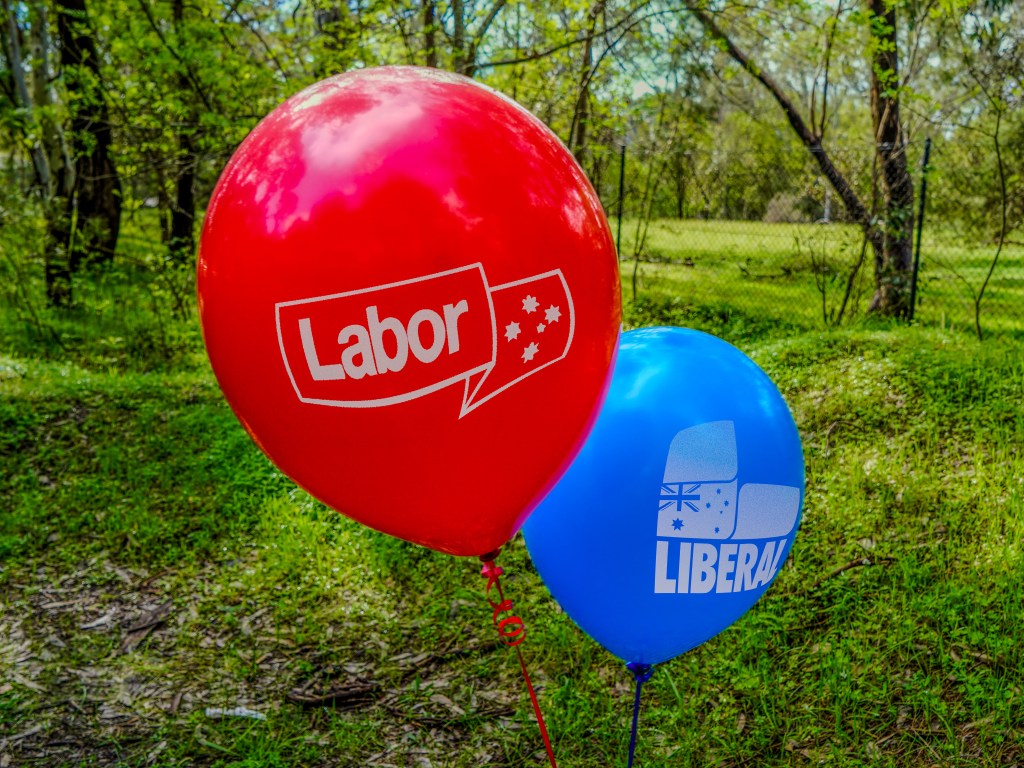
When Labor won the recent federal election, political pundits hailed it as a win for the ages. Now, Labor’s dominance in the south-east of Adelaide serves as a warning for South Australians ahead of the 2026 state election. (Image: Mia Handley)
By Mia Handley | @miajh1428
Amid the foothills and beaches in Adelaide’s south-east, a political shift is gaining momentum.
Labor’s dominance reflects a greater national trend, as Flinders University Associate Professor Rob Manwaring warns the “fabric of Australian politics is really changing”.
Adelaide’s south-east comprises one federal electorate, Boothby, and several state electoral districts: Davenport, Waite, Gibson, Elder, and Black.
However, while Gibson, Elder and Black have swung between parties, Boothby, Davenport and Waite have always been a blue-ribbon heartland.
Historically, these electorates have been dominated by the Liberal party — Boothby for over 70 years, Davenport for 52, and Waite for nearly 30.
However, all three elected Labor candidates in recent elections.
Attention now turns to the 2026 state election, with a focus on whether Davenport and Waite will continue to swing to the left, or if this veer away from the Liberal Party is temporary.
“There’s been a few [Boothby] boundary changes over time, but actually, the overall demographics have changed significantly,” Manwaring says.
More than 34.1 per cent of Boothby residents have a bachelor’s degree or above, compared to the state average of 22.7 per cent.
“There’s a correlation between education and voting intentions. So, particularly centre-left parties tend to be picking up higher educated voters, not necessarily more affluent ones, than previously.”
The state election will be held on 21 March 2026 to elect the 56th Parliament of South Australia.
2026 Liberal candidate for Davenport Trent Burnard says “South Australians are being let down by a Labor Government that is wasteful and distracted from the real issues”.
Davenport includes the suburbs Aberfoyle Park, Bedford Park, and part of Happy Valley.
“Over the past fifty years, Davenport has remained loyal to Liberal values, and now that they have a Labor sitting member, they are asking, what has Labor delivered for them in return?” Burnard says.
Burnard is campaigning against current Labor MP Erin Thompson.
“Residents also feel that maintenance and local infrastructure investment are falling behind in Davenport compared to other areas, and that our community is being short-changed,” Burnard says.
Neighbouring electorate Waite is currently held by Labor MP Catherine Hutchesson, with Liberal candidate and former SA-Best MLC Frank Pangallo announced in early August.
Reflecting on the broader political environment, Manwaring does not see the federal Liberal Party rebuilding soon after running “possibly the worst election campaign that we have on record since the Second World War.”
“I don’t actually imagine [Boothby] flipping back anytime soon,” he says.
Boothby was one of two key electorates in South Australia during the 2025 federal election, receiving special attention from Prime Minister Anthony Albanese.
Albanese visited Boothby during his first SA campaign visit on March 31 and pledged a $150 million contribution to a new Flinders University healthcare centre.
Boothby MP Louise Miller-Frost retained her seat with an 11.7 per cent margin against Liberal candidate Nicolle Flint.
Miller-Frost says Labor won Boothby because they “had a really positive story to tell people”.
“We’ve got inflation down, we’ve got a lot of really fantastic things like cutting down HECS debt, fee-free TAFE becoming permanent, cheaper childcare [and] cheaper medicines,” she says.
“[These are] so many things that actually make a difference to people’s lives.”
Burnard says the recent federal election was “fought on very different issues to those that matter here in Davenport.”
“Local families in Davenport are focused on state issues that directly affect them every day … cost-of-living pressures are hitting households hard; energy, water and grocery prices just keep rising,” he says.
Along with Boothby, Labor won long-term blue-ribbon seat Sturt, leaving only two federal SA Liberal seats remaining.
However, Manwaring warns this dominance, including in South Australia, brings “democratic kinds of questions and issues”.
“The party system in state politics in South Australia is like… a one-party dominant system,” he says.
“If you look at the Labor Party’s electoral record and state politics, it’s not actually that helpful to have an opposition that’s so helpless.”
After the 2006 state election, Labor held majority power with 28 seats compared to the Liberal’s 15 — the worst result in SA history.
But while Labor was again victorious in 2010, they received less than 50 per cent of the two-party preferred vote.
At the time, ABC analyst Antony Green attributed the decrease in votes to Labor “devot[ing] less resources” to previously safe seats.
This is a warning for the 2026 state election, as polling already points to a strong red-shift.
SA has experienced three by-elections since the 2022 state election.
Black, the electorate of former Liberal leader David Speirs, and Dunstan have both turned from Liberal to Labor.
Even Bragg, while held by Liberal MP Jack Batty, recorded a moderate swing to Labor.
“There’s been a few boundary changes over time, but actually the overall demographics have changed significantly,” Manwaring says.
“[Adelaide’s south-east electorates] operate where the Liberal/coalition vote sits at the fringes. It sits by a coast, and it sits in the hills. Increasingly, there’s been an expanse of the Labor vote in the hinterlands of those suburbs.”
Ahead of the 2026 election, public opinion polling group YouGov predicts SA Labor will deliver “the most decisive electoral victory in the state’s history”, reducing the Liberals to two seats.
Burnard says South Australians should be “extremely concerned” about SA sliding into a one-party system.
“Regardless of political persuasion, the presence of an opposing party forces governments to justify their policies, moderate excesses, and ensures that ideas are properly debated before they are implemented,” he says.
“A strong opposition is vital.”
However, Manwaring says, “Australia’s democracy is still pretty robust,” with an increase in votes to minor parties.
“It’s more of a sociological phenomenon … people now think about and identify with parties differently … they don’t have that rusted identity [anymore]”.
While Labor still won a majority vote in Boothby, 24.9 per cent of votes went to minor parties.
21-year-old south-east resident Madalyn Toet supported the Greens in the recent election as the cost-of-living crisis and HECS debt “are almost constantly weighing on [her] mind”.
“I’m also worried about Australia’s commitment to net zero and how we will navigate the current conflicts across the globe. … [our response] will determine how we’re living in the next 20–50 years so it’s really important that we’re proactive,” she says.
A minor party has never held Boothby, but at the 2025 election, Greens candidate Joanna Wells secured 17.08 per cent of the vote.
“It’s quite frustrating for people who were seeking more progressive reform that the Labor Party weren’t more ambitious,” Manwaring says.
“But they were running on a two-term strategy … [in 2022] let’s just set the foundations for a potential second term and then we might be a bit more reformist.”
Toet is uncertain whether she will support the Greens in the state election.
“My vote in the next election will be based off each party’s policies and their previous work,” she says.
“It’s all great for a party to have the ‘strongest’ policies, but it’s just as important to consider what they have done in the past three years in the lead up to the election.”
For future elections, Manwaring recommends the Liberal Party complete a “root and branch policy review” and examine all areas and current problems.
“You put everything on the table, and you say: ‘Look, let’s be honest — what didn’t work, even if we are in favour of it … [to] work through our issues,’” he says.
He recommends the party adopt quotas for female representation, after only six Liberal women were elected at the recent election.
“I think that’s something they just have to do. There’s no other way when they’ve been stunningly unsuccessful in recruiting and retaining women,” he says.
Boothby, Waite, and Davenport are all currently held by Labor women.
Burnard disagrees with Manwaring and says the Liberal Party have “a very clear philosophy” when choosing candidates: “democracy, competition, and merit”.
“Our candidates, both for the upper and lower houses, are chosen through a competitive pre-selection process where local members decide,” he says.
“It is up to the electorate to decide, and that’s exactly how it should be.”
In the south-east, where Labor now holds the majority, the challenge now falls on the Liberals to identify opportunities and reclaim support.
Manwaring believes the Liberal Party should “identify weaker electoral ministers and … pick up some short-term political wins” to be competitive again.
“The road back is huge,” he says.
 ontherecordunisa.com