
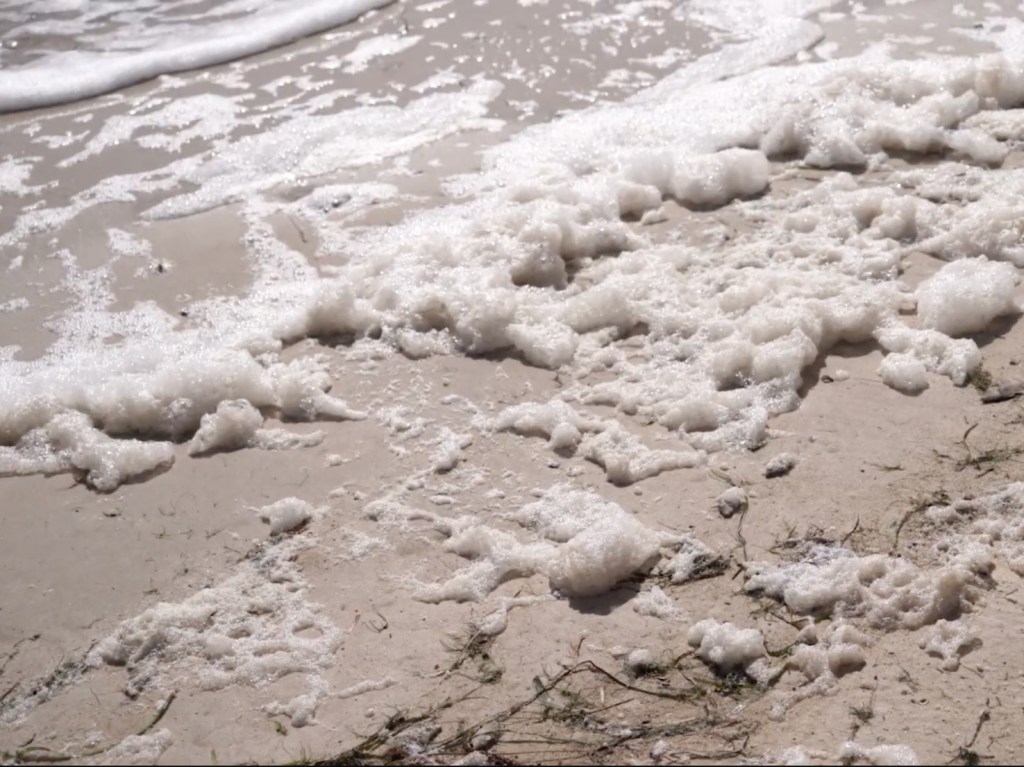
SA’s algal bloom is a major disaster for the tourism and fishing industries, but its impact extends beyond just environmental devastation. (Image: Rocco Ventra)
By Rocco Ventra and Mia Handley | @roccoventra and @miajh1428
Early media coverage portrayed SA’s algal bloom so severely that one seafood vendor says, “It sounded like all our fishermen were fishing in a barrel of nuclear waste.”
Since March 2025, the algal bloom has impacted over 390 marine species.
It has led to the SA seafood industry — worth an annual $478 million — being hit with devastating financial hardship.
“At the moment, we’re running at about $200,000 down a month. That’s over the last four months,” Safcol seafood market manager Ian Mitchell says.
As stock remains limited due to restrictions and seafood prices have risen despite a cost-of-living crisis, he says, “the money’s not coming in”.
“Now, we’ve had a problem with the public’s perception of whether South Australian seafood is edible or not,” Mitchell says.
The media’s portrayal of the bloom has changed, but to seafood vendors like Mitchell, it still paints a misleading picture.
“[The algal bloom] has not affected Spencer Gulf, it has not affected the west coast, it has not affected the south-east,” he says.
“Just putting ‘South Australian harmful algal bloom’ puts everything in one bucket. It makes it sound like the whole of South Australia is covered with an algal bloom, and it really isn’t.”
The term “toxic” has also been criticised by the Premier, with media outlets shifting to “harmful”, intended to more accurately describe the bloom’s effects.
InDaily deputy editor David Simmons has covered the bloom extensively since its discovery and says he had to “become [an] expert … overnight”.
“I think the one that we’ve gone with … harmful algal bloom, toxic algal bloom. It’s been inconsistent because it’s changed so many times, and the situations have changed a lot as well over time,” Simmons says.
“We were being told certain things by the government about what it was, and then there were scientific groups that also were doing their own independent studies.
“There was a lot of competing interests in telling that narrative.”
Mitchell has his own opinion on the effectiveness of this change.
“It just gets under my skin … even to the point of ‘harmful algal bloom’, it still doesn’t tell the public that it’s not harmful to them, it’s actually harmful to the sea life,” he says.
“We’ve got fishermen in the south-east, we’ve got fishermen on the west coast, we’ve got fishermen in the Spencer Gulf, they’re all feeling the brunt of the media’s portrayal of South Australia’s harmful algal bloom.”
Mitchell also recognises the responsibilities of the state and federal governments for communicating through the crisis.
“If we got six buckets of our local water and took it down to Darling Harbour and tipped into Darling Harbour, how quick the Albanese government would be all over it,” he says.
“We’re the forgotten people down in South Australia.”
Former state Liberal opposition leader Vincent Tarzia previously criticised the Albanese government in August 2025, saying that “the time for sympathy and platitudes has long passed”.
This was a response to a visit by Prime Minister Anthony Albanese, who later announced the $102 million Algal Bloom Summer Plan with the state government in October.
The funding aims to support coastal businesses and communities, advance research, and ensure that South Australians have an enjoyable summer.
Fisheries and aquaculture licence holders can apply for the Small Business Support Grant and the Fisheries and Aquaculture Assistance Grant until March 31.
Mitchell’s criticisms do not extend to the state government.
“Peter Malinauskas and his mob, I believe, are doing a fantastic job,” Mitchell says.
The government has produced its own media campaign, notably utilising Instagram to assure the safety of SA oysters, and to relay information to the media and other businesses.
The December 2025 campaign ‘Tis the season for South Australian seafood’ encouraged South Australians to buy seafood and dine at coastal restaurants.
While the bloom has affected over 30 per cent of SA coastlines, Mitchell emphasises that almost 70 per cent are still unaffected.
“I might be biased. I’ve been the manager for the last 16 years. I’ve been working for Safcol for 25 years,” he says.
“I still believe South Australian seafood is the best seafood you’ll get anywhere in the world.”
Looking into the future, Mitchell believes that the media needs to emphasise scientific research, instead of repeating “fish killed, fish killed, fish killed”.
“The one thing that the public needs to realise is ‘listen to the science’. Science is the thing that is going to get us through this,” he says.
As journalists often face criticism from involved parties, Simmons believes that one must “take it in your stride.”
“I think every time we publish a story, we get like five or ten letters criticising [it],” he says.
“[Criticism] does impact how you report on things in the future, but I wouldn’t say it means that we’ve stopped … just because the seafood producers have been annoyed at the repetitive nature.”
This summer, state government health advice says beaches can still be enjoyed, but visitors should avoid foamy and discoloured waters and not eat self-collected bivalve molluscs, such as cockles, oysters and pipis.
“If they are buying [commercially available] seafood, it hasn’t come from algae-affected waters. There’s no fish there. They’ve died, or they’ve moved,” Mitchell says.
“We need some positivity … [and] we need the media to get across to the public.”
Simmons is sympathetic to these concerns, but ultimately says it is not a journalist’s “position” to ensure that companies stay in business.
“I don’t think that that’s our role. We’re there to report the facts of the day,” he says.
 ontherecordunisa.com