
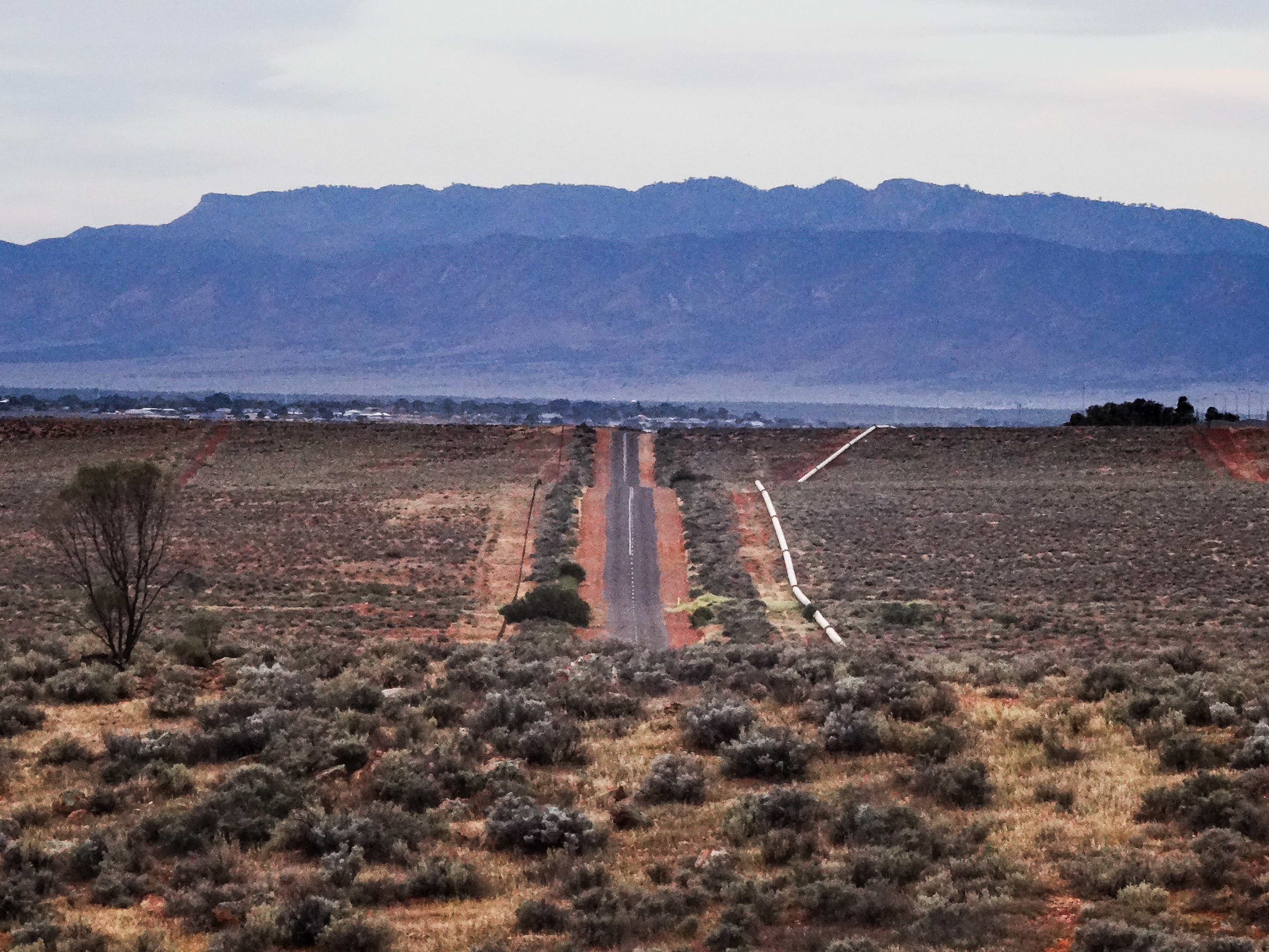
A writer and a couple of friends travel to the South Australian outback to uncover townships that have surrendered to obsolescence, in what was once the heart of a prospering desert hub (Image: David Payne).
By William Clemente
THE OUTBACK HIGHWAY, South Australia
I drove a sturdy Holden Commodore at high speed with my two friends, David and Niall, as sweat profusely trickled down our foreheads in a desperate attempt to cool our bodies. We could have only been on the Outback Highway, destined for the townships of Farina and Beltana to learn about a forgotten outback past.
The highway is just under 300 kilometres long, remote, dusted in red dirt, and lined with dry scrub. It dissects South Australia’s north, connecting travellers to the desolate outskirts of the outback. Farina and Beltana are nestled alongside this stretch of bitumen, and most who drive past know little to nothing about them.
Farina and Beltana are both veritable ghost towns. Farina is abandoned with its last known residents packing their bags in 1967, and Beltana boasts a small population of just 35 residents. This spawns a few questions: why do these towns still exist? And what were they like in their heyday, if they had one?
A journey to these townships is long and tiresome as Farina is located around 600 kilometres north of Adelaide, nearing the end of the Outback Highway, connecting to the Oodnadatta Track, and Beltana is approximately 100 kilometres before it.
On a Monday morning we ventured north, leaving Adelaide behind. Eight hours of open road were ahead of us, and plenty of supplies, most importantly water, were in the boot of the car. It was warm, about 30 degrees Celsius; once we go onto the Outback Highway it would be warmer. Farina and Beltana were the hot topics of conversation, and as there was a lot of time to spend in the car, there was certainly much to talk about.
Niall, 22, curiously chimed in; “Surely these towns we’re heading to had some purpose, whenever that was.”
The fatigue had well and truly settled in after more than seven hours of continuous driving. The Flinders Rangers, a true natural phenomenon well-traversed by South Australian tourists, was in clear view from our right-hand side window, meaning that Farina was not too far ahead. The atmosphere inside the car brimmed with excitement, and once we arrived at the turnoff to Farina, we were relieved that our time in the car was over at least for today.
Driving down Farina’s turnoff was certainly no picnic. A speckle of bitumen could not be seen, just dirt and large pieces of rock; I feared I would pierce one of the tyres. After about a kilometre of tediously slow driving to protect the tyres, Farina’s broad entrance welcomed us, and there we could see the buildings crumbling away.

The old Farina hospital gradually decaying in the background (Image: David Payne).
Campgrounds were on the other side of the township. There were dirt roads that led us through the centre of town. I drove slowly and each one of our eyes was glued to the windows, trying to understand what to make of it.
Once we made it to the campground and set up for the evening ahead, we ventured out into the township on foot. The sun boasted its fiery wrath, and a strong heated gust blew across the crusty plains, but it did not diminish our willingness to explore what we had come so far to discover.
We wandered the dusty tracks, seeing many buildings in disrepair dotting the vast landscape, looking somewhat out of place, but they insisted that their dilapidated presence belonged there.

A train rusting away on the cut-off old Trans Continental Railway (Image: David Payne).
A realisation dawned on us that Farina’s past has not fully dried up in the desert terrain. Some sights were closed off, but there was a tourist office that looked like it could have been built last week. Neatly presented plaques stood in front of each ruin before us, telling the stories of their former use and significance.
Tom Harding, 90, was taken aback after stumbling across Farina for the first time on a caravan trip. He was inspired, founding the Farina Restoration Group in 2009. Every year during the winter months, Harding and his budding volunteers spend several weeks there restoring the township. In 2024 more than 200 volunteers swarmed to Farina, the highest number to date.
“It was a ruin, it was a ghost town; it still had the characteristics of the ruins but there’s an integrated story now,” Harding said.
“These buildings will stay in this semi-ruined state, but we will stop them from decaying any further.”
Harding insisted they had “no intention of rebuilding”.
“It’s impossible to rebuild,” he said.
As I glanced at each ruin, I stopped and read the signage and could feel the township’s mystic aura.
In its beginnings in 1876, Farina was established as Government Gums beyond Goyder’s Line, and was soon renamed Farina, the Latin word for “wheat”. It was thought to be the epicentre of an agricultural breadbasket after unusually consistent rainfall in the 1870s.
As we traversed the arid landscape, it was hard to believe that the inceptual idea for Farina was to grow wheat. It was not meant to be, as a drought devastated the region in the 1880s with many residents losing their farms.
However, the population boomed between the years of 1882 to 1884 when 600 residents called Farina home. It was a cosmopolitan mix of Europeans, Adnyamathanha people, Chinese and Afghans, even though its agricultural potential immediately shrivelled in the sun.
“It was a self-sustaining township from the 1880s till the 1920s,” Harding said.
We all pondered on how the population grew when the wheat crops simply did not. The answer to this was before our very eyes. We saw a decrepit railway line. At its head was a late 19th century train, rusting away, casting a great shadow that provided us some respite from the sun’s intensity.
“In 1874, the railway line reached Farina, and it was not built for Farina. It was for the Trans Continental Railway to Darwin,” Harding said. Once the line was extended to Marree and Alice Springs a decade later, Farina was then established”.

(Image: David Payne)
The railway brought frequent activity. Back then Farina had a good fresh water supply, great for steam trains, and “that’s why the railways were interested in it,” said Harding. The hive of activity made it one of the upper echelon outback towns at that time, and at its peak there were two breweries, a police station, a bakery (now revamped by volunteers and partially in operation), a school, a general store, a post office, a church, and a brothel.
Some of these structures have not survived the passage of time, but we stopped in front of the police station, one of the more intact ruins. I stood there for a while, tilting my head, trying to imagine a policeman in uniform, baking in the sun. We explored its inside; its roof was barely intact. David stood in the distance by a rusted car without wheels which faced the former police station.
It was soon nightfall; the campground was illuminated by the spectacular brightness of the unfettered outback stars. We reflected on what we had experienced, knowing that the next day we would have to journey back down the Outback Highway. Beltana awaited.
The car’s engine roared, and its wheels spun ferociously on the trail exiting Farina. The dirt whirled in the air, obscuring our final view of Farina through the rear-view mirror. It took an hour to arrive to Beltana. This time round we felt less uncertain and more prepared, making us eager to explore.
Another dirt road that veered off the Outback Highway led to Beltana. It was much longer than the one in Farina, but less harsh on the tyres. A big sign welcomed us to Beltana, and immediately we felt a different type of ambience compared to Farina. Some people still call Beltana home but, back in 1883, there were 70 houses in the township with 390 people inhabiting them. It was hard to imagine walking Beltana’s streets back then.

A sign welcoming us into Beltana (Image: David Payne).
After parking the car in the township’s heart, we began exploring. There were people around. Some were tourists, taking snapshots of the crumbling ruins, and a few were going about their daily affairs. One of the residents is Jan Ferguson, 53, who lives in Beltana on and off.
“I have a 50-year association with the town,” Ferguson said, “I haven’t been here all the time I’ve come and gone for work like a lot of us have.” She kindly gave us a little tour of the township where we viewed the railway station, general store and police station, crumbling in ruins, and not maintained like the ruins in Farina. In 1875, a station for The Overland Telegraph was built and the town played a pivotal role in what was Australia’s greatest engineering feat of the 19th century. The history of Afghan cameleers in Beltana is rich.
“They brought Afghan cameleers out here, as their formal transport of goods in the bush,” Ferguson said. Outside the town, we spotted the Afghan Well, and we were intrigued about the Afghan presence in the township. They mixed with Europeans and the local Adnyamathanha people.

The old Afghan well just outside of Beltana where Afghan cameleers transporting goods collected water (Image: David Payne).
After our tour, Ferguson encouraged us to look at the cemetery, and there we discovered that Afghans married Aboriginal women as they were not allowed to bring Afghan women with them.
The cemetery was deserted, and tumbleweeds skipped across the arid red dirt. There we saw traditional Afghan headstones, collecting dust in their intricate ridges with the names of Afghan Aboriginal people in Beltana.
“We still have a strong Afghan presence,” Ferguson said, “It’s part of the culture.”
On our journey over, Niall questioned the purpose of these townships, and now, after we farewelled Beltana and sped down the Outback Highway returning to Adelaide, we knew.
More than a century ago, these townships were the focal points of what was a prospering desert hub that has now dried up in the sun. While many do not know anything about them, this is slowly changing.
“People are looking at this as a holiday destination,” Ferguson said.
In Farina and Beltana, one can feel the unique natural beauty, and its colonial and Aboriginal history. We certainly did.
“They’re very representative of other outback townships that are abandoned and have disappeared,” Harding said.
The great work of Farina’s motivated volunteers and the resilience of Beltana’s few remaining residents are proof that these townships’ former glory is worth showcasing to a modern Australia, encouraging travellers like David, Niall and me to take a journey into an outback past.