

The Australian government has announced students completing mandatory placements in specific tertiary fields will receive $319.50 per week after July 1, 2025, but students in the areas left behind still face the threat of placement poverty. (Photo by Nathan Dumlao on Unsplash).
By Robert Hicks | @_roberthicks
The Commonwealth Prac Payments (CPP), a paid placement program for select in-demand tertiary study areas announced in the 2024–2025 budget, aims to help keep Australian students afloat as inflation bites.
Students undertaking mandatory placements while studying teaching, social work, nursing and midwifery will be paid $319.50 per week for their placement from July 1, 2025; this is on top of concurrent government payments such as Youth Allowance and Rent Assistance.
Outside of these four study areas students on placement will not receive the payments.
When UniSA laboratory medicine student Jessica Wells learnt that only select study areas would be covered under the new scheme they thought it was “bullshit, to be honest”.
“The placement hours [of those degrees] are equal to, if not less, than some other degrees,” they said.
“Dentistry, specialised medicine, and veterinary studies have really high placement loads.”
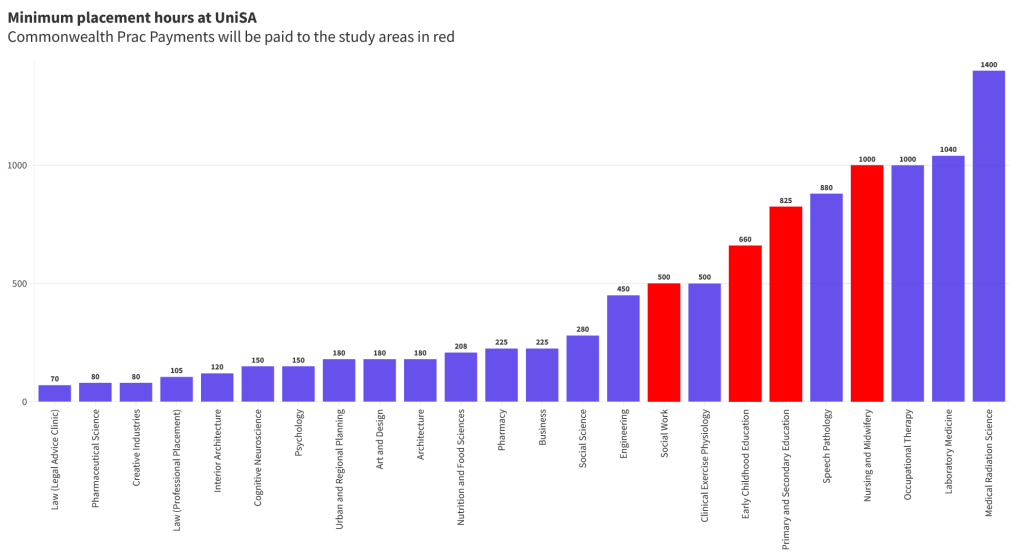
Minimum placement hours for degrees at the University of South Australia. (Source: UniSA, collated by Robert Hicks)
Federal Education Minister Jason Clare said the study areas selected were recommended by the Australian Universities Accord which focused on critical in-demand sectors in their 2024 report.
“The Commonwealth Prac Payment will give people who have signed up to do some of the most important jobs in this country a bit of extra help to get the qualifications they need,” Clare said.
“Placement poverty is a real thing.
“I have met students who told me they can afford to go to uni, but they can’t afford to do the prac.
“Some students say [compulsory] prac means they have to give up their part-time job, and that they don’t have the money to pay the bills.
“The Universities Accord team recommended we focus the Commonwealth Prac Payment first on teaching, nursing, midwifery, early education teachers and social work, and that’s what we’re doing.”
Greens Senator Mehreen Faruqi said in a press release that the placement payments do not cover enough students and will not come soon enough for those it does.
“Their policy excludes most of the students it should be helping, works out to a measly $8 per hour and won’t do anything for anyone until 1 July 2025,” Faruqi said.
While Wells, who is undertaking their final placement this year, will not be eligible for the payments, they said it would have allowed them to be more independent.
“I am very fortunate that my parents support me; if they didn’t I wouldn’t have been able to make it through placement,” Wells said.
For people living independently, Wells said the payment would stop them from facing the hard decision “over whether you have to put study or feeding yourself first”.
“Most people cannot do both when it comes to placement.”
In a cost-of-living crisis every cent counts and for students undertaking placements, travel costs — both in dollars and in time — are a significant expense.
“It was costing me up to $40 a week in public transport due to peak-hour travel times, and costing me three hours out of every day,” Wells said.
“Parking, on the other hand, would be $10 a day, with the cost of fuel being around $40 a week — depending on distance — and that’s being generous.”
But Wells said this also depends on where students are placed.
Students placed in metropolitan areas during their placement will have to take either public transport or drive and face high parking fees.
“The Royal Adelaide Hospital is extortionate with parking, up to $20 a day, while the Lyell McEwin Hospital [in Adelaide’s outer-northern suburbs] is cheaper at about $5 a day,” Wells said.
“Schools, on the other hand, have free parking for teaching staff and are generally close to public transport.”
Students placed in rural and regional areas during their placement may also require temporary accommodation, further stretching their savings.
The National Union of Students (NUS) have already begun their campaign to expand the CPP to students outside of the prescribed four study areas and increase the payment from the current $8 a day to at least minimum wage — currently $24.10 per hour.
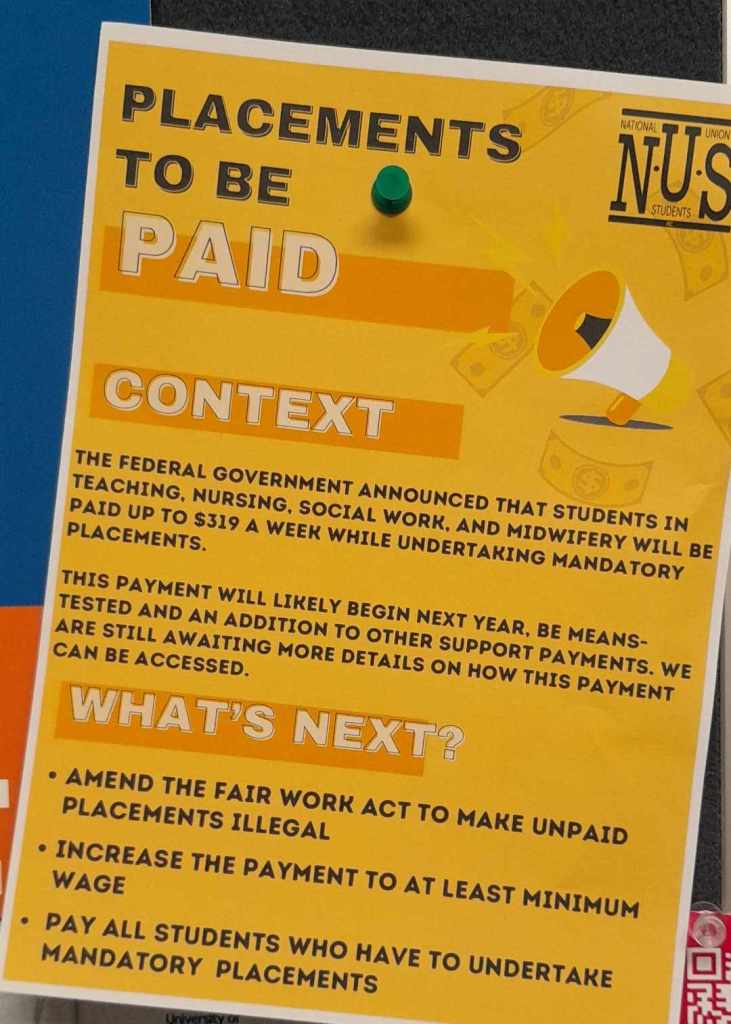
NUS flyer pinned to a board at the UniSA Magill Campus. (Source: Robert Hicks)
The NUS have also called for unpaid placements to become illegal under federal law.
“The NUS Stands against unpaid internships and does not believe they provide the value of educational experience as required under the law,” the NUS said in their campaign document.
“We believe that in an equitable society all people should be paid for every hour of work.”
 ontherecordunisa.com