
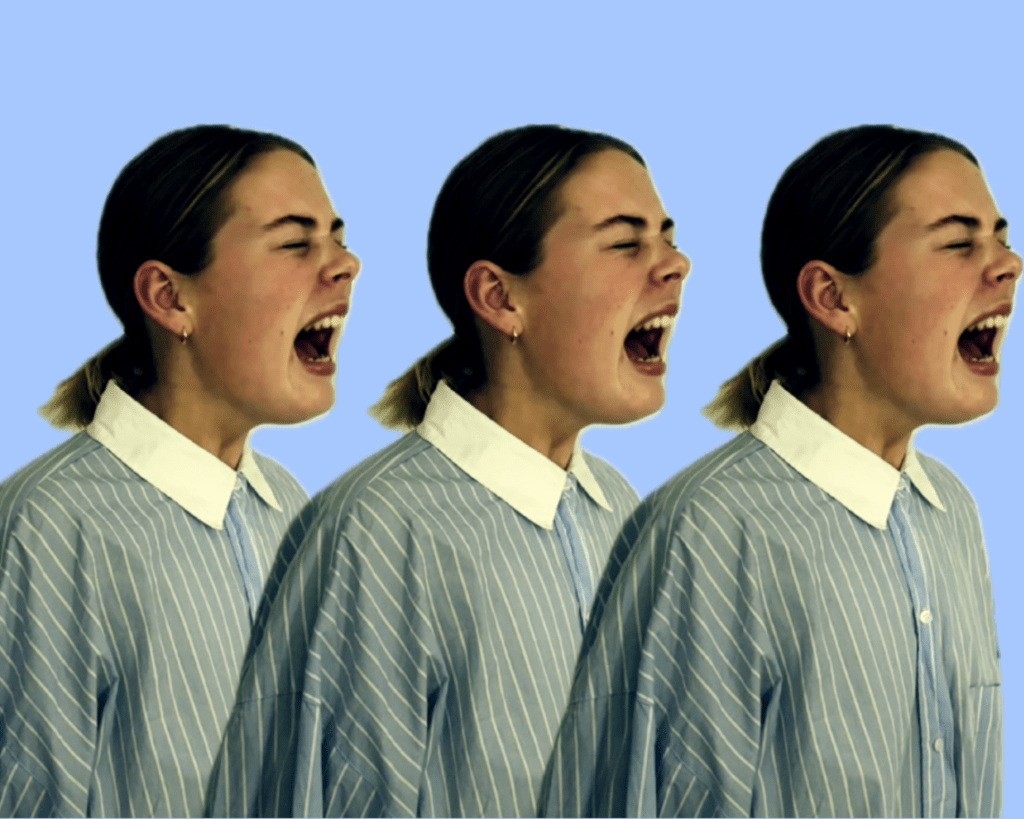
Caroline Wilson, Katie Bridges and Helen Karakulak are all too familiar with the exclusivity of gender in the media. Through their own individual lived experiences, these three women highlight a need for change following increased anxieties for female journalists and their progression within the industry. (Image: Amelia Hegarty)
By Amelia Hegarty | @amelia_heg
When Caroline Wilson first joined the Melbourne Herald (now the Herald Sun) in 1978, she says female journalists who covered stories on sport in Australia were a commodity. Expectations were that female journalists would go into the women’s department and write features on “arts and fashion, culture” she says.
Wilson defied this expectation when, four years into her career, she joined and wrote in the department of the Australian Football League (AFL) at the Melbourne Herald. This was only the beginning of her journalistic pursuits, eventually becoming chief football writer for The Age in Melbourne.
Katie Bridges has worked at Nova Entertainment in Adelaide for approximately 10 years, with six of those in a senior position. As she progressed in her career and continued to move up the corporate ladder, she says then and even now, “I am one of few women in the room, in senior leadership.” She says for the first three years in the role, “I was the only woman that was a GM [general manager],” and it was only three years ago that Bridges began working alongside another woman.
In 2023, Helen Karakulak acquired her first full-time job in the media at CityMag and InDaily after a year working as a freelance journalist in South Australia. She prides her current workplace as having “an open and inclusive vibe in the newsroom” with an equal gender split. However, Karakulak stresses that a lack of female leadership and representation in the industry deters young female journalists from pursuing a media career.
Karakulak’s concerns for female journalists and their representation in leadership roles within the media industry is not an isolated worry, especially since the release of the Women in Media’s Industry Insight Report for 2024. The national, not-for-profit initiative observes a rate of over 50 per cent of women in the media industry, notably early and mid-career, voicing anxieties surrounding career progression and gender equality.
“The majority of women surveyed considered the media industry’s commitment to gender equality as somewhat weak,” the report states, leading to a three year high of career dissatisfaction and over a third of women considering leaving the industry.
Karakulak believes the nature of gender inequality in the media industry is both subtle and widespread. Despite feeling “fortunate” in her own experiences working in a diverse newsroom, she says “there are still those little ways that gender bias can be pervasive.”
“I think we need women in leadership, and I think we need change to come from the top, down,” Karakulak says.
“I think women are very easily deterred from industries when they cannot see themselves represented.”
Women In Research categorise this lack of career progression as the glass ceiling. They define this concept as an “invisible barrier that can prevent talented women from senior leadership roles.” Women In Research express that the glass ceiling is largely present in male-dominated fields or industries where men hold the majority, if not all, positions in leadership, a statistic that is supported in the Women in Media report.
Women in Media state women’s career progression declines the further one goes up the corporate ladder; women comprise 53 per cent of the current media industry workforce whereas just 29 per cent occupy a leadership role.
Throughout the course of her 40-year career, Wilson concludes “it’s people and management, having the guts to put these [women] in positions of authority and hosting and in senior jobs, I think that’s what really changes things.”
In Wilson’s experience, times have changed, and attitudes towards women in the workforce have improved to be more inclusive. “It shocked me how difficult it had been for so many women in the industry,” she says, “[but] there’s still pushback and there’s still a long way to go.
“It’s not as simple as you stand up for yourself and you smash the glass ceiling. Sometimes it’s a bit more complicated than that.”
Wilson is not unused to overt criticism and sexism as a prominent sports journalist working in a male dominant field.
“I look back to the 80s and our sports department, and the things that were said to me … it was a different era,” she reflects. “There were times when I would make mistakes or be accused of giving footballers votes because they were good looking.”
Most notably, when Wilson began her job as chief football writer, the level of sexism from the public, as well as prominent men in the media, increased tenfold. “When I became the chief football writer, I think a lot of the resentment towards me about stuff I wrote, I do think some of that was gender-based,” she says.
A significant point in Wilson’s career was the reporting of the Essendon Drug Scandal in 2011, a period when she was subjected to immense criticisms. “It was out of proportion … [and] I think that the hatred towards me, I think was more so, because I was female,” Wilson says.
“It was pitched as Caro versus James Heard [head coach of Essendon in 2011] which I thought was very much a gender thing as well.”
This behaviour was also viewed by audiences of Channel Nine’s Footy Show when Sam Newman, former AFL player and sports commentator, dressed a mannequin up as Wilson, with her photo stapled to its face and dressed by Newman over the course of the episode.
“No one really reacted or said anything, everyone just laughed about it for a week,” Wilson says. “That was pretty horrific, and I don’t think there was much of an outcry about it because people accepted it.”
Wilson describes feeling pressure to quit the industry after making it known that what was happening was not okay – that it made her feel uncomfortable.
“I look back and maybe other young people would have struggled in that environment … I was able to deal,” she says.
Wilson views the current atmosphere of the media industry as a lot more progressive and inclusive compared to the early 2010s. She sees real improvement and vocation for women’s presence within the workforce yet notes there are still areas that need to be addressed, including career progression.
“Very few editors at The Age, very few had been women,” she says. “These shouldn’t be breakthrough positions [for women], they should just be regular positions.”
Kate Bridges has been involved in radio, both in commercial and programming, for 25 years, including 20 years in a leadership position. Over that time she has noticed an improvement and progression to closing gender gaps, as well as fostering opportunities for women to further their career.
“I think that the more women that are in senior roles, the more that glass ceiling gets lifted,” she says.
Bridges views barriers for women’s career progression as stemming from entrenched subconscious bias within the industry. “You had a lot of middle-aged white men in those roles that automatically had an unconscious bias towards men … and they have hired a lot of the same people,” she says.
“I think the glass ceiling exists for a variety of reasons; I think to do with the people that are in charge.
“Twenty years ago, a lot of females just never got a seat at the table, they were never considered, they weren’t developed.
“You’ve got to give people the foundation, set them up for the opportunity, to have a seat at the table and then decide from there who is the right person.”
Bridges is now taking the steps to challenge subconscious bias and “say ‘hey, why wouldn’t we interview that person?’” and look into how we can open up opportunities for other people.
Bridges discusses the human resource program at Nova Entertainment, called Future Women. The 12-month program is a unique opportunity for Nova employees only which gives them the confidence, skills, access, opportunity, mentoring, coaching and training to develop, Bridges says.
This program is set to “develop females in [the] business to be future leaders of the business,” Bridges explains. “When our leadership roles come up, we [will] have women in our business who feel empowered to apply.”
It becomes more about providing opportunities than filling a diversity spot or finding that “token [person] … to tick a diversity piece,” Bridges says. “We actively need to go out there and foster women, develop them to a point where we do have this talent pool of women then that are able to apply or have the skills to do that job.”
It is about increasing the 29 per cent of women in senior positions to a more equal ratio between genders, to allow for more career progression and equal opportunities in the media industry.
To take the right steps in that direction, she advises young journalists and journalism students to “find people in the industry that have stepped those steps before you.”
“There are some really great male mentors and advocates for gender equality in that industry as well, and there are some terrible ones,” Bridges says. “Finding good female and male networks and mentors in that industry will be of real benefit.”
“[And] if you are the only voice in the room, be confident.”
Efforts are being put into place to change the working environment of the media industry and close the gender gaps that are still present, from developing programs for skills development for women to resetting the foundation and attitudes in the workplace to be inclusive and diverse, Bridges says.
Now, you shouldn’t “feel like you have to act like a man to progress in the media world,” Bridges says. “a lot of women felt they [did] … to be part of that club but that’s changing over time.”
Though the Women in Media report shows dissatisfaction over career progression from female journalists, Karakulak says this does not mean the opportunities are not there.
Working for CityMag and InDaily, Karakulak feels in her position she is equal to pursue or advance her career based off an assessment of the stories she produces and her work ethic.
“If you’re just focused on the work and you dive into a story and you’re passionate about that then I think that will always come through … people will see that and respect that,” she says.
 ontherecordunisa.com
One response to “It’s not you, it’s your gender: three women’s experiences of subconscious bias and sexism in the media industry”
Wonderful article Amelia.
This is found in so many industries where women are as good or better than men but don’t get the opportunities.
I’m glad to see that females in your generation are now getting equal opportunities to pursue their roles and ambitions.
LikeLike